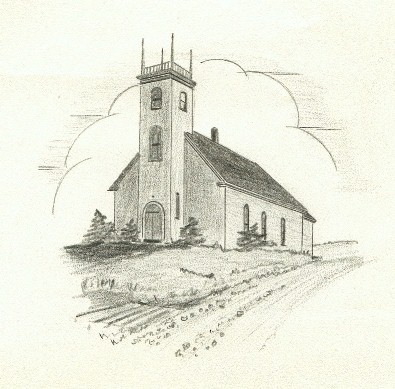
St. Barnabas, Blandford
ONE HUNDRED YEARS
1867 - 1967
St. Barnabas Church,
Blandford
Published under the auspices of St. Barnabas Church,
Parish of Blandford, to commemorate the hundredth
anniversary of the building of the church, 1967.
FOREWORD
It is said by some, that "history repeats itself", or that "it travels in cycles". As I sit here at my desk in St. Stephen's Rectory in Chester, having read this small but important booklet, I can feel that I was part of such a cycle. The Rev. Richard Payne came to Blandford from this parish, and now, Blandford has sent its rector here.
But this history of the Parish of St. Barnabas is not, thankfully, a record of the comings and goings of its clergymen, ..... for that would make very dull reading indeed! Rather, it is as it should be, a record of the Church People of Blandford, whether Clerical or lay, and how they contributed in various ways to the establishing of St. Barnabas church as a living witness to Almighty God.
Mrs. Cecil Gates is to be commended for her painstaking work in gathering this material together from very scant sources, and presenting it in so readable a form.
If the history of St. Barnabas Church "repeats itself" during the second century of its life in the same terms of the Service, Devotion, and Dedication of its past members, then the future augers well. My hope and prayer is, that under God's guidance, even greater things will be accomplished by the people of St. Barnabas Church, Blandford.
St. Stephen's, Chester.
K. E. Bourke.
St. Barnabas, Blandford
ONE HUNDRED YEARS
1867 - 1967
DEDICATION
THIS BOOK IS PREPARED IN THE HOPE THAT IT WILL BE PLEASING TO GOD; AND IN GRATEFUL MEMORY OF THOSE WHO BUILT OUR CHURCH AND OF THOSE WHO HAVE WORKED SO HARD THROUGH THE YEARS TO MAKE IT A FORCE FOR GOOD IN OUR COMMUNITY.
-----"and let us think of one another and how we can encourage one another to love and do good deeds. And let us not hold aloof from our church meetings, as some do. Let us do all we can to help one another's faith, and this the more earnestly as we see the final day drawing ever nearer".----- From the lesson read at the 100th anniversary of the building of our Parish Church.
Hebrews 10: 24-25 (Phillips Translation)
ST. BARNABAS CHURCH, BLANDFORD
ONE HUNDRED YEARS
There it stood on top of the Wood Bank and overlooking the Cove B their new Church! It was June, 1867, when the band of workers, Church of England and Lutheran, stood back and surveyed the result of months of effort. They were proud of what they had built, but more proud of them was the man who had set their sights on this goal, who had encouraged them and who now rejoiced with them - Rev. Richard Payne. The congregation of St. Barnabas owes its sound beginning to this devout and devoted scholar.
Richard Payne came to Chester from his home in Hastings, England. He came under the aegis of the Colonial Church and School Society in response to a request for "a gentleman in Holy Orders to take charge of a school in the Town of Chester and to assist the Rector in the Parish". He was ordained in Nova Scotia in 1853. He instructed pupils in the school during the week and on the Sabbath attended the outstations of that important Mission (Chester). Blandford was one of the "outstations".
The people to come earliest to Blandford were Irish settlers (who arrived around 1750), English settlers (Governor Franklin's report of 1767 gives the number as 62), and German settlers (who came from Rose Bay in the early 1800's).
Travel in the early days was mainly by water. A land route between Blandford and East River was blocked by Aspotogan Mountain, as it was between Bayswater and North West Cove. Footpaths served for travel in Blandford. The forest came down to the shore.
The brothers Shreve (Rev's. James and Charles Shreve), successive rectors of Chester, were concerned about the need for religious instruction at Blandford. These good men held occasional services there. It may be that these services were held where the first school classes were taught, i.e. in a spare room of an old house near where Mr. Cyril Blakeney now lives.
An 1824 report from Proceedings Of The Society For Propagation Of The Gospel reads, "At Blandford there are twenty-five families ... the want of religious ordinances is deplorably manifest ... in the profanation of the Lord's Day." "Blandford is a place highly deserving of the attention of a visiting missionary ... it is at present accessible by water only. The inhabitants (of German extraction) are in good circumstances."
By July, 1839, Blandford had a building which was to be used as a school-house and chapel. "The Colonial Churchman" of September, 1839, (published in Lunenburg) had a feature story on the opening. "On Thursday the 20th day of July (1839) being the time appointed for the opening of the school-house and chapel, the congregation with the teacher and
his pupils (John Thomas, Master, 23 scholars) assembled at an early hour to witness the opening of the first building erected by the inhabitants of Blandford in which Divine Worship might be performed, as well as for the education of the rising generation in the ways of knowledge and holiness. Rev. James Shreve, D.D., came across the bay by sail-boat, although the day was foggy. He performed Divine Service. There were about ninety persons present. Before the departure of the Rector the deed of a piece of ground whereon the school-house is built, being signed by the Messrs. Publicover, was made over to the Lord Bishop of Nova Scotia and his successors for the public benefit."
For many years after the Church was built, this building continued in use as a school. When its usefulness in this capacity was over, it was sold to Mr. Dan Publicover. He used it as a barn. It was demolished in 1934.
It was in this school-house and chapel that Richard Payne held church services on such a day as July 16, 1854. He wrote this report to the Colonial Church and School Society in his journal. "Left (Chester) early for Blandford, by water 6 miles, wind variable, rowed and sailed and at length arrived at half-past ten. Commenced service immediately, the people being assembled". And again on Aug. 27, "Held service at Blandford where I had arrived yesterday. About 121 were at church".
In an 1855 report he writes, "The second Sunday in the month I go by water to Blandford. Morning service is held in the Blandford School-house, where an attentive congregation of about 100 assembles. The School-house being too small for the present congregation even, the inhabitants intend to erect a Church. Plans have been drawn, and half the required sum is already subscribed".
Another extract from Richard Payne's journal for Aug., 1855, states, "I decided to go to Blandford . . . In consequence of the wind being unfavorable, I was put ashore 2 miles from Blandford, which distance I walked with carpet bag full of tracts, gown, etc. It was a bad road, partly over the beach . . ."
By 1860, Richard Payne is listed as being at Blandford. He was thus the first resident clergyman there. By his presence in the community he undoubtedly gave impetus to the work of building the Church. Thus, in 1867 the building was finished.
The main part of the present day building was their Church. It is a sturdy structure with good proportions. On each side and above the door were 24-paned windows with a graceful curved top. It is said that in the early days there was in the peak above the door a large hand carved from wood with a finger pointing upward.
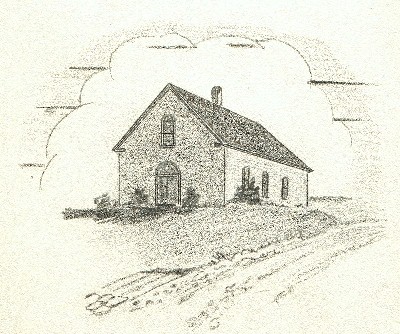
There is a gallery or loft, where the choir sat in the early days. Later, when the chancel was added, choir seats were built there.
Members of the Established Church and of the Lutheran Church gave their time, labour, money and materials to make the place of worship possible.
In the original record of Marriages, Baptisms, etc., preserved in the Parish one may read the following in Richard Payne's handwriting:
"Marriage is this thirty-first day of October, 1867, solemnized between us at Blandford Church according to the rites of the Ch. of England by License.
Witnesses
ANGELINE BOUTILIER
AUGUSTA ZINCK
ISAAC ZINCK
PETER BOUTILIER
By me
This is the earliest record of a marriage in the new Church.
In 1867 Richard Payne wrote, "Upper Blandford is a station for a weekday service once a month. It is two miles from the new Church and is intended principally for those who are too infirm to get to the school-house on Sunday. One family of three generations attend, from the tottering grandfather to the child that had to be led to the little store-house where prayer was wont to be made."
It is interesting to note that while Rev. C. O. Holm was rector of Blandford parish he, too, held services at Upper Blandford. These were held at the home of Mr. and Mrs. Ben Meisner, then quite old and infirm. These old folks walked to Church as long as they were able -- Mrs. Meisner was 85 years old when she could no longer walk there.
At the Church "the people assemble long before Church time, and while many take their seats in the pews, and read or listen to the choir practising, the rest patiently wait outside."
The Sunday School was taught by the Rector and Mrs. Payne.
By 1872 two churches had been erected (St. Barnabas, Blandford, and All Saints, Bayswater) and were out of debt. There was also a well-built parsonage.
The esteem in which Mr. Payne and his wife were held is shown in this excerpt from one of his reports: "In addition to the stipend received by me from the people, I have thankfully to acknowledge gifts of fish at all times of the year. I am always thought of, too, when rarities of halibut and salmon are caught. I have loads of wood brought to me gratis, though some I take in lieu of money. In the fall I receive many presents of meat and vegetables -- pork, sausage, goose, mutton, and beef. All these contribute to save household expenses and are thankfully received and valued as showing the good feeling of the people."
Mr. Payne often spoke of his health in his reports. On one occasion, "My cold was renewed by exposure to the wet on the memorable occasion of the gale of Oct. 12 (1876), when the high tide reached the parsonage, but providentially it sustained no injury."
In January, 1877, it was reported in a Colonial and Continental Church Society Report that "Rev. R. Payne, one of the Society's oldest missionaries, was so seriously ill that no expectation was entertained of his ever resuming his duties."
In February, 1877, he died. He was buried beside the Church whose people he had served for eighteen years. The chancel of the Church was later built over his resting place. His tombstone is set into the wall inside the Church. When the furnace was installed (in 1957) the footstone of his grave, bearing the initials "R. P.", was found.
Richard Payne was succeeded by the Rev. John Manning, who wrote the reports for 1877. He says that the inhabitants now number about 200. In addition to "several persons who profess the Lutheran doctrine, a few Wesleyans and Baptists are here". "The Church is not consecrated, the Lutherans claiming the right for their minister to officiate there." He adds, "It is probable that this right will soon be relinquished."
Mr. Manning's report has more of interest. "We have now supplied to everyone who can read, a copy of AChurch Hymns" and a copy of "Hymns With Tunes" to each member of the Choir. Although this item of expenditure amounted to $60. it was given most willingly."
"The next improvement was in singing. I conducted a class of fifty members who have made sufficient progress as to be capable of singing a hymn tune at first sight. Consequently, our service of praise is much improved. On three evenings a week, during winter, singing classes were conducted for the benefit of all who wished to attend."
"I next endeavored to get an organ for the churches. My appeal to the parishioners was responded to immediately. Two instruments to the value of $200. and $100. respectively have been received and paid for. Four pupils are now about to take lessons in organ-playing."
"Having a large choir and an organ, I proposed that a chancel should be built, which was agreed to. The expense of which will be almost met by the sale of the old choir seats (they sold the right to occupy the seats). The erection of the chancel will increase our seating accommodation by 40 seats."
David Zinck of Mahone Bay is said to have been the carpenter who built the chancel. At the same time, the sturdy four-sided tower was built at the front of the Church. M. Allen Gibson, in his column "Churches By The Sea", tells us, when writing of the Blandford Church, that it was William of Wykeham, Bishop of Winchester, England, "who originated the idea of the four-sided tower as a suitable substitute for the Church spire . . . .
William . . . . conceived of the stalwart tower as a messenger, too, bespeaking the firm sureness of God and the strength of those who trust in Him."
In his 1880 report, Mr. Manning says "about 20 young women have assembled at the Rectory on one day in each week, when fancy articles have been prepared for sale at a tea meeting which we intend to hold in September, the proceeds to go towards completing the Rectory and buildings." This would seem to be the way St. Barnabas Sewing Guild had its beginning.
Parish records show that Jonas Hutt and Lavinia Baker were married in the Rectory on May 22, 1880. This is the first record of a marriage in the Rectory. This building is now occupied by Mr. Laurie Publicover and his family.
In 1885 Rev. Edward Roy became Rector of St. Barnabas. It was during this time that the Sunday School had its first Christmas tree and concert. It was held in the upstairs part of George Meisner's shop (Grandfather of Roy Meisner). It was held for Blandford and Bayswater Sunday Schools. There were readings, songs, and recitations. Santa Claus put in an appearance and gave each child a bag of candy and an orange.
A Musical and Literary group was organized for both young and old, It met every fortnight. An entertainment was put on and tea and cakes were had for refreshment. The money thus raised was used to purchase a bell for the tower and to enlarge the chancel.
The following news item from an 1894 paper (published in Lunenburg?) is of interest:
CONCERT AT BLANDFORD IN 1894
--------------
(March 21st, 1894)
On the evening of Friday the second instant a musical and literary entertainment was given in Orange hall, Bayswater, by local talent, the performers belonging to Blandford and Bayswater. During intermissions, sweetmeats were sold and $38.00 realized which will be devoted to paying off rectory debt. The programme is:
Song--The Old Musician and His Harp--By choir.
Recitation--Effie Murphy.
Reading--Isaac Seaboyer.
Recitation--Susie Cleveland.
Dialogue--Married by the New Justice of the Peace--Agnes Fleet, Hugh Zinck, Isaac Seaboyer,Albert Gates.
Song--Eyes that stole my heart away--by choir.
Reading--Isaiah Roast.
Song--Mulligan's Funeral.
Recitation--Minnie Cleveland.
Reading--Mr. Andrews.
Dialogue--In want of a servant--Lydia Publicover, Clara Publicover, Lizzie Publicover, Mary Laura Boutilier, John Publicover.
INTERMISSION
Song--Gathering the Myrtle with Mary--by choir.
Reading--James Gaetz.
Lecture--Mr. Andrews.
Dialogue--Leaving Jonah--Cedilla Zinck, Hugh Zinek, O. Publicover, Albert Gaetz.
Reading--Alma Publicover.
Song--The rain upon the roof--by choir.
Dialogue--Trouble in a Morman Family--Clara Publicover, Isabel Publicover, Ida Publicover, Emma Meisner, Agnes Fleet, Isaac Seaboyer.
Song--Good Bye Old Cabin home--by choir.
Address by Mr. Andrews and vote of thanks for use of hall by Mr. Roy.
Rev. Frank W. M. Bacon served the parish a short time in 1895. He married Maud Publicover, a sister of Mr. Eli Publicover. During his time and that of his successor, Rev. Samuel Trivett, lamps were purchased for the Church, matting for the aisle, and a fund for a new organ was started.
During our Centennial Year, Miss Jean Trivett (niece of Rev. Samuel Trivett) visited St. Barnabas Church. Her nephew, Rev. Donald Trivett, was taking the services in the parish and she accompanied him to Blandford. She and the older members of the congregation reminisced about the far-off days when she had visited at the Rectory.
In August, 1896, the St. Barnabas Friendly Society was started. There were to be weekly meetings. At each of these, Mr. Isaac Seaboyer, organist, gave a lesson in singing. The Sunday School lesson for the following Sunday was discussed.
It is interesting to note that at this time there were 200 volumes in the Sunday School Library. In 1908 there was reported to be 400 volumes. A Dec. 12, 1907 report says that "Mr. Ellis Gates, our energetic Librarian, is attending the Maritime Business College, Halifax."
Early in the new year (1899) it was decided to build a hall for Sunday School and other meetings.
"The people got out the logs and hewed them (assisted by church friends from Bayswater). A lot of land 72' x 28' was purchased adjoining the Rectory. The foundation was laid and slowly yet surely the work went on. The labour (with the exception of carpenter for making windows, doors, etc.) all being done by ourselves, for even the Parson can use saw and plane; and for three weeks before Christmas we were seldom out of the building before nine; sometimes it was ten before we put out the lights, so
busy were we making tables, benches, etc."
"On Monday, Dec. 26th, we finished our work as far as funds permitted and we were able to hold our annual Christmas tree. The ladies had a sale of work and tea, proceeds of which went to the building fund."
In 1903, Rev. R. T. Dobie says, "The Ladies Guild has not been idle. That at Blandford held a successful bazaar and social in the Parish Hall, the proceeds to be donated for Church purposes and repairs of Rectory, which last is sorely needed."
In 1905 he reports that the clergyman's house has been repaired and "may rightly claim the name of Rectory. Our thanks are largely due to the local "Ladies' Guilds" and to generous friends in Halifax for funds."
In the April, 1906 issue of "Church Work" it was reported that "the Loyal Orange Lodge (of Blandford) have recently donated a stained glass window for the chancel of St. Barnabas Church." This beautiful window with its symbols of the Christian belief is a crown jewel set in the simplicity of the Church.
In 1907, Rev. James Weagle was Rector of St. Barnabas. In addition to his duties as Rector, he gave music lessons to those who wished to learn.
During his first year at Blandford, Mr. Weagle writes, "The Sewing Guild has been re-organized under the name of the Ladies Sewing Guild of St. Barnabas Church, Blandford. The officers for the year are: Mrs. J. A. Weagle, President: Mrs. Joshua Cleveland, Vice-President: Miss Blanche Publicover, Sec'y: Miss Inez Publicover, Treas."
"On July 17, (1907) the ladies of the Sewing Guild held an Ice Cream Sale at the Parish Hall. It was a grand success. The Guild intends having an Ice Cream Sale each week during the summer months."
These Ice Cream Socials continued for many years. Most people have vivid memories of what they involved - the girls went to collect cream and eggs from the families who had cows and/or hens, their mothers went to the Hall to prepare the mixture, smash the ice and turn the big ice-cream freezer by hand. Occasionally, a man or an older boy came to help with these chores. After letting the mixture "set" for awhile, came the delightful moment when both children and their elders could settle down with a dish of the delicious stuff!
One item in the Vestry minutes of 1919 was "Permission asked of Morton Publicover to keep ice in his ice-house for our ice-cream sales."
As factory-made ice-cream became easily available, the sales of the home-made variety were no longer held.
In July, 1907, a Sunday School Teacher's Training Course was formed. A later report says: "At the examinations of the Teacher Training Association the following candidates passed, making good marks in Hurlburt's Revised Normal Lessons: Mrs. Rebecca Zinek, Mrs. A. E. Hyson, Miss Cora Zinck, Mr. Selvyn Gates."
During Lent, "This was the first time in the history of the Parish that Lenten boxes were given out."
"In August (1907) a handsome wire fence and gate have been erected on the street side of St. Burnabas Church."
In September of the same year, Mrs. Bacon, wife of a former Rector, Rev. F. W. Bacon, visited her parents, Mr. and Mrs. James Publicover. Her two boys accompanied her.
Part of the St. Barnabas Choir, Blandford, and part of the Choir from All Saints, Bayswater, were present at the first service in the new Church at North West Cove on Sept. 8th. Mr. Isaac Seaboyer, organist at St. Barnabas, presided at the organ.
In the report for December, "Services were held in all churches on Christmas Day. The churches at Blandford and at Bayswater were prettily decorated with evergreen." "At the new Church at North West Cove on Christmas Day, Mr. Edward Publicover of Blandford and Miss Charlotte Verge of The Lodge were joined together in Holy Matrimony."
"There is an adult Bible class of about 50 members at Blandford. There are active Women's local auxiliaries in different parts of the Parish. These should shortly merge into branches of the W.A." This was done. Some of the ladies of the Church still have their W.A. pins and recall their connection with this group.
"A warm welcome was given the new Rector (Rev. John Bamford) by the parishioners. Many willing hands assisted in unloading the schooner and getting his furniture safely installed in the Rectory. And many helped fill the larder at the Rectory with kind gifts." (1910).
"On Dec. 14 (1910), Warren Gates organized a chopping party, when the young men met at the Rectory and chopped the Rector's wood, after which a bean supper was given." "A quartette was formed consisting of Mrs. John Bamford (soprano); Mrs. Milford Publicover (alto); Warren Gates (tenor); and S. (Selvyn) Gates (bass)."
In 1912, Mr. Bamford writes: "The Parish Church badly needed repairs and cleaning and by a special effort we raised the money to pay for the inside of the Church to be thoroughly renovated. It was sheathed throu-
ghout with A1 spruce and on,the sides with hardwood, the whole was varnished; also the vestry and the porch were sheathed. We also had made a new oak communion table (this table was given in memory of Mrs. Ann Zinck), a hardwood floor laid designedly in the chancel, a storm-sash placed over a leaky stained glass window, with additional lights added to make things brighter, at a cost of nearly $500. I am pleased to be able to say we were able to meet our bills, closing our account with $7.00 in hand."
In 1913, Rev. Charles Woods became Rector. He wrote in 1914, "We propose during the present year to finish the Parish Hall and to shingle it."
"On Thursday evenings the Rectory is a hive of industry, three rooms being necessary for the various works being carried on under the auspices of the Blandford Sewing Guild. A Technical Instruction Class, including wood-carving, passé-partout and plaque-making, undertaken by your missionary, being a recent innovation."
"In December we received a visit from Rev. G. M. Ambrose in advocacy of the Duplex Envelope System. The Parishioners promised to subscribe by this means." Until this time there were "collectors" for each section of Blandford, who went to collect the Church money at intervals during the year. Vestry minutes give this information.
"In the fall we unveiled a Brass Memorial erected in the Parish Church at a cost of $90.00, to the memory of three young fishermen who lost their lives on the Banks in the spring; the expense was defrayed by the parents and the Lodges of which they were members."
In 1917, during the time of Rev. Charles Woods, there is a reference to a musical production: "On Feb. 17th the Rector hired teams and took the Blandford choir by sleighs to North West Cove, where the service of song, Christy's Old Organ, was beautifully rendered to a packed school-house. The day was an ideal one and the road in splendid condition."
Rev. Charles Barnes came to Blandford as Rector in 1923. It was in this year that the decision was made to sell the old Rectory. Land and Rectory were sold to Mr. Warren Publicover (father of the present owner, Mr. Laurie Publicover). It was further decided to build a new Rectory on land owned by Isaac Seaboyer. This land lies next to that now owned by Mr. Lee Zinck. Since there was no access to the lot, arrangement was made with the Oddfellows Lodge for a right of way to the Rectory. The Vestry minutes of 1926 say that 25c a year was paid for the right of way!
There was a Girl's Guild (in 1925) of fourteen members who worked with the Senior Guild doing useful work. There was also a Men's Club which
met weekly in the Hall.
The minutes of the Vestry Meeting on May 23, 1928, (Rev. J. H. Markham, Rector) set out regulations governing the use of the Parish Hall. Every care was to be exercised to make sure that activities carried on therein be in character with its association with the Church. Later, in 1953, there was a reference to a decision "that the janitor be given authority to keep order at parties".
During the years 1934-1937 Blandford had as its Rector, Rev. C. O. Holm (now Canon C. O. Holm of St. James', Armdale). In his quiet, friendly manner he endeared himself to his people. He and Mrs. Holm spent a great deal of time visiting the people in the three congregations. So genuine was their interest that twenty years later they could recall every family in the entire Parish.
During 1943 the Hall was hired by the reserve army. They used the upper floor of the building.
A piano was bought for use in the Hall in 1945. Some years later it was needed for use on the stage upstairs, so the men cut a hole in the floor and raised the piano through it. It was returned to its original position and was never taken upstairs again.
For many years the ladies worked in very inconvenient quarters in the Hall when they prepared a supper. At first the kitchen was on the ground floor and the food, when ready to be served, was carried upstairs to the tables. Later, a kitchen was put upstairs beside the stage, but it was small. Tempers must have flared when groups of ladies struggled to prepare and serve a dinner in these hot, cramped quarters, especially at the Annual Church Picnic. At present there is a much larger kitchen. It is, however, a hot place to work, as a wood stove is still in use.
In 1946 it was decided to paint the interior of the Church. Ivory-coloured paint was used on the upper part of the walls and the ceiling. This did much to make the interior lighter. Electric lights were installed in the Church at about the same time, replacing the Aladdin (mantle) lamps and the bracketed oil-lamps of a still earlier day. The Hall was wired for electricity in 1947.
It was decided in 1947 to sell the Rectory. It was bought by Mr. Frank Morton. In 1949, Vestry minutes record the decision to purchase the home of Mr. Wellesley Publicover for use as a Rectory. In 1954 a furnace was installed in it. In 1965 an oil-fired water-heater was bought for the Rectory. It was paid for largely from Guild funds, and the remainder from Church funds.
In 1955 we have record of the first contribution made by this parish to the Anglican Youth Camp at Mason's Point in Halifax County. Several of the young people of the community enjoyed the experience of being at camp there.
1961 will be remembered by many because during this year the first Every Member Visitation was held. It was felt that if every home in the three parts of the Parish were visited, it would let people know that others were concerned about them. It was hoped that it would lead to a better attendance at Church, more people interested in the work, and, as a result, more money would be contributed to that work. Canon Hobbs and Rev. Ronald Harris directed the visitation. A great deal of interest was aroused and it was felt by all who took part that it was a very worthwhile effort. Several years later a second visitation was carried out, this time directed by Canon Davies and Rev. K. E. Bourke.
Rev. Ronald Harris was awarded a Morris Scholarship for study overseas in 1961. He was succeeded at Blandford by Rev. Kerry Bourke, who carried on the work in the parish while he was completing his final year at Kings College (1961-62).
During the winters of 1962 and 1963 the inside of the Parish Hall, (the downstairs of which had never been finished) was sealed with plywood and varnished. The Ladies Guilds paid for the materials. The men of the parish did the work free of charge, as the men of this parish have done down through the years. It was work of which the men might well be proud.
In 1964 the entire floor of the upstairs, including the kitchen floor, was covered with a good tile. The old, rough board floor had had its day.
In 1967, as a Centennial project, a fine new Church sign was bought and set up beside the Church. It was designed by Mr. Bourke. Also in 1967, the unsatisfactory heating arrangement (by oil stoves) in the Church was replaced by an oil furnace. The entire cost was met in less than a year by special contributions.
The Diocese of Nova Scotia presented to St. Barnabas a Centennial plaque to commemorate the hundredth anniversary of the building of our Church. It was dedicated by the Rt. Rev. W. W. Davis, Bishop of Nova Scotia.
LADIES SEWING GUILD OF ST. BARNABAS, BLANDFORD
The story of this group of women has been told as we have related the story of the growth of our Church. It is right that it should be so, for its work is bound inextricably to that accomplished by the Church. The Guild is a prime money-maker for our Parish, and let no one underrate the effort
that is put forth. The present group is part of a long procession of women who, through the years, have used their talents to help in God's great work.
SUNDAY SCHOOLS
Mention has been made from time to time in this story of the work among the children of the Parish. Always, there have been those who have been interested in the work of the Sunday Schools and were willing to give of their time and talents. Those who have been leaders in the Sunday Schools in recent years have been: Mr. Isaac Seaboyer, Mrs. Clarence Publicover, Mrs. Clyde Cleveland, Mrs. Ralph Publicover and Mrs. Hardy Gates.
Sunday School has always been held in the Church, except in very early times - at first in the afternoon and, more recently, in the morning. During the time when Rev. Mr. Pitcairn was in charge of our Parish, Mrs. Hardy Gates became concerned that the children from the upper part of Blandford were not able to attend Sunday School because they lived so far from the Church. With the generous and kindly assistance of Mr. and Mrs. Ervine Young, Mrs. Gates was able to arrange that Sunday School for Upper Blandford children be held in the Baptist Church. This was with the consent of the congregation of that Church. Thus, for twenty or more years (at the time of writing) there has been a fine example of the working together of two denominations for the good of all the children. Today we call it ecumenism!
MUSIC IN THE CHURCH
From earliest times music has played a very important part in our church life. References have been made, in this story, to the early choirs and of instruction in playing the organ. Of those who have contributed much in this field, the names of Isaac Seaboyer and his sister Eliza (later Mrs. Ben Meisner) must be honored. Eliza Seaboyer played the organ in the Church until she was married. (It is interesting to note that upon the occasion of her marriage, she was given a dinner set by the congregation of the Church.) It was in her home that her brother conducted Singing School for the Upper Blandford young people, just as he did in his own home for those of Lower Blandford.
Mr. Isaac Seaboyer contributed largely in several areas of Church life, but his greatest joy lay in teaching the young people to sing. He had no formal musical education but was largely self-taught. He conducted Singing School for the young people for many years. He would gather the children around the organ in his home and teach them to read music and to sing in four-part harmony. The Christmas concerts were a delight - he would spend hours with infinite patience preparing the Christmas music.
The choir in Isaac Seaboyer's day included as many men as women. Mr.
Will Gates contributed not only his tenor voice, but on occasion played his violin to add variety to the music. (His fiddle served for entertainment more often, providing music for dances in the Hall.) "Mr. Will" sat in the front seat. In the back seat were Mr. George Gates, who occasionally played his sweet-toned piccolo, Mr. Josiah Zinck, Mr. Enos Publicover and Mr. George Meisner.
Mr. Seaboyer's entire adult life was devoted to the Church. He gave his time and talents unselfishly B he was Lay Reader, Choirmaster, Organist, Superintendent of Sunday School, Teacher of Bible Class, Vestry Clerk. His years of service were gratefully acknowledged by several gifts of money and by many expressions of appreciation.
When his eyesight failed him, "Mr. Isaac" had to relinquish his post as organist and choirmaster. He was succeeded by Mrs. Clarence Publicover, who had been organist at St. Matthias Church in Halifax before her marriage. She performed a faithful service at St. Barnabas for many years. Upon her retirement in 1955, she was presented with a copy of the Bible suitably inscribed.
Mrs. Rob Publicover was then persuaded to be organist. She gallantly filled the position and served her Church well in this capacity for many years. Some time after Mr. and Mrs. Bourke returned to the Parish from a year's stay overseas (Mr. Bourke was awarded a Morris Scholarship for 1962-63.), "Mrs. Rob", as she was affectionately called, asked to be relieved of the responsibility because of her health. Mrs. Bourke and Mrs. Roy Meisner then shared the work for several years. Mrs. Meisner was organist for the Upper Blandford Sunday School for many years and still assists in this way. After Mr. Bourke left to take charge of the Parish of Chester, Mrs. Meisner and Mrs. Scott Young shared this important work.
In the beginning, St. Barnabas had a reed organ operated by foot pedals. In 1962 an electric organ was purchased, with the money left to the Church by Mr. and Mrs. Clarence Publicover. This was replaced by a better instrument in 1964, the greater part of its cost being met by a portion of the same legacy.
A. Y. P. A.
A branch of the Anglican Young People's Association was first organized at St. Barnabas Church in August, 1945, by Mr. Thomas A. Peach. This group made a fine contribution to the life of the Parish. It provided an excellent training experience for as many as thirty-eight young people for six or more years. The A.Y.P.A. raised money and provided (in 1946) the cement walk to the Church building. They bought chairs for the Hall and paid for the wiring of that building. They presented crystal cruets and a silver bread-box for use at Holy Communion. Through their efforts we have
the beautiful cross which adorns our Altar, ever reminding us of the sacrifice made for us by the Son of God.
In 1963, during the ministry of Rev. Mr. Bourke, the A.Y.P.A. was organized again at St. Barnabas. About twenty young people, aged fourteen to twenty, formed a very active group. Various members attended A.Y.P.A. conferences. They had informative talks given to the group. They addressed envelopes to Church members for various communications. They bought and sent out prayer-letters to the sick and shut-in. They gave money to the Church's missionary effort and to the general funds of the Church. They presented a fine desk set for use in the Vestry.
SERVERS
Mr. Bourke trained two of the young men of the Parish as Servers, to assist at the service of Holy Communion. These young men, Gary Publicover and Lowell Meisner, performed their duties with dignity and understanding.
VESTRY CLERKS
In every Parish there must be someone who provides continuity in its affairs. This continuity is supplied in the person of the Vestry Clerk. Rectors move from parish to parish, Wardens change, Vestry personnel changes, but the Vestry Clerk carries on for long periods.
Mr. Isaac Seaboyer is the earliest clerk at St. Barnabas that we have record of. He served from 1916-1924. Mr. Rufus Gates served from 1924 to 1933. He was succeeded by Mr. Edwin Publicover, whose years of service in this office continued until 1950. Mr. Heman Gates served from 1950 until 1956. At that time this important work was undertaken by Mrs. Scott Young. In recent years she has had the help of Mrs. Hubert Fleet when the volume of work has warranted it. St. Barnabas has been well served by her Vestry Clerks.
ALTAR GUILD
An Altar Guild was formed in 1964. This group, originally nine in number, was instructed in the proper care of the silver, the crystal, the linens, and the brass articles in the Church. The care of these articles is to be undertaken in a right spirit - becoming to those who do work in the Lord's House.
LAY READERS
Two sincere and dedicated laymen of St. Barnabas have served as Lay Readers; Mr. Isaac Seatboyer and Mr. Cornelius A.
CEMETERIES
The oldest cemetery at Blandford is located on what is called "Blandford Head". The original road from the Cove to New Harbour followed the shore (parts of it can still be discerned) and access to the old cemetery is still possible by foot along the shore road.
Upper Blandford, too, has a very old cemetery. It is located adjacent to the properties now owned by Mr. Osborne Gates and Mr. Bruce Gates. Both these cemeteries have become overgrown, so that it is difficult to find gravestones, but a careful search still reveals interesting memorials on hand-hewn stones.
There is another old cemetery (which has been enlarged in recent years) at Lower Blandford. This is located beside the highway adjacent to the property of Mr. Josiah Zinck.
High on the hill above the Church and almost surrounded by trees, is another cemetery. Many members of the Gates family of Lower Blandford are buried here. This is also the resting-place of Mr. and Mrs. Isaac Seaboyer and Mr. and Mrs. Ben Meisner.
In 1942, during the ministry of Rev. Douglas Batten, the decision was made to purchase land for a "general cemetery", to be the property of the Church. The land was bought and cleared. It surrounds the old Publicover cemetery. Eventually, it was set off into lots which were numbered and sold. A Cemetery Committee was set up to look after its care.
MEMORIALS
The earliest record in Vestry minutes tells of a legacy from Lucy Meisner and a legacy of $50.00 from the estate of Mr. John Meisner to be used for the better lighting of the chancel. This was around the year 1917.
Since that time there have been many gifts given to be used in the Church.
Mr. Selvyn Gates gave a fine carved chair for the chancel in memory of his mother, Mrs. Catherine Gates. At his death he left a legacy of $1000.00 which is invested. The interest is paid to the Church funds.
Mr. Creighton Zinck gave a fine chancel chair in memory of his mother, Mrs. Norman Zinck.
In January, 1960, Vestry minutes record a legacy of $1600.00 from Mr. and Mrs. Clarence Publicover. Part of this money was used to buy a new chalice and paten and linens for use at Holy Communion. The remainder was used to pay the greater part of the cost of the new electric organ.
Mr. Ellis Gates left a legacy of $4000.00 to be invested and the interest paid to the Church.
There is, on the Church wall, a brass memorial plaque to the memory of Otto and Lawson Publicover who were drowned May 17, 1913.
In 1964, sixty booklets containing the service of burial were given for use in the church by children and relatives of Thomas Ainslie Zinck.
A Memorial Fund provided money for the purchase of a funeral pall.
Altar hangings in green were purchased from Memorial Gifts for Mr. and Mrs. Cornelius Zinck, Mr. Warren Gates and Mr. Thomas Zinck. Matching hangings for the Reading Desk and Pulpit were given in memory of Mr. and Mrs. Cornelius A. Zinck by their children.
Hangings for the Reading Desk and the Pulpit, in purple, were given in memory of Mr. and Mrs. Elias Publicover by Mr. and Mrs. Lindsay Publicover.
Two beautiful silver collection plates were given in memory of Mr. Edwin Publicover, who served a long time as Vestry Clerk, by Mr. Warren Publicover.
A beautiful Baptism Shell was given in memory of Mrs. Maude Schnare by Mr. and Mrs. Ernest Meisner.
This is the story of our Church up to the time of
our Centennial year. Now, 1968, we are at the
beginning of a new century. With us, to guide and to
help us, is a new Rector and his wife, the Rev. Leslie
Dignan and Mrs. Dignan. This association promises
much for the future of St. Barnabas, Blandford.
ACKNOWLEDGMENT
To Rev. K. E. Bourke, Rector of St. Barnabas in our Centennial year, for his help.
To Dr. M. A. Gibson for his encouragement and for the inspiration of his column "Churches by the Sea."
To Miss Ruth Blakeley and staff at the Nova Scotia Archives in Halifax, N. S.
To Mr. Leslie Ball, Secretary, Colonial and Continental Church Society, Halifax, N. S.
To Rev. Dr. H. A. Seegmiller of Fairview, N. S.
To Mrs. Cecil E. Gates who prepared the book.
To all those people, young and old., whose memories have yielded information for this record.
