To start this walk begin at the Tour Eiffel on the Rive Gauche (left bank) and proceed upstream (towards Notre Dame). At the Ile de St. Louis, cross the river and head back downstream (towards the Tour Eiffel).
- Tour Eiffel
- Quai Branly
- Egouts (sewers)
- Esplanade des Invalides
- Palais Bourbon (Assemblee Nationale)
- Musee d'Orsay
- Quai Voltaire
- Ecole Nationale Superieure des Beaux-Arts
- Pont des Arts
- Quai de Conti
- Pont Neuf
- Quai des Grands-Augustins
- Quai St. Michel
- Petit Pont
- Ile de la Cite
- Shakespeare and Co.
- Quai de la Tournelle
- Ile St. Louis
- Quai de l'Hotel de Ville
- Place du Chatelet
- Quai de la Megisserie
- Samaritaine
- Louvre
- Tuileries
- Place de la Concorde
- Grand Palais, Petit Palais, Pont Alexandre III
- Cours Albert 1er
- Pont de l'Alma
- Palais de Tokyo
- Trocadero
Maupassant, along with 300 others writers, artists, and musicians, signed a protest against it, and he declared that the construction had driven him to leave Paris. Verlaine used to make a detour so as not to have to see it. And Hitler wanted to melt it into bullets.
At No. 11, eagle motifs over the doors designate Napoleon III's old stables.
Follow the footsteps of Jean Valjean in the entraols of the city's underground.
In the summer, soccer players mix with tourists tanning on this majestic grass beach. Inside the Invalides, Napoleon sleeps his last in six coffins, one inside the other. During his blitz tour of Paris, Hitler declared his visit to the tomb to be "the greatest and most beautiful moment of my life."
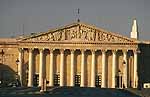 The
slanted facade of the Palaise Bourbon houses the National Assembly, the
equivalent of the U.S. Congress, is not meant to reflect the turmoil within,
but to establish a parallel with the Church of the Madeleine, which is
directly across the Seine through the Place de la Concorde. Nearby
are other government buildings such as the Ministry of Foreign Affairs,
Ministry of European Affairs, and the Ministry of Defense.
The
slanted facade of the Palaise Bourbon houses the National Assembly, the
equivalent of the U.S. Congress, is not meant to reflect the turmoil within,
but to establish a parallel with the Church of the Madeleine, which is
directly across the Seine through the Place de la Concorde. Nearby
are other government buildings such as the Ministry of Foreign Affairs,
Ministry of European Affairs, and the Ministry of Defense.
Considered an eyesore when it was erected in 1900, the former train station was almost leveled 70 years later to make room for a high rise. Instead, gutted and redone inside by Gae Aulenti, it now houses nineteenth century art, including all the Impressionists.
At No.13, an eighteenth century house squeezes itself into view like a crooked tooth. It is possibly the most narrow house in Paris. In the house at No.27, Voltaire died of an accidental overdose of opium.
Much of the lively anarchistic spirit of the Beaux Arts academy has subsided. The students in this building of conflicting styles now seem in perfect harmony with the sedately arty atmosphere of the St. Germain area.
Notable mostly for its view, France's first iron bridge is where Albert Camus' antihero of The Fall, Clamence, heard a weird, untraceable laugh break out, echoing the emptiness of his life. This bridge is for pedestrians only and you can always find many people hanging out, day or night.
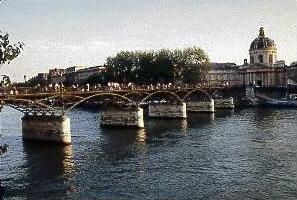
The austere, regular facade of the Hotel des Monnaies (the Mint) houses a hardly more exciting collection of coins. A majestic Parisian edifice, the Insitut de France hosts the French Academy, which holds its assembly under the cupola. Part of the Academy's time is devoted to deciding whether or not to add the latest English barbarism to the French dictionary. Try to sneak into the Biblioteque Mazarine. It is one of the most beautiful libraries in the world.
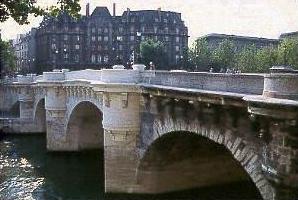
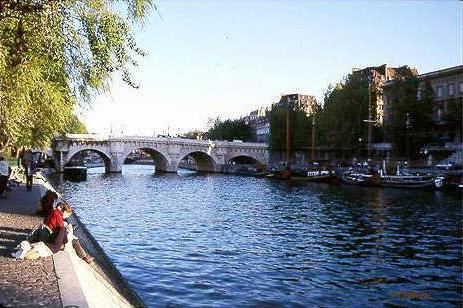
It is the oldest bridge in Paris and, completed under Henri IV, was the first not to be lined with houses-that is, the first from which the river could be seen. A late incarnation took place in 1985, when Christo had it wrapped for 15 days. The statue of Henri hides a rebellious spirit. The Bonapartist smith who recast the stern bronze statue during the Restoration hid within it writings to the glory of the emperor. Weigh the view from the Square du Vert Galant, which stands at the ancient level of the Ile de la Cite.
The city's oldest (1313), this quay's main attraction is the restaurant Laperouse, in an eighteenth century mansion. The private salons, where courtesans left scratches on the mirrors, testing the diamonds their beaux gave them, are intact.
The Gibert Jeune bookstore's rows of secondhand textbooks are one of the last truly thriving relics of the Latin Quarter's student life.
This bridge and its predecessors on the site have been the city's shortest for 2,000 years.
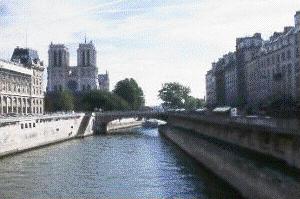
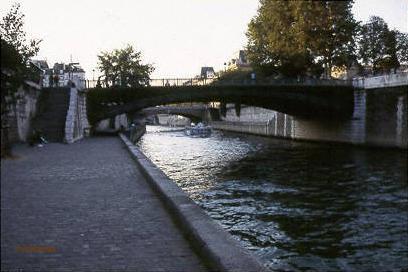
This island is the historical heart of Paris. As it stands, the famed Gothic cathedral of Notre Dame is mostly the work of Viollet-le-Duc, whose loose nineteenth century conception of restoration led him to "reconstitute" the 1334 edifice. Contrary to the current vogue of "derestoration," present work on the cathedral, whichis badly threatened by the etching exhaust of tour buses, includes restoration of Viollet-le-Duc's efforts. Behind the cathedral stands the eerie, fierce Deportation Memorial to the concentration camp victims, on the old site of the morgue. The waters at the foot of the quai du Marche Neuf represent one of modern art's important "works." In 1962, the painter Yves Klein sold the view of the water to an American art lover as a "sone of immaterial pictural sensibility" for 16 gold ingots, split between him and the Seine. As far as anybody knows, the Seine's 8 ingots are still at the bottom of the river. LIt up at night, the Conciergerie, the ex-prison that housed Marie Antoinette, takes on a paradoxical fairy tale air. The crenellations of the Tour Bonbec, on the far right, soften, letting one forget that it was a torture chamber, whence the Seine washed bodies away. Time has stopped farther down on the left at the Tour de l'Horloge, which boasts the oldest public clock in Paris, now out of use. The Flower Market, on Place Louis Lepine, lightens up these austere settings. On Sunday there is also the chirping of a bird market.
This odd bookstore perpetuates the great literary tradition of Americans living in Paris. Owner George Whitman claims to descend from Walt and to be the cultural heir of Sylvia Beach, whose original Shakespeare and Co. bookstore, in the rue de l'Odeon, was a beacon for Joyce and Hemmingway.
The Tour d'Argent is worth a pause, even if you don't stop in. Henri III learned to eat with a fork here. At No.57, the Hotel ci-devant de Nesmond, mansion of teh vain Mme. de N., was the first to bear its owner's name on the lintel. It still ostentatiously exhibits its "nonname," one of the last testimonies to the Revolution's obsession with eradicating aristocratic titles.
Home to the celebrated Berthillon ice cream parlor, the island also contains exquisite jewels of seventeeth century French architecture. The Rothschilds' Hotel Lambert hides behind a classic facade the splendors of a private mansion build and decorated by the artists of Versailles and the Louvre. Voltaire frequented the hotel a century later, when it became the property of his aristocratic msitress, Mme. du Chatelet. Discretion in a setting reminiscent of yesterday's vanished pomp is also what attracted the decadent aesthetes of the mid nineteenth century to the Hotel Lauzun, at No.17. In the frescoed salons, the poet Theophile Gautier assembled his dope smoking Club of Hashishins. Lush, Oriental dreams still seem to hover in the small rooms, with their low, richly painted ceilings and gilded paneling.
Burned down during the Commune, the Hotel de Ville was restored to neo-Renaissance and Belle Epoque pomp in the purest official style of the Third Republic.
Framed by two ornate theaters, this square epitomizes Second Empire respect for frivolousness. The theater on the right belonged to Sarah Bernhardy. A small museum in the foyer displays her last right slipper before her leg was amputated.
Once the site of the tanneries, the stench haas persisted through centuries.
The view from the terrace of this department store is worth a stop. It is free to go to the top floor and even a little cafe where you can take a break and have lunch or a snack.
Formerly a palace of the kings and queens of France, it is now one of the greatest art museums in the world.
The garden designed by Le Notre has a curious mix of tourists and food vendors. The banks below are informally known as Tata Beach or Queen Beach. Overlooking the PLace de la Concorde, the Musee de l'Orangerie boasts Monet's Nympheas.
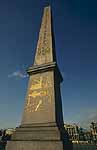 The
bloody traces of the guillotine that claimed the lives of Louis XVI, Marie
Antoinette, Danton, Robespierre, and scores of others have vanished. The
coolly elegant work of Gabriel is now for many the quintessential image
of Parisian elegance and detachment. Of course, it is also a hellish traffic
circle, but at night it creates a glow around the central Obelisk of Luxor,
a piece of Egyptian antiquity and the oldest monument in Paris.
The
bloody traces of the guillotine that claimed the lives of Louis XVI, Marie
Antoinette, Danton, Robespierre, and scores of others have vanished. The
coolly elegant work of Gabriel is now for many the quintessential image
of Parisian elegance and detachment. Of course, it is also a hellish traffic
circle, but at night it creates a glow around the central Obelisk of Luxor,
a piece of Egyptian antiquity and the oldest monument in Paris.
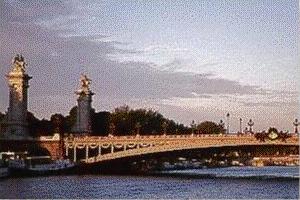
Inaugurated in 1900 for the World's Fair as a monument to French art, the Grand Palais is now an exhibition all specialized in museum shows famous for long lines. The oft-neglected Petit Palais is too big to properly present the permanent collections it now houses. The popular Pont Alexandre III is a work of technical prowess, meant to cement the growing ties with czarist Russia.
At No.40 along this tree-lined promenade is the house that Rene Lalique designed for himself. The glass doors, with their Art Nouveau motifs of pines and firs, are an elegant counterpoint to the row of trees lining the promenade.
The statue of the Zouave that decorates the bridge is a popular high water marker. The most famous flood occured in 1910, when the water rose to his chin. On the Place de l'Alma is a replica of the Statue of Liberty's flames, a French Revolution bicentennial gift from the International Herald Tribune with a list of businesses commemorated on the base. It is now cluttered with letters, flowers, and poems written in memory of Princess Diana.
Rising like a Mussolinian mausoleum above the Seine, the Palais is a leftover from the 1937 World's Fair. Inside, the Museum of Modern Art of the City of Paris has, among other treasures, the biggest painting in the world: Dufy's Good Fairy Electricity, 6,095 square feet that recount the story of this form of energy.
A remnant of the 1937 exhibition also, the Palais de Chaillot's Augustan architecture extends even to the gold lettered maxims by Valery on the facade. It houses the Henri Langlois Cinema Museum, a mecca for film enthusiasts.