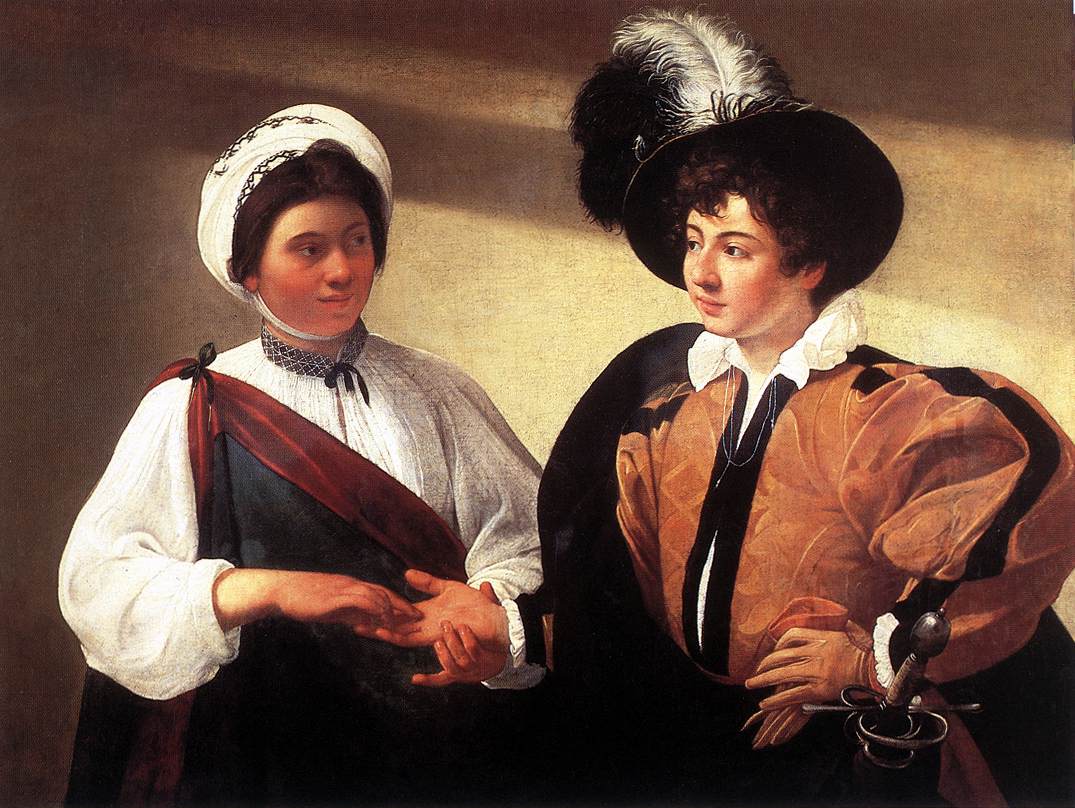
The Fortune Teller, (La Zingara) 1594/95.
With this painting Caravaggio introduced a subject into Italian painting that was known, if at all, only in Netherlandish paintings. This so-called genre painting depicted scenes of everyday life. Often there was a hidden or underlying meaning depicted for the edification of the observant spectator. There are two themes from Caravaggio's early years that can be put in this category of genre painting: one representing a card game is unfortunately lost, the other is the Fortune Teller. The theme of the Fortune Teller is preserved in two paintings. One painting is in the Pinacoteca Capitolina in Rome. The one shown here is in the collection a the Louvre in Paris.
A fashion victim in Renaissance times, a naive young man, gives his right hand to a young girl whose expression we can�t quite read. She takes his hand to read his future. The state of his future will be effectively influenced by this astute young gypsy girl. She gently caresses the lines on the hand of this handsome young dope. So full of himself and so completely captivated by this pretty girl, he fails to notice
his ring being slipped from his finger. This painting invites you to further embroider the plot. The feathered hat, the gloves and the showy, oversized dagger immediately told those of Caravaggio�s time who they were dealing with here. Similarly, the gypsy girl with her light linen shirt and her exotic wrap may have been seen as a sort of stereotype rather than as an individual person. No specification of place or time detracts our
attention from the point of the story, which gives the spectator a sense of complacent superiority as well as aesthetic pleasure. This could be an everyday tale from a time forgotten, or does it remind one of the pickpockets in the metros of today�s Paris? |