
 Perhaps you hum a few bars of Zbigniew Preisner's
formidable score as you
drink your coffee in the morning, or you have a nightmare about the kind of
car crash that sets this
story in motion. And when a friend doesn't appreciate the film -- in fact,
they think it's a dull,
pretentious throwback to the French New Wave or somesuch -- you find yourself
speechless. It's
hard to use words to explain the cinema's moments of great beauty, and you
may as well give up
before you begin.
Perhaps you hum a few bars of Zbigniew Preisner's
formidable score as you
drink your coffee in the morning, or you have a nightmare about the kind of
car crash that sets this
story in motion. And when a friend doesn't appreciate the film -- in fact,
they think it's a dull,
pretentious throwback to the French New Wave or somesuch -- you find yourself
speechless. It's
hard to use words to explain the cinema's moments of great beauty, and you
may as well give up
before you begin.
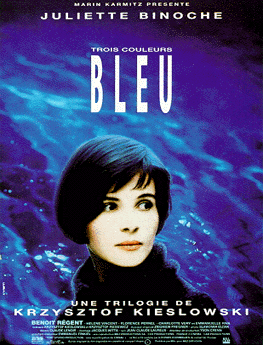
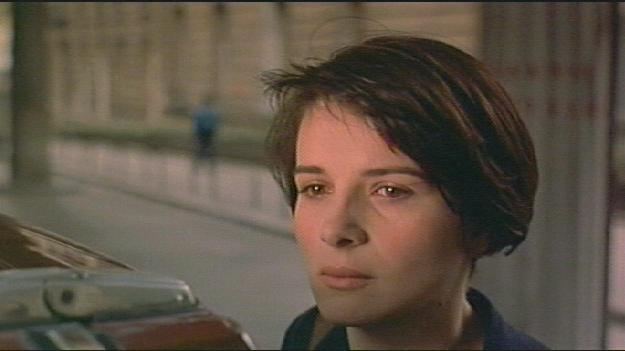
THREE COLORS: BLUE is the first film in Polish director Krzysztof Kieslowski's trilogy built around the precious themes of liberty, equality, and fratenity (the second and third films are WHITE and RED, respectively). The concepts correspond to the three colors of the French flag, and the conceit is actually less a stricture than a simple excuse for Kieslowski to make a set of movies that meditate on love, loss, and our essential humanity. Liberty is personified in the newly-widowed Julie (Binoche), who survives the automobile accident that kills her husband Patrice (a famous composer) and daughter Anna. This sea change in her life drives her to divorce herself from familiar people and surroundings, but she's dogged by an unwelcome artifact from her husband's life. His unfinished composition, Song for the Unification of Europe, is the subject of intense interest, and although Julie disposes of Patrice's notes for the piece (and tries to dispose of all her own memories), it continues to insinuate itself into her life until she confronts the music as well as her own devastated psyche.
It sounds very color-by-numbers, but the film is actually anything but. Kieslowski is a bold filmmaker, with a knack for hypnotizing an audience. As much as Kieslowski's THE DOUBLE LIFE OF VERONIQUE seemed concerned with lenses, this one dwells on reflections -- Julie's face reflected on the curve of a spoon, a doctor's face reflected in the iris of her eye, filling the screen. The richness of imagery occasionally rivals that of a novel (Julie touches a sugar cube to coffee; as we watch, the sugar turns the luminous color of her own skin). And Kieslowski works at capturing the essence of memory and the passage of time. At four moments during the film, the screen fades completely and music swells Patrice's unfinished piece and then the music cuts, and the scene fades back in at exactly the moment where it faded out. It's part of the mystery of the film that a viewer can have an immediate and intuitive grasp on such an abstract device.
Intuition, indeed, is the driving force behind Kieslowski's films. The
relationships and imagery are
drawn so intricately that the pictures reward repeated viewing, and it's only
on the second or third
time around that the whole power of one of these films really becomes
apparent.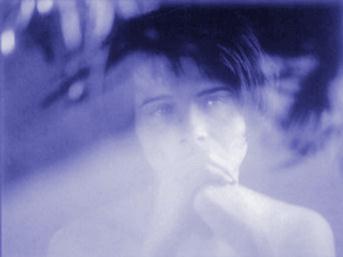 It's easy to
belittle a film like this, with its languid pace, elliptical dialog, and
propensity for introspection
(navel-gazing?). Don't these somber sequences substitute a content New
Age-ism for any real
statements in response to the questions they pose? Isn't Kieslowski living in
a blithe, egocentric
dream world? How can we be expected to identify with the rich widow of a
French composer as
she mourns her way through Paris?
It's easy to
belittle a film like this, with its languid pace, elliptical dialog, and
propensity for introspection
(navel-gazing?). Don't these somber sequences substitute a content New
Age-ism for any real
statements in response to the questions they pose? Isn't Kieslowski living in
a blithe, egocentric
dream world? How can we be expected to identify with the rich widow of a
French composer as
she mourns her way through Paris?
Yet through Binoche's performance and Kieslowski's guidance, we do identify. We feel Julie's aloneness even as we understand her resolve to cast off her sentiment and distance herself from the inexorable sadness. At the end of BLUE, as Preisner's music swells up on the soundtrack, all of the disparate characters and situations that make up Julie's story finally come together. Pictures recall pictures as Julie is finally reflected in the eyes of another, and the delicate shape of another character is traced on a video monitor, echoed in shades of blue. These final moments articulate character and contradictory emotion in one crystalline, irrefutable passage of images, absolutely wordless -- the very definition of great cinema. If you're asking the same questions as our director, the simple clarity of such images provides answers enough.

