
Bottlenose Dolphin
Tursiops truncatus
CLASS : Mammalia
ORDER : Cetacea
SUBORDER : Odontoceti
FAMILY : Delphinidae
GENUS : Tursiops
SPECIES : truncatus
The bottlenose dolphin is perhaps one of the most well known cetaceans, because of its widespread use in marine parks and research facilities. The bottlenose dolphin may be best known as "Flipper" (as seen in the television series). This is the dolphin most frequently seen along the shores of the United States. This species is very flexible in its behavior. GENERAL DESCRIPTION
The bottlenose dolphin grows to be at most 12 feet (3.7 m) long, sometimes weighing more than 1,400 pounds (635 kg). Most are smaller than this.
SHAPE AND FINS
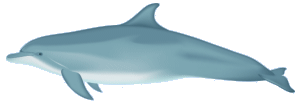
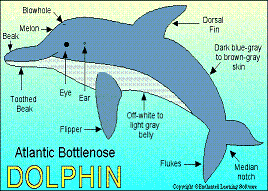
Bottlenose Dolphins have stream-lined bodies and a rounded head with a distinctive beak. They have a tall, falcate (sickle-shaped) dorsal fin and broad, slightly pointed flippers.
DIET AND TEETH
Bottlenose dolphins are hunters that fish mostly at the surface of the water, eating mostly fish and squid. They have many pairs of sharp, pointed teeth distributed in both the upper and lower jaws.
PREDATORS OF DOLPHINS
Some sharks (including tiger sharks, dusky sharks and bull sharks) and orcas will prey upon dolphins. Dolphins are also often trapped in people's fishing nets.
SOCIAL GROUPS
Bottlenose dolphins live in small pods of up to 12 whales; they are very social animals. Often, many pods group together to form congregations of hundreds of dolphins.
DIVING, JUMPING, AND BOW RIDING
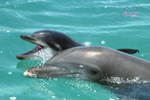
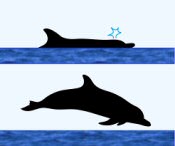
Dolphins can dive down to more than 1,000 feet (300 m) and can jump up to 20 feet (6 m) out of the water. A bow rider is a dolphin that hitches a rides in the bow wave in front of a ship. The dolphin surfs using the pressure created in front of a moving ship.
SPOUTING - BREATHING
Dolphins breathe air at the surface of the water through a single blowhole located near the top of the head. They need to breathe about every 2 minutes, but can hold their breath for several minutes. Their blow is a single, explosive cloud.
SPEED => Dolphins are very fast swimmers.
HABITAT AND RANGE
Bottlenose dolphins live near the coast and inshore waters from northern Cape Hatteras to southern Florida and westward through the Gulf of Mexico. Another population lives near the continental shelf off New Jersey. Bottlenose dolphins live in different areas during the different parts of their life cycle, for example, breeding and giving birth.
LIFE SPAN => Bottlenose dolphins have a maximum life span of about 25 years.
POPULATION COUNT
Bottlenose dolphins are in no danger as their numbers are abundant.
MATING AND BREEDING
Males reach sexual maturity at about 10 years. Females reach sexual maturity at about 5-10 years. The gestation period is 12 months. Calving can take place year-round with peaks in some areas during spring and fall. Calves nurse for over a year (12-18 months), and stay with their mothers for 3-6 years learning how to catch fish and other important tasks.
DISTRIBUTION AND MIGRATION
Bottlenose dolphins are found worldwide in temperate and tropical waters, absent only from 45 degrees poleward in either hemisphere. They are frequently seen in harbors, bays, lagoons, estuaries, and river mouths. There appear to be two ecotypes: a coastal form and an offshore form. Population density appears to be higher nearshore. Biochemical studies now are providing more information about the relationship within and between the ecotypes. In some areas, dolphins have limited home ranges; in others, they are migratory. A second species Tursiops aduncus, inhabits the Indian Ocean.
NATURAL HISTORY
Based on a number of studies of nearshore populations, bottlenose dolphins seem to live in relatively open societies. Mother and calf bonds and some other associations may be strong, but individuals may be seen from day-to-day with a variety of different associates. Group size is often less than 20 nearshore; offshore groups of several hundred have been seen. Much of what we know of the general biology of dolphins comes from studies of bottlenose dolphins, both in captivity and in the wild.
STATUS
The bottlenose dolphin is protected in U.S. waters by the Marine Mammal Protection Act. Bottlenose dolphins are still generally plentiful in numbers, but are near depletion in some areas. Both incidental and direct exploitation of bottlenose dolphins are known to occur, generally at low to moderate levels. The largest direct kills have traditionally been in the Black Sea, where Russian and Turkish hunters apparently have reduced local populations. Bottlenose dolphins are accidentally caught in a variety of fishing gear, including gillnets, purse seiners used to catch tuna, and shrimp trawls. These dolphins also are occasional victims of harpoon and drive fisheries. Live captures of bottlenose dolphins for captivity have had effects on some local dolphin populations in the Gulf of Mexico and southeastern United States, but no commercial live captures have occurred in the U.S. since the 1980's. Bottlenose dolphins are vulnerable to pollution, habitat alteration, boat collisions, human feeding of and swimming with wild animals, and human disturbance (such as boating). Several die-offs of bottlenose dolphins have occurred. Retrospective analysis of tissues of dolphins that died in 1987-1988 during a large die-off (approximately 800-1,000 dolphins) on the Atlantic U.S. coast indicates that mortality may have been caused by a morbillivirus. This virus has been linked to dies-offs of Gulf of Mexico bottlenose dolphins as well. Dolphins with disease symptoms appeared to have elevated levels of PCB's, leading researchers to conclude that pollutants may be playing a role in these events. Preliminary evidence from other studies show links between contaminant residues in tissues and impaired immune system function.