7. Cosmological implications
i.) To sum up, the context for interpreting spin according to our heuristic proposal appears to be roughly this: The two-valuedness of intrinsic spin is a theoretical and experimental requirement. But the ontological connotation of 'spin' is less important than the two-valuedness which it stands for in the formalism. Indeed as mentioned in paragraph 1.ii, there is no sensible fraction of c which can be set as the peripheral velocity of a spinning electron that would account for the required energy in terms of angular momentum. This is true if an electron is any smaller than the Compton wavelength, which is already six orders of magnitude larger than the limit allowed by the scattering data, at which radius the peripheral rotation would have to be much greater than the speed of light. And if an electron were truly a point particle, then the spin velocity v/c would of course become infinite. Yet spin angular momentum is inevitably bound up with the notion of metrical extension. As long as electrons are regarded as point particles in absolute space the original Schrodinger equation suffices. The relativistic Dirac spinor represents a departure from this view which remains problematic in terms of field theory.
ii.) To elide these difficulties and to embrace fully the context-dependency and wave-function symmetry of spin observables we propose to give up the particle/field representation in favour of a network of nonlocal linear objects. Under local measurements, each nonlocal object has a basic two-valuedness of position which also entails a basic two-valuedness of electron spin, expressed at opposite nodes reciprocally. It is conventional that a few pairs may preserve a singlet state of spin in a specialised nonlocal EPR symmetry, but according to our generalised symmetry all pairs can always be thought of as preserving a singlet state of superspin. Superspin is supposed to be carried as a 'super-rotation' of the plane of polarisation of a (linear polarised) photon. The photon itself 'sees' the restored superspin symmetry normalised (in null proper time) to that of a spin-zero scalar 'particle' and is blind to an imaginary torsion which it carries over into the mass relations of a pair of spin-half leptons as a spin-one electrodynamical symmetry. The emergence of the local-relativistic electrodynamical symmetry is to be identified with the spontaneous breaking of nonlocal superspin symmetry in the network. In this emergent local network each point of measurement of an electron can be seen as the origin of N complex radius vectors, each of which has some probability of being the photon vector which a measurement will elicit as being 'the electron spin axis'. Where the super-rotation of the photon (linear) polarisation plane inverts through p at the measurement node, radial direction determines which of two reciprocal spin vectors is 'measured' at the node at any 'instant' on a given radius vector, whilst the same binary choice is available on an indefinite number of radial orientations corresponding to an indefinite number of other photon vectors. The outcome of a measurement (for an electron) will be equivalent to determining a single active channel in this nexus (larger compound spins being vector sums of a number of such channels), and crudely speaking we can liken the electromagnetic coupling rate of 1/137 to a probability that any one channel will be (as it were) 'illuminated' at any given 'instant', the further implication being that if the unitary superposition of these active channels were not reduced by a perturbation such as a 'measurement' they would correspond to virtual photon states. (Of course, by definition of an electron as a 'permanent' entity, we have to say that they are continually being reduced by such 'measurement') As such they, and the indefinite number of similar electron/photon couplings to which they are nonlocally coupled throughout the cosmic network, represent what in QED becomes the self energy of the electron concerned. However, in the absence of a continuous Lorentzian local manifold of point position states this is a 'self-energy' that can go to infinity only in a universe containing an infinite number of 'particles', and its theoretical cancellation by 'renormalisation' can be seen to be a reflection of an actual process enjoined by the scalar gauge renormalisation that follows from self-consistency constraints of the cosmic string self-interaction - see 2. xvii. above. (And the continual reduction of virtual states by 'measurement' is just the instant-by-instant actualisation of this self-consistency in the form of 'an electron'.)
iii.) Such a network ontology would have general implications for problems in cosmology, and one can immediately point to the areas of flatness and homogeneity and the cosmological constant. Here there is the prospect of an alternative perspective to that emerging from spin-networks and loop quantum gravity. There is also the remote prospect of an interpretation of anomalous galactic mass-to-light ratios within a general deductive theory. I'd like to close with a short discussion of these points.
iv.) Loop gravity claims to be background-independent but seems not to escape the problems of continuity. That is, unlike string/M-theory and traditional perturbative quantum gravity it does not split the GR manifold into a background metric and a superimposed quantum field. In this sense it is fixed background-independent. But it is quite conservative in that it takes the classical GR manifold as a given physical foundation and then follows the traditional route of quantising the formulae for classical observables. The loop representation carries spins around little loops to turn continuous GR spacetime into a Planck-scale spin network with something like 10180 nodes or vertices, a foam-like lattice down at 10-33cm with a recurring elementary geometry, perhaps tetrahedral. It therefore does have a GR dynamical spacetime background with a smooth surface topology on moderate scales. The justification for this procedure is obviously that GR is a good theory. But if GR is an effective theory, not a structurally perfect theory, one naturally asks whether this procedure may import some structural imperfection.
v.) And so it does. The flat-Euclidean GR spacetime from which this process begins is known to be a hugely improbable outcome of an unnatural relation between inflationary fine-tuning and a mysterious cancellation of an enormous vacuum energy. It would be nice if a proper understanding of spacetime turned this unnatural relation into a natural one. But having generated something discrete which looks 'for all practical purposes' (FAPP) like smooth spacetime, loop gravity then discovers (not surprisingly, one might suggest) that its representation is altogether too efficient in that its Euclidean flatness remains colossally improbable. Smolin [88] estimates a probability in the region of 10-81.
vi.) Consider the problematical concept of the position of an electron 'inside' the spatial volume of a single atom: Can it be the correct approach to import a scaled-down analogue of classical spacetime, which is to appear flat-Euclidean on the scale of an electron, and then to derive this appearance of an improbable continuuum condition from a matrix of 1075 spin-network nodes in an equally improbable state? Cosmic spacetime is then to be a tissue of such appearances stitched together, meaning that a number of nodes equal to some 1019 times the cosmic fermion number (about 1099) is hidden inside every cubic centimeter of space. And if we think about this we can see that this huge quantity of hidden information exists essentially in order that loop gravity theory can import into each atom or each cubic centimeter the Trojan Horse of flat Euclidean space - an embarrassment of riches indeed, since this brings with it the even vaster disparity (10120) of the unnaturally-cancelled cosmological constant. This seems especially redundant when we reflect that even on atomic scales forces are in principle unobservable.
vii.) This is to re-echo the problems of microcosmic quantum theory in a cosmic arena. As Feynman complained, 'How can all that be going on in that tiny space? Why should it take an infinite amount of logic to figure out what one tiny piece of space/time is going to do?' [89] The answer is not to simulate unmeasurable continuity at any scale at all, but to accept that measurable discontinuity is scale. A loop gravity spin network has a vast number of vertices, each connecting just a handful of edges, these distributed completely independently of observable changes of particle momenta. On the other hand our net divides that number of vertices by fully 10140, but allows the tiny proportion remaining (1040) to each be intersected by 1040 edges. There are of course exactly the same number of points of measurement in our network space, since a measurement always lives on an observed transfer of momentum. There is the same amount of information. But a loop gravity net has a huge number of redundant nodes that never become points of measurement, and those that do are themselves information-poor; whereas each of our points is information-rich and no point is ever redundant. The difference is between a FAPP local smooth continuum governed by global constants and a nonlocal network structure coemergent with local FAPP constants.
viii.) There can be no fuller specification of the position of any real observable than the set of its angular relations to all possible real observers. One doesn't need a continuum for this where the number of possible real observers is finite. If instead one looks for a procedure of 'joining the dots' in the most direct and exhaustive possible way, what one gets is not some clumsier analogue of continuous non-Euclidean spacetime but a different kind of structure entirely, a scale-free fractal architecture that is more like a tensegrity structure than anything else. A tensegrity structure is a dynamical equilibrium of compression struts and tension wires, a 'force-transmitting network' analogous to the model of the cell cytoskeleton proposed by Ingber [90, 91, 92] in which mechanical stresses on a web of protein filaments and microtubules transmit information to the nucleus much faster than chemical diffusion rates and might help to explain adaptive cell shapes, programmed cell death and tumour division. Physically, the analogues of compression struts and tension filaments would be the scale-dependent self-dual functionality of 'inflation' and 'deflation', operating nonlocally to generate resultant local 'mechanical stresses' on the segments of the network in the form of spacetime and electrodynamical forces. Ex hypothesi, in the self-interaction of the string there is a spontaneous symmetry breaking to the local spacetime phase of this network, and intrinsic spin, which supersymmetrically carries the hidden superspin, occurs as an embodiment of this breaking. It is therefore interesting that a tensegrity structure's characteristic resistance to developing torque under shear could be conversely expressed as a capacity to transmit torque, perhaps explaining the efficiency of spacetime as a rotational energy 'sink' via gravitational contraction (see 4.xviii.).
ix.) Which leads to the questions of large scale cosmic structure and gravitational dynamics. The cosmic validity of the isotropy and homogeneity assumptions built into GR is presently under increasingly critical examination. Several rather strong arguments are listed by Baryshev [93], for example the problem that the linear Hubble relation is now known to apply on relatively short scales far smaller than any possible homogeneity distance that may exist, deep within the region where fractal structure is observationally well established [94]. The force of the traditional argument pointing to the consistency of a linear Hubble constant with the cosmological homogeneity principle has thus vanished, and the origin of a linear Hubble flow inside a complicated fractal velocity field becomes interesting. It is also the case, as pointed out by Baryshev, that global gravitational energy conservation is a problem in an FRW model on at least two counts: the loss of radiation mass during expansion [95]; and violation of the 1st law of thermodynamics by the zero pressure gradient of homogeneous unbounded space [96]. Penrose [97] is intrigued by the nonlocal character of gravitational energy in GR (and would like to use this uncertainty to somehow interpret state vector collapse in QM; see Part 4). And a canonical quantisation of GR which tackles the fine-tuning of primordial inflation and the vacuum energy in an accelerating universe seems as far off as an explanation of the origin of inertia in a local field theory of gravity.
x.) Several attempts have been made to avoid the need for another theoretically awkward plug-in - 'dark matter' - by modifying gravitational dynamics. The MOND scheme due to Milgrom [98] has proved empirically very successful indeed, and the objection that MOND is theoretically arbitrary may be true but doesn't carry conviction in view of the fact that many lines of argument seem to lead to the conclusion that GR is a limit-case effective theory. In the 1930s discrepancies between observed and dynamically estimated mass were noted in the solar neighborhood by Oort [99] and in galaxy clusters by Zwicky [100], and analogous discrepancies in the rotation curves of many galaxies were confirmed in detail in the '70s and 80s [101]. Modified gravity theories in which the Newtonian law breaks down above distances on the order of 10kpc failed because some compact galaxies need corrections below this scale, whilst others need none far above it. It became obvious that a systematic modification of a pure distance law alone would not work, hence the idea of dark matter. However MOND scores by choosing an acceleration parameter instead of a distance parameter and so doesn't demand naive scale relationships that aren't observed. Almost all of the effects predicted by MOND are observed, although where the constant of acceleration comes from which supplies the cut-off in the transition to Newtonian dynamics is as yet unclear [102].
xi.) The upshot of the last two paragraphs seems to be that a new kind of gravitational dynamics is required which goes over approximately in some limit to an effective field theory producing GR and the MOND low-acceleration parameter, whilst emerging from an essentially fractal underlying quantum theory. It is possible that such a theory could look like a scale-free network theory of the present type, for several reasons. Firstly, we expect relative inertial mass to be nonlocally determined according to a scale factor only in the sense that relative scale is itself determined nonlocally, and this appears to give the necessary connection between spacetime geometry and inertia. In other words, the component of inflationary 'force' which represents the scale dependency of the relation between two inertial masses is the same component responsible for the local geometry of the effective metric between them, and this spacetime slope according to GR is the acceleration due to gravity. Mass and scale are codetermined by inflation (or from a different point of view are codeterminants of gravitation), so that there should be a covariant coupling between scale and mass which is not constant but whose underlying rate itself varies inversely with the emergent scale according to a cosmical constant which has the dimensions of an acceleration. Empirically there is such an acceleration called the Hubble constant, Ho, which turns out to be related in a simple way to the scale-free MOND acceleration parameter, ao, as ao » Hoc; and if it is true (as suggested in 7.ix. above) that Ho is a robust constant of a fractal galaxy distribution that has no homogeneity scale, then the suggestion is strong that these may be co-derivative limit values of the same parameter, related by a global constant - the speed of light - in an effective local field model that is driven by an underlying nonlocal, fractal, quantum theory in which c is a network renormalisation parameter cnorm (see 4.vii). In the effective field c becomes a constant of all scales so that energy conservation requires m to be a constant of all scales. But on the network E = mnorm cnorm2, where the total real energy is automatically self-constrained (see, e.g.: 4.ii; 4.vii. note 10), and effective mass varies with effective scale - i.e., with the gravitational deformation of route-dependent time, or equivalently with the acceleration. (From a field-theoretical point of view this renormalisation of m can be treated as an adaptation to the fact [7.ix above] that in FRW models gravitational energy is not properly conserved.)
xii.) I should emphasise again that because this variation in norm arises as a property of the network 'dispersion' (renorming at each self-interaction of the string, as a constant of successive segments or 'particle pairs') it does not translate into a direct proportionality with distance scale. The emergent global variation will be a statistical resultant of these nonlocal component 'forces', which will show a systematic variation only in rough indirect proportion to global distance scale. So although it will be a qualitative prediction of our model that as effective inertial mass changes with the look-back time so the effective values of 'fundamental constants' will change (see 7.xvi. below) this is quite different from postulating secular temporal variations in a field theory based on an homogeneous physics. The statistical resultant will be like the sum over a complicated effective field of local variations converging in the scalar limit of the light horizon, which convergence produces the fractal analogue of an homogeneity scale. The homogeneity is not physically fundamental but instead emerges from a quantisation condition which is radically scale-free and radically fractal.
xiii.) The coherent nonlocal symmetry of the network is spontaneously broken in its own self-interaction, and in the emergent local universe of 1080 EPR-uncorrelated fermions each observation of a 'particle' (every vertical change of momentum) represents only one of the 1040 different values of m appropriate to its pairings, via a hidden superspin symmetry, with all other 'particles'. Of necessity those pairings where the dynamics of the relation have historically been inferrable from direct kinematic measurements have been within the 'laboratory' of the solar system, which imposes a practical limit of numerical scale. A measurement of inertial mass which indexes (say) 1020 pairings of a particle in this 'laboratory' still leaves out of account 1020 other inertial masses which that same particle (node) possesses in respect of other pairings outwith the accessible 'laboratory'. The variable degree of spatial anisotropy of this quantity called inertia (gravity) in the frame of the 'laboratory' is modelled quite well by Newton's 1/r² law. But looking beyond that frame we find that the law is contingent primarily on this ratio of numerical scale, which secondarily expresses as a renormalising metrical scale deformed by gravitational acceleration.
xiv.) This contingency is more complicated than simply altering some distance parameter for an attractive force on a smooth background because this 'background' can itself only be introduced as a dynamical variable. This happens in GR. But a network theory would eschew the background altogether, the difference being that mass itself now becomes a dynamical variable. The local limit in which the Newtonian law breaks down is always a false vacuum state supported on the internal inflationary pressure of a domain of nodes - an aggregate mass - and for small aggregates this internal vacuum energy operates with an opposite sign to the external constraint coming from the cosmic environment. For much more extended aggregates the scale factor associated with the external constraint begins to introduce a component of the same sign, increasing expansion velocity in the observable limit of the cosmic light horizon. (This global horizon then represents a phase change beyond which internal and external vacuum contributions operate wholly with the same sign for an aggregation of 1040 nodes.) Systems of varying node number will encounter equivalent phase transitions at varying local scales because scale and mass are co-emergent dipole representations of the nonlocal network monopole. That is, for each numerical scale of aggregation the contribution of the external vacuum constraint changes sign parallel to that of the internal vacuum energy at a different metrical scale. Gravitationally bound structures will thus represent a scale-free heirarchy of such dynamic equilibrium surfaces which are generally phase transitions at domain boundaries where the net vacuum polarity begins to change. These transitions will be associated not with any constant or function of scale or mass (except derivatively), but with a discontinuity at which local gravitational (-) acceleration goes over into global inflationary (+) acceleration. The suggestion is that this scale-free domain boundary rolls over quite rapidly for all such structures with a critical transition near ao, the MOND acceleration parameter.
xv.) In summary, this means that instead of treating mass as a scalar constant on the radius of a galaxy or cluster and inferring that a given mass moves 'too fast' to be gravitationally bound, one would treat mass as a radially diminishing component of a conserved angular momentum plotted on a curve of rising inflationary velocity, but, in line with the spirit of MOND there would be only a statistical correlation with distance scale. Cosmologically, if there really is no physically fundamental homogeneity scale then it becomes necessary to try to produce the MOND acceleration parameter from a fractal type of theory, where again one would expect scale-free correlations analogous to the nonlocal long-distance correlations that characterise our network model. It is at least arguable that the intrinsic inflationary function of a superspin network would render natural the resemblance of the galaxy distribution on supercluster scales to a 'foam' of colliding compression wavefronts, as well as supplying an overall accelerating expansion-rate proportional to cosmic scale and thereby obviating (in principle) the need for a superadded 'dark energy'. Intuitively, the mean global geometrical resultant would naturally be 'flat' with G = 0, just as the total network 'virtual' self-energy cancels away as a null correction to the 'real'. A zero 'cosmological constant' would therefore occur as an average condition of an effective local field theory of GR spacetime which is 'simultaneously' expanding and contracting, and which is underlain by a nonlocal, inhomogenous, anisotropic, quantum theory based on a scale-free fractal network principle.
xvi.) As mentioned in 7.xii. above, the renormalisation of constants in a network theory would not imply truly smooth secular variations in these values; nevertheless it would imply global spatial effects that look like past secular temporal variations reducing to vanishing at the here-and-now. In 1999 evidence was produced by Webb et al. [103] of apparent variations in the strength of the fine structure constant inferred from displaced absorption lines in QSO spectra at high redshifts, and they further strengthened their case in more recent studies [104, 105]. This is widely interpreted as tentative evidence of a secular variation in one of the components of alpha over look-back times approaching 10 billion years. In essence, if alpha 'has increased' then this appears to mean that c 'has reduced' or e 'has increased'. This chimes with the VSL (varying speed of light) theory proposed in 1999 by Albrecht and Magueijo [106] to address problems with inflation, and more recently Barrow, Maguiejo and Sandvik [107] have proposed a model of variations in e and/or c confined to one early cosmic epoch which fits the data on alpha. Davies et al. [108] argue that an increase in e would violate the proposed law of black hole horizon area conservation, and therefore the 2nd law of thermodynamics, implying that the whole variation must be due to a larger value of c in the 'past'. They admit that the chain of inference from the horizon-area constraint remains conjectural (it depends in fact on a great deal of quantum black-hole entropy theory which would invite reinterpretation in a network model; moreover, the overarching laws of thermodynamics become extremely delicate to interpret in a cosmological context). Some variant of VSL appears currently to be favoured. However, note that if one adheres to energy conservation then allowing c2 to vary upward globally means that m must be allowed to vary downward globally. In observational terms this would mean that an increase in alpha over cosmic time reflects a decrease in mass proportional to scale. This is the relation expected according to our theory.
xvii.) The Webb results are not about the physics of quasars as such but about the physics of large scales. The spectra effectively index pairs of interactions, photon emissions from quasars and absorptions by interstellar gas clouds in an intervening galaxy. A variation in the norm of alpha therefore doesn't mean that 'electron mass was smaller in the past'; it means that the norm of electron mass-energy appropriate to a pair of measurements both made close to the here-and-now is larger than the norm appropriate to a pair of measurements (between quasar target and gas-cloud foresight) effectively made over a cosmic scale of millions or billions of light years. The best constraint on local variations in alpha, derived from the Oklo fossil natural reactor, is tight, on the order of 10-17 per year over 2 billion years [109]. Langacker et al. [110] point out that this limit is two orders of magnitude smaller than the variation already implied by the QSO data, although Calmet and Fritzsch [111] caution that the Oklo limit is really a limit on a product aMp under the assumption that other strong-interaction parameters remain constant. So the absence of local secular temporal variation is weak positive evidence for the scale-dependent variability predicted by our theory, but arguably this 'recent' data is not probative since the cosmological evidence is strong only at larger red shifts and could also be consistent with highly nonlinear changes in alpha confined to an early epoch of the conventional cosmos. Two tests of the present theory, therefore, would be:
1) that no future evidence for variation in a at any earlier time is found in the physics of the solar neighbourhood; and
2) that analysis of the observations should show a correlation between a and the distance from QSO source to absorber, which will be more direct than the correlation between a and the gross look-back time to the QSO source.
xviii.) It is in fact unlikely that experimental evidence will be found in our immediate neighbourhood to test the nonlinear temporal variation hypothesis. Discovery of a sufficiently ancient 'Oklo' analogue is ruled out since the age of the earth is comparable only to redshift 0.3 or so, and therefore doesn't sample the redshift >1.0 epoch of real interest. However the integrity of the standard model together with the astrophysical theories based on it does represent a sensitive model of primordial solar system physics. For example the electroweak interaction rate that plays an important part in the solar model would be upset by changes in alpha. As Calmet and Fritzsch [112] point out, light-element nucleosynthesis would be sensitive to implied variations in the proton-neutron mass ratio, among other parameters. Banks, Douglas and Dine [113] argue (along with, independently, Kaloper and Susskind [114]) that not only the standard model but also string and M-theory models are equally challenged. Observing that the vacuum energy in any low-energy effective field theory, even independently of any assumptions about the cosmological constant, must depend upon a, leading to 'fantastically tight bounds', they argue that 'such a large variation of a can only be compatible with basic principles of quantum field theory if there is an extraordinary degree of fine tuning of many parameters of the underlying theory.' They say: 'Our overall conclusion is that we do not have any field theoretically natural explanations for a variation of the fine structure constant as large as would be required to explain the observations . . . . If these observations are confirmed, one will have to invent some very exotic physics to explain them.'
xix.) A scale-free network model which is not a low-energy effective field theory of the usual kind would in principle avoid the associated field-theoretical vacuum energy problems for the reasons discussed earlier. Also, an effective cosmic temporal variation in fundamental constants becomes a variation in imaginary time only. Since the true (approximate) correlative is emergent real scale rather than any local history there will be no temporal variation on terrestrial laboratory scales and probably no effect on the astrophysics of the local solar neighbourhood (or, of course, of any equivalent stellar neighbourhood). In network terms, a scale-variable mass becomes a natural consequence in principle of an underlying theory rather than an arbitrary correction to a field theory already strained by requiring cancellations of several unnaturally related parameters. The need to preserve the quantum superspin symmetry relation of h and c is seen to be the 'reason' for the renormalisation of mass-energy, and one could say that the 'reason' for an effective field-theoretical spacetime curvature is to allow just this global variation in effective inertial mass. Thus network renormalisation becomes the 'reason' for gravitation; or, inversely, 'gravitation' becomes the agency naturally cancelling the infinities which arise, spuriously, in an effective field-theoretical quantum theory. (Note that GR 'curvature' is directly representable, both in the conventional differential formalism and in the Cayley-Klein algebraic formalism, as a variation in norm of the geometrical constant p, so that the connection back to superspin symmetry - which can be represented as the segment-by-segment renormalisation of p - becomes transparent.)
xx.) It is suggested that the most fruitful general characterisation of the approach advocated here is by way of analogy with the classical black body problem and its solution by the Planck action constant. (See also Section 1.viii.) A finite cosmic network should behave statistically like a cavity filled with linear 'gravitational radiation' in equilibrium, where the quantisation condition on the network means that the 'energy density' is not free to approach infinity in any given volume because 'volume' is quantised. The dimension of quantisation of spacetime volume is not itself a unit volume, however (this would lead to paradox in the lower limit of scale), but angular direction, leading to a scale-free unit distance as the elementary quantum. This is possible because the 4-space volume of the 'cavity' exists only as a projective relation, an effective field, and the (dis)continuous string of ravelled 1-space constructing the network has in fact a fractal global dimension with no real 'walls' and no real homogeneity scale. In this cavity the linear self-interaction of quanta (network segments) naturally produces a distribution of 'wavelengths'. But these space waves, instead of yielding a spectrum of different peak-to-peak measures of concentric spherical wavefronts expanding through an homogeneous field, will occur nonlocally on the network lattice as statistical distributions of real distances (actually half-wavelengths) between pairs of position states, not as local spatial distributions of imaginary amplitudes. In other words the informational structure of the emergent 'gravitational field' will be dispersed - holographically, as it were - as waves encoded in an abstract 'information field' rather than as ripples in a field metric.
xxi.) To illuminate the change of perspective implied here we can pose a fantasy question: If, in another reality, Planck and Einstein had been commissioned, early in the last century, to find a quantum field theory of gravitational black body radiation in a finite universe, how might they have approached it? One imagines that they would first take the gravitational energy density in a finite 4-space cavity as a statistical mix of waves of all lengths, amplitudes and directions, finding a successful analogue of the Rayleigh-Jeans limit for long waves and applying an ad hoc analogue of the Wien displacement law as a correction for short wavelengths. They would conclude that quantisation - either of the mass-charge coupling to the field or of the radiation field itself - will prevent the gravitational energy density going to infinity at short wavelengths. Einstein would favour quantising the radiation field where Planck would favour quantising the mass-coupling. Einstein would win on the strength of a statistical thermodynamical argument. They would then attempt to recover a continuous wave model of spacetime from a formula for the mean square fluctuation of numbers of gravitons of energy hn per unit volume. (This time Einstein would not look for experimental support in some gravitational analogue of Lenard's photoelectric effect, knowing that gravitational radiation must be too weak to dislodge particles from any surface.)
xxii.) Now this may not look a very fair picture of any current quantum gravity programme! But it is in the spirit of the assumptions behind the modern field-theoretic ambition to make GR spacetime dual with a Planck-scale ideal quantum gas. The difference in a scale-free network theory is that gravitational quanta will not mimic the dissolution of 4-space into a particulate gas of unmeasurables; rather the gravitational black body radiation will distribute itself through the 1080-space 'cavity' in the form of a spectrum of measurable cosmic distances. In other words, instead of postulating a nonlinear quantum gas ulterior to the particles of mass-energy that we observe, the network view is that these 'particles', when supersymmetrically paired as linearly-interacting nonlocal network elements, are already (statistically speaking) an ideal quantum-gravity gas. From our point of view, the black body law which underlies basic quantum theory, and which also permits modelling of the cosmos as a radiation-filled cavity, stems directly from the radical linearity of the network self-interaction. It is the deep and perfect generality of this network principle that allows a cosmological model based on the empirically-discovered thermodynamical behaviour of hot ovens to so successfully represent statistical properties of the actual fractal cavity, at least up to the Grand Unification energy (of the model) of about 1028 kelvins, which is well 'behind' the last scattering surface of the CMB (but frozen in to it in the form of its pattern of 10-5 temperature fluctuations). For this reason the black body statistics allow us to say something about the way the spectrum of distances ought to be distributed.
xxiii.) In the inflationary standard model the huge superluminal inflation at the time of GUT symmetry-breaking is held to have imprinted scale-free microscopic quantum flux on 4-space and so to have frozen-in the density fluctuations from which incipient cosmic structure emerged. This regime, mapped onto the last scattering surface as the 10-5 temperature fluctuations recorded by COBE, can (with a degree of approximation) be regarded for our purposes as the effective 'wall' of the 4-space radiation cavity and the GUT energy as its equilibrium temperature. But this effective radiation temperature is not the same as a gravitational temperature, of course. In a network theory this is because there is no real gravitational 'field' and no characteristic gravitational energy. Gravitational energy is quantised over all local scales, not just in some global limit, because it is precisely the function of emergent scale to preserve the conjugate variability of space-time and space-energy for all possible angular relations among all 1080 intrinsically scale-free Planck oscillators in the network. In the standard model, on the other hand, there is a characteristic gravitational limit of both scale and energy, in a regime located at a still ‘earlier’ epoch, the Planck time, when the universe is 'only 10-43 sec old' with a temperature of 1032 °K. The GUT regime is therefore not the gravitational ‘wall’ of the cavity in the standard model. The electroweak and strong nuclear interactions unify satisfactorily at the supersymmetric GUT point, but generally speaking the big problem remains connecting the GUT regime with the Planck regime so as to bring gravity into the fold in a TOE. From the point of view of a network theory this becomes a non-problem.
xxiv.) Our rationale for this can be set out as follows. Global gravitation and inflation represent opposite signs of a coemergent dipole in the supersymmetric network. Spacetime is not a fundamental substrate but a projective representation of this emergent property, having merely real, merely imaginary and actual (i.e., complex) components. The merely real components are Lorentz-invariant relations between observables and the 4-space 'cavity' is a merely imaginary projective volume containing them. This imaginary volume does not support wave amplitudes; only the complex linear 'volume elements' constructing the network support (complex) wave amplitudes, and the sum over all such actual amplitudes gives the phase of electrodynamics. This phase already 'includes gravity', not just in the form of a short-scale high-energy correction (as represented in the imaginary unification regime lying 'beyond' the GUT wall in the standard model) but in the form of phonon modes of the string occurring at all scales arbitrarily, including long-scale, low-energy phonons. This phonon 'field' is a scale-free fractal. As the electrodynamical phase of the folded string self-inflates (in imaginary time) it cools and a scatter of real distances freezes out over all scales. The emergent spin-2 gravitational phonon wavelength obviously increases as double the real scale of the string segment, so that at the largest scale - comparable to the horizon radius - whole phonon wavelengths of the order of 1010 light years reach vanishingly small energies. In this sense the gravitational temperature TG of the GUT wall in fact approaches 0°K, in equilibrium with a gravitational ‘radiation’ temperature also approaching zero. ‘Approaching’ zero means the vacuum energy reciprocal to a GUT temperature T = 1028 °K. With T normalised to unity, therefore, TG = 10-28 °K. This has the significance that the length of the longest measurable spacetime wave at the ‘present epoch’ is of order 1028 cm with the cavity radiation temperature reduced from 1028 °K to order unity (2.73°K). In other words the ratio of cavity ‘scale’ to cavity equilibrium temperature is governed by a constant of proportionality of order unity at any epoch. This constant is evidently related to the Wien displacement constant, which is independent of the energy, the scale of the cavity, its material or its geometry. It is a universal constant of cavity radiation in equilibrium and has the experimental value Co = 0.2898 cm/°K.
xxv.) Our desired scenario, then, is this: The 'gravitational' coupling emerges from a scalar inflationary background in the form of relations of real distances at what is now a ‘triple point’ representing the supersymmetric convergence of electroweak, strong and gravitational forces. There is no gravitational TOE scale ‘beyond’ the effective GUT regime of 1028 °K, and no meaning to the field-theoretical extrapolation of GR to still hotter and denser states and ultimately to a singularity. There will be no inflationary era either, of course, since the GUT scale is a horizon on emergent spacetime. Inflation becomes a functional property of the general nonlocal interconnectivity of the network rather than an historical plug-in, and the very long-wavelength TOE-equivalent space waves that one gets by putting in the reciprocal of the Planck temperature (10-32 °K) for the gravitational vacuum temperature become imaginary phonon modes, giving a lmax some 103 times the radius of the observable universe. (It seems doubtful that such imaginary phonon modes can be said to have any physical meaning. They can be considered to ‘wrap around’ the GUT-scale horizon. This wrapping would be analogous to the winding modes of superstrings wrapping compactified dimensions at the Planck distance, where that theory discovers its own version of the renormalisation of emergent [global] scale. In a similar way, a phonon wavelength longer than any measurable real network string segment cannot be used as a clock; it has no frequency, so that real scale - and energy - become completely indeterminate.)
xxvi.) Now our analogue of the spectrum of quantised gravitational radiation density in the cavity will be neither that of a gas of n free particles nor that of a mixture of continuous harmonic waves, but rather a histogram showing a frequency distribution of n discrete, measurable distances. Obviously ‘measurable’ means observable, which in terms of the usual effective field model means observable at our cosmic epoch, and this distribution of 'spacetime quanta' must preserve the characteristic gravitational black body signature of the cavity just as a flux of photons (the CMB) preserves its electromagnetic black body signature. Based on a number of arguments, then, two further predictions of this model will be:
1) That the global, effective, geometry at the largest scale should be perfectly simple (even though the topology of 1-space is multiply connected, exhaustively at 1040 nodes, reiterating itself on all scales). The topology of 4-space will not be multiply connected because it is only a projective 'cavity' whose phonon 'winding modes' are imaginary; and
2) That the frequency distribution of cosmic distances in a mass-scale regime associated with the cosmic limit of gravitational binding (the global phase transition; see note 27) will resemble a black body spectrum with a peak calculable from the equivalent cavity wall temperature.
Both of these predictions are testable against existing and future galaxy surveys.
xxvii.) Galaxy clusters are the largest gravitationally bound structures, so the intercluster distance scale defines the limit of gravitational binding, or in network terms the phase transition from gravitational to inflational dominance. This is the supercluster/complex regime. (The characteristic mass scale of superclusters - in terms of the standard cosmological models - is around 1016 to1017 solar masses, or about 10-5 of the observable universe mass scale of 1022 solar masses.) The statistical distribution of intercluster distances should therefore measure the distribution of half-wavelengths associated with the black body temperature T, and will have a mode given by
½lmaxT = ½Co cm/°K
(7.27.1)
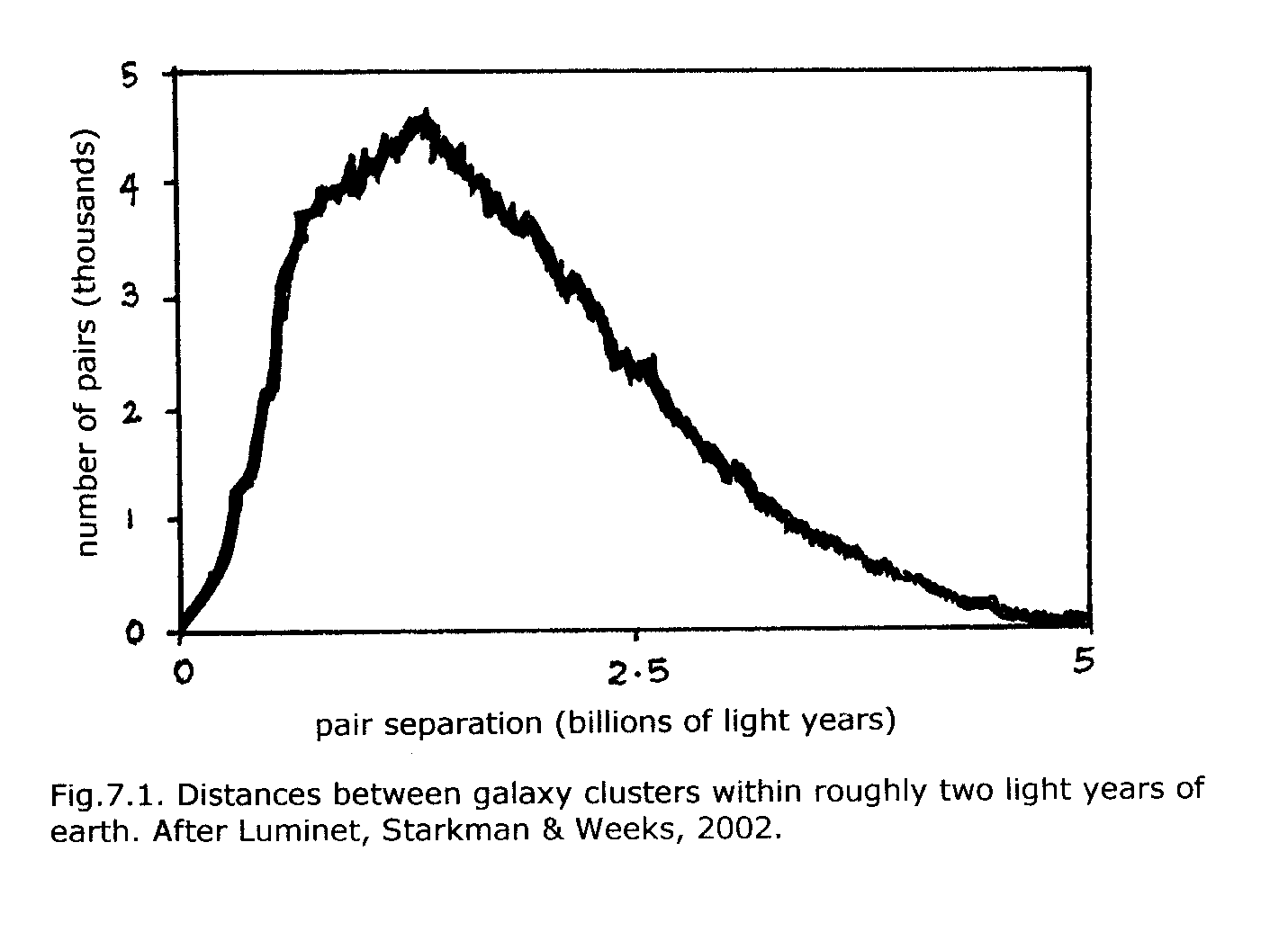
where Co is the Wien displacement constant for cavity radiation. For T = 10-28 K this leads us to expect: 1) In general, a curve which does not exhibit multiple peaks indicative of repetitive global topology; and 2) specifically, a black body spectrum of separation distances (half-wavelengths) with a peak at 1.45 x 1027cm, or a little over 1 billion light years.
xxviii.) This can be compared with the result of a study by Luminet, Starkman and Weeks [116] analysing the frequency distribution of pair separations between all galaxy clusters within a sphere about 4 billion light years in diameter in search of a pattern of peaks indicative of involuted spacetime topology. Their result, shown in Fig. 7.1, gives no indication of multiply-connected topology, and instead closely resembles a black body curve with a peak at a little over 1 billion light years (about 1.25 x 1027 cm). Given the approximations involved this match can be considered good. Luminet, Starkman and Weeks suggest that evidence of exotic structure may yet appear in studies of cluster separations in larger data samples extending to larger look-back times, because there is nothing to rule out multiply-connected global topology in GR. However such evidence in future high-redshift galaxy surveys would probably argue against a scale-free network model of this kind.
xxix.) Finally I refer to this important remark by Sylos Labini and Pietronero [117]: 'A crucial point to understand is therefore the origin of the scale-invariance in the gravitational clustering phenomenon. This would correspond to the understanding of the origin of self-gravitating fractal structures and of the properties of Self-Organized Criticality (SOC) from the knowledge of the microscopic physical processes at the basis of this phenomenon.' They advocate a new approach from the directions of statistical physics and complexity theory. But the contention of this essay is that they may be mistaken in seeking a basis for cosmic SOC in 'microscopic physical processes', in the sense that no physical processes in a radically scale-free fractal universe can properly be understood as microscopic. It is argued that only a radically scale-free fractal dynamic operating on processes at all scales will get rid of the problems inherent in scale-dependent effective field theory in a fully self-consistent way.