3. Epistemology & Ontology of Spin Measurement
i.) The starting point for these speculations was the evidence that electron 'intrinsic spin' cannot refer to a gyroscopic rotation. Indeed it can be shown that, considered as particles, even the electron 'orbital' momenta are not classically 3-rotational as a class, because s-states would be straight lines through the nucleus. QM at this point retreats from all mechanical models. But the interpretation in terms of extended nonlocal objects broached here appears, so far, to be justified to at least some degree by the intuitive order it is capable of bringing to otherwise perplexing quantities. However, for such objects to be taken seriously they would have to lead to some clear explanation of exactly why the process of 'correcting' the electron orbital angular momentum by means of adding spin vectors to explain the spectroscopic fine structure [42] 'works' numerically. Pragmatically, the meaning of the spin component of the total angular momentum is a doubling of each of the atomic energy eigenstates into pairs of spectroscopic absorption lines at closely-spaced frequencies. How is it that these levels can be labelled symbolically as contributions from the 'up' and 'down' spin vectors of differently orientated electrons, although in QM electrons have no orientation marks on their surfaces - and indeed, no surfaces? If the spectroscopic fine structure is indeed related to classical 'angular momentum' then the implication of QM is that electron spin will have to be allowed to reinterpret the meaning of angular momentum, rather than vice versa. Therefore 'intrinsic spin' ceases to look like a minor correction, and we are led to expect that angular momentum in general ought to be understood in terms of some transform of the binary linear elements we have surmised.
ii.) Visualisation seems to me to be quite important here. It is an obvious and trivial point, but when thinking about absorption spectra one needs to remember not to confuse the abstract statistics of a system of 'radiation and particles' with the imagined concrete structure of an atom. The frequencies of the spectral lines represent not a series of absolute atomic micro-states somehow 'photographed' by light waves, but rather they are cross-sections through a dynamical map, sections through a series of contours of gauge-equipotential difference which exist as scale-free relations between what we characterise as a system of emitters and a system of absorbers. (This can be intuitively pictured as something like the energy levels in the band theory of solids.) They are of course not static pictures of states but dynamical shadows of interactions, countless photon tracks comprising sheaves of null trajectories between spatially remote intersections which we call electrons at atoms A and B. One level is a state connecting A' and B', the next 'higher' level connects A" and B", and so on. Both A and B generally stand for some large ensemble of atomic intersections, and the series of absorption lines is a statistical summation of activity taking place across these several bundled strata of gauge-equipotential difference, generally without regard to distance. Historically, classically, and reductively, one sought to explain these equipotential contours by associating them causally to potentials in isolated Keplerian structures of orbiting atomic particles, and, although this mechanical model has long since failed, the old programme of causal reduction largely remains in place. Thus today the emission/absorption energy levels still 'live' on redefined local particle-states, connected by exchanges of confined wave-packets; although 'everyone knows' that the primitive ballistic connotations of this sort of exchange should not be taken seriously.
iii.) It is possible to locate an electron energy level on a coordinate point in some phase space of very high dimension where this 'point' object has the same dimensionless nonlocal function as a null Cartesian point; but this space is not 4-space. What we want for an ontology that makes intuitive contact with the sensory world of discrete-objects-at-discrete-places is to be able to show how to contract a series of contours of equipotential difference down to a set of points in 4-space by some projection that doesn't leave classical spacetime (this is not because of any affection for the classical manifold, but to preserve Lorentz-invariant relations between physically countable observers/observables). So we have to see pairs of spatially remote states in some imaginary null projection. The only physical projection we know that does send a dimensionless point to its linear dual in 4-space and vice versa in this way is the relativistic projection whose fulcrum is the speed of light, and by happy 'coincidence' this gives us the photon's-eye view of a transformation that maps an excitation of a point state 'in' an atom to a positive time interval between two remote point charges in atoms anywhere in the universe. But this projection also threatens to give us, as a neat mathematical package, the entire classical spacetime manifold. In this way we find ourselves torn between the space-holists and the particle-reductionists, which is a good moment to remind ourselves of the manifesto of our linear 'third way'.
iv.) In fact this projection maps our two-valued nonlocal objects not just from points to lines but from points to lines and from lines to sheets. Leaving spin aside for a moment, one dimension of the sheet expands on the null signal line of a photon tracing the equipotential contour, the other appears as a sideways displacement of that contour at the head of the relativistic worldlines of two electrons. So the displacement of the equipotential contour, proportionally to the real time interval associated to the null signal line by a given observer, traces a two-dimensional world sheet which preserves the action. From this sheet it is then possible, by a reverse projection, to recover the idea of a downward electric dipole transition between a pair of atomic energy levels and a corresponding upward transition between a pair of spatially remote atomic energy levels. Which is the primary map projection? The particles? Or the sheet? And does it matter? Phenomenologically, no; but ontologically, it does matter. If we take the particle projection as primary then we can represent the orbitals (after a fashion) but not the intrinsic spin. If we say the sheet is primary then we have to represent particle trajectories by matching the edges of curved spacetime sheets made out of some unbounded prior geometry that is ontologically troublesome. What after all is the meaning of a prior non-Euclidean geometry, given that spacetime geometry has to be, if it is not a relation of nothing, a relation of observables? It is quite as hard to understand an arelational geometry as primary as it is to understand the antithetical null element of such a geometry, the geometrical point, as primary. Geometrical points can't be rationally constructed into anything; unbounded geometrical space cannot be rationally deconstructed into anything. An ontology has to be built on measurable properties of observables, and rational measurable properties are inherently relational. Therefore, as argued in 2.viii above, the elements of our ontology must be: a) simple, yet not so simple as to be uncountable; b) constructable into, or deconstructable from, a geometry of finite relations; c) local-relational and nonlocal-elementary. Which leads to the conclusion that our choice of the complex 1-space element is, according to the porridge principle, just right.
v.) Now as we saw (paragraph 1.ii) the quantum spin state is a state which emerges in a participatory 'measurement' context involving the collective parameters of a system of 'particles'. In terms of the standard QM phenomenology this is simply mysterious - a 'given' of the wave function. This might be easier to understand if one could just say that spin is a phenomenon which appears in ensembles. Why, after all, should not new collective properties be emergent? And why should not an electron decide to acquire a spin according to spin 'instructions' derived from its neighbours? But this is not what QM says, as was pointed out earlier. It says that there is an increase in the space of quantum mechanical states for an electron, which doubles the number of energy eigenstates, even though the difference between the paired eigenvalues might be zero. It isn't zero, because the eigenvalue equation is said to be 'perturbed' by the presence of a magnetic field which lifts the degeneracy in the angular momentum quantum number to split the energy level into a group of orbital sublevels and spin sub-sublevels. But this perturbation does not alter the eigenfunctions. The quantum state space includes the spin eigenstates, in principle, whether there is perturbation or not. So spin is 'intrinsic spin' in this precise sense: that the single-electron wave function contains a spin state which is as 'actual' as any other quantum variable but is simply not well-defined. Definition is context-dependent, and the unmeasured spin state is poorly-defined; but not in the sense that it has one vague state, rather in the sense that it has a very large number of perfectly definite states each of a certain probability. We can express this by saying that the unmeasured electron spin state contains a huge quantity of statistical information. But the sense in which a point particle may be said to contain any quantity of information is unclear. It may be said that the information resides in the measurement field, but the wave function of this field itself has no clear physical interpretation in QM. As pointed out in 1.ii. the number of spin terms for any many-electron system multiplies the dimension of the state space at an alarming rate, and again it is not clear physically how this abstract dimensionality relates to the wave function of the measurement field.
vi.) One possible advantage of the ontology under consideration here is that it allows an indefinite number of probable spin states to live each in its own actual complex space. Consider a set of our nonlocal objects coordinate at an origin, where we wish to specify a state of spin. The situation is as mentioned in 2.vi, where it was pointed out that two binary objects like |Ax| or |Ay| are unable to share two common nodes, one at A and another at x or y, simultaneously without being the same object. This is our generalisation of Pauli exclusion to a dipole (which is also implicit in the locality condition), according to which they may however share one common node at A since their positional two-valuedness gives them a discernable nonidentity as different radius vectors terminating at different nodes x and y. Evidently the 'exclusion principle' is a special case of this dipole which has an opposite form as an inclusion principle, since we can give no reason a priori why an indefinite number of nonlocal objects should not share the node at A. Indeed our theory requires that the largest possible number of any set of N objects will always do so (remembering that the construction is that each end of every object is connected by one object to each end of all other objects). This number is (2N)1/2-1, which interestingly is an integer only for certain values of N and in this manner offers a simple model of context-dependency in atomic shell structure (see 3.ix.-xi. below). But in general for very large N we can see that because each of these objects has (according to our hypothesised general spin-correlation symmetry) at any imaginary 'instant' a reciprocal spin state specified somewhere else, then we have on the order of N1/2 potential answers to the question: 'What is the spin state at A?' from which a unique result has to arise in response to some particular measurement. We have here the idea of a measurement operating to reduce a superposition of states (see vii. below) which is causal, and intuitive, yet not classically deterministic. Crucially, it is not classically deterministic - i.e., it cannot be predicted from knowable Lorentz-invariant positions and momenta - for an intuitable reason. In other words, it is a 'hidden variable' theory of quantum spin states in general.
vii.) The crucial feature of this construction is that the nonlocal spin-correlation symmetry which in principle would have allowed us to predict a resultant of this superposition of spins at A is broken by the local electromagnetic gauge symmetry. Thus, in principle, each spin state is fully cosmically determinate, in the sense that the outcomes of all 'instantaneous' superpositions (in some unit time), each of N1/2 spin states, are cosmically self-consistent; but without applying a theoretical torque against the hidden photon superspin to recover this broken general symmetry there is no way to 'see' the correlations that are latent among apparently arbitrary measurements of 'ups' and 'downs'. Each of N1/2 outcomes is therefore found to be a probabilistic detail of a merely statistically-deterministic classical state for a system of N objects. (One important metaphysical point should be mentioned in passing here, though it is too large to go into: Of course locality constraints mean that this information is never available locally, even in principle, which negates both prediction and nonlocal signalling. So although the global state is determinate - i.e. causal - it is not classically deterministic - i.e. predictable. This is an important distinction. Only emergent mesoscale ensembles will have deterministic histories.)
viii.) It is fair to claim that the naturalness of our construction is here revealed in its aptness to the curious and seemingly arbitrary procedure for spin calculation in standard QM. In that procedure the probable spin of a particle is found as the complex linear superposition of some set of spin vectors in Hilbert space, which can be graphically represented as a set of radius vectors on the Riemann sphere. For simple spin-half electrons the projection gives a single radius vector as the resultant of a combination of 'up' and 'down', indicating a real orientation with respect to the local magnetic field. As Penrose [43] points out, this mimics classicality. But for massive compound fermions of higher spin N the spin state will be something like N different complex superpositions each of N orthogonal states, and the macroscopic spin does not emerge from a statistical averaging of random quantised spins at 'the classical level'; instead what happens is that a 'measurement' transition causes the spin state to jump to one of many values, thereby recovering a simple spin-half 'classicality' that had become lost in the higher-order quantum system! The spin that emerges is in general not like the resultant of all the radius vectors on the Riemann sphere; they only yield relative probabilities. The implication is that no matter how large a compound particle gets - even the size of a snooker ball, say - without this reduction of the quantum spin state vector its angular momentum will never go over into a classical state by cumulative averaging in the way that one might imagine by analogy with statistical gas laws.
ix.) This is a typically puzzling example of the measurement problem for quantum particles. But if we consider, instead of an ensemble of particles, a fairly large system of N nonlocal binary objects (in an imaginary 3-space for the purposes of visualisation; their 4-space projections become analogous to 4-vectors) then the number N of objects is related to the number N' of nodes like N = N'(N' - 1)/2, which is recognisably just thhe number of terms required to specify a two-electron wave function in a system of N possible position states. In general it is the number of unordered pairs of position states in the system, where a 'position state' is equivalently a network vertex, or node. For large N the number of nodes approaches N' = (2N)1/2, or just ÖN in the limit ¥, and the set of objects is characterised by (2N)1/2 vertices, each the origin of approximately N/(2N)1/2 radius vectors in polar coordinates, so that when N is normalised to unity in order to treat a system with a zero vector sum of linear momenta as a single object with a total angular momentum, this normalizing factor 1/Ö2 will enter in. But for small N each nodal 'position state' or vertex (like A in 3.vi. above) represents a potential measurement of electron spin, where the spin state will be some superposition of the (N' - 1) different spin states associated with the set of (N' - 1) radius vectors terminating there.
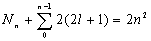
x.) Atoms may be approximately objectified in this way but their 'internal' structures show exactly why objectification is never truly context-independent. To recap some well-known background: The old mechanical ontology of shells and orbitals appears to allow a degree of objectification of different substructures, with the K shell filling, then the L shell, and so on, with each new electron assigned to an objective state within its shell independently of those to follow. The Pauli [44] exclusion principle controls this assembly process by giving the number of electrons of principal quantum number n according to
Schrodinger offered a new ontology that made Pauli's 'policing' of quantum states seem less unnatural, producing discrete 'orbital' angular momenta by mixing standing waves of different phase and amplitudes. In wave mechanics doubling the number of states to allow for spin means that the wave function may be symmetric in certain pairs of electrons, i.e. they may be interchanged without altering the function, which introduces questions about the exquisite distinction between identity and indiscernability and requires a many-particle treatment in which all particle states evolve simultaneously. This many-particle wave function has no location in 4-space and the unitarity of its evolution in phase space brings in the awkward issue of reduction. It is another successful phenomenological theory, but again one which seems to fail in its goal of representing atomic phenomena as objective.
xi.) The possibility of capturing useful features of these theories in a network ontology can be illustrated by reducing the structure problem to connections. Thus, in any very large ensemble of N nonlocal linear objects networked according to our simple rule (each end of every 'object' is connected by one object to each end of all other objects) the state found at any vertex O will be some superposition of the states associated with the set of [(2N)1/2-1] radius vectors or 'objects' having an origin at O. But attention has already been drawn (3.vi.) to the fact that this formula is only asymptotically accurate in the limit N ® ¥ and does not in general have natural integer solutions. So why is it interesting? Because the natural numbers which it does produce belong to the sequence of values of N beginning 2, 8, 18, 32, 50 . . . which we recognise as the number of electrons in completed K, L, M, N, O . . . atomic shells. Now what does this mean? What we have done is treated the problem as though for a single 'atom' whose electron occupancy approaches infinity. But the interesting thing is that if we enclose any small region of this network where N is small we can then count a finite number of nodes (points of local measurement where null photon lines terminate) and if we calculate the maximum internal connectivity of this set of nodes the above sequence of values corresponding to interesting electronic structure never emerges. As will be shown momentarily, solutions which have physicality are therefore inevitably dynamical solutions not statical solutions, because there is no 'atomic architecture' except as enacted in the interactivity of the class of structures called atoms. Thus these numbers are evidence that the gauge-equipotential epistemology of 3.ii. does reflect a primary ontology.
xii.) The sense in which the progression from 2 to 8, and from 8 to 18 and so on, 'builds' successive shells is clear: it is entirely a phenomenological ordering, not a physical order of priority. The ontological order of the physical structure expressed in these magic numbers is an interconnectivity that exists across all shells, so that the operation of the rule for the K shell occupancy has no meaning in a universe solely of K shells. This is because we are not asking that some units assemble themselves into a structure under instructions from their internal programming; neither are we expecting them to enact the instructions contained in some 'field' or invoking a Platonic law. Crudely speaking, the numerical structure is just an inevitable outcome of the way some collection of rods is obliged to stick together. This atomic holism might be called a weak, local, context-dependency. But it in turn must be assumed to operate under a stronger, global, context-dependency that arises from the global self-consistency condition of the network. This is implied by the hypothesis, and as intimated above there is also the rather curious and subtle argument that the local context-dependency operates as though it were global when it 'shouldn't'! The subtle question is: How is it that we are able to apply this formula, which is only an approximation for small N, and yet derive the correct electron distribution over the set of principal quantum numbers? The answer is that the formula is in a sense 'right' exactly one third of the time even for small N - or more pregnantly, networks of small N which have the right kind of 'flawed' structure enable us to use the formula as though it were right! (See 4.xiv.)
xiii.) In section 2.vi. the generalisation of the Pauli principle to a dipole was proposed, and this result is an example of that generalisation, which applies to all of the linear objects in the electron network of an atom, regardless of q-number labellings, and extends arbitrarily to all the molecular and macro-structural connections of the larger network in which a number of atoms is embedded. This effect appears conventionally as the symmetric wavefunction of a chemical valence bond in wave mechanics, and in general we can equate the exclusion dipole with the basis of molar chemistry; but always these results are to be taken in the limit of an underlying doublet superspin symmetry. The structure which emerges from the self-consistency condition of the doublets is essentially dynamical. The principal quantum numbers and their subdivisions into s, p and d orbitals etc. are surely not 'parking bays' attached to atoms into which electrons and photons may or may not drop according to various rules, and it is not the 'filled inner shell' of helium which forces the third electron of lithium to occupy a new shell. It is not possible to isolate these approximately-objectified structures from nature because the network condition which generates the rule for this atom of lithium here does so in the context of generating the rule for that atom of beryllium there and another of uranium somewhere else. It is the global network condition which matters, the global condition which determines that only certain possible integer solutions lead to dynamically stable properties of the network. This general implication is contained in quantum field theories, of course, but there the field is a plenum which inherits divergence problems from the infinite degrees of positional freedom of an infinite volume of spacetime when gravity is introduced. The renormalisation question has yet to be properly understood in any of the varieties of quantum field theory. [Note 1] Looking at this slightly differently, then, it would be useful if self-consistency conditions in a fundamental theory were to demand that universes containing infinite numbers of infinitesimally small objects are not viable universes. In terms of particles and continua such a rule would require that there ought always to be, at some scale however small, holes in the plenum, available empty position states for free particles to move into. Given this, one might ask: Why does the centrally-important Pauli principle represent the exact converse of such a dictat, an exclusion from position states which an infinite continuum would declare to be available? In terms of a cosmological assumption of isotropy and homogeneity the emergence of structure per se can be held to be an unnatural relation, and to maintain that a fundamental empirical principle which limits nature's ability to occupy certain potentials argues strongly for a smooth-field cosmology would seem perverse. But the Pauli principle emerges in a natural relation if the global state is not a state of free particles and empty continua, but rather is a one-dimensional plenum of linear objects, simultaneously joined to and separated from one another at infinitesimal discontinuities, whose essence is mutual exclusion and whose total degrees of spacetime freedom are self-limiting.
Note 1. Various intertwining offshoots of the renormalisation programme have emerged over the years, from source theory to axiomatic field theory, constructive field theory , S-matrix theory and 'Reggeization', asymptotical safety and effective field theory. No solution is fully consistent or fully consensual. See Cao and Schweber [45].
xiv.) Consider Table 3.1. in which some properties of small-N networks are set out. There are two types of network. There is one set of 'closed' networks associated with the integer series of node numbers in column one, for objects obeying the basic network condition that all ends are connected to all others under the super-rule of dipole exclusion. (Hence the absence of 'impossible' configurations such as four antinodes, for example, which automatically goes over to an interconnectivity of six.) And less obviously there is another set of 'open' networks associated instead with an integer series of vertex numbers in column five. The vertex numbers and node numbers are 'obviously' the same, since every vertex is situated at a node - but they are not necessarily the same nodes. Notice that the 'open' networks come in as integer
node no. (N') |
antinode no. (N= N'(N'-1)/2) |
network state |
vectors per vertex (Ö(2N)-1) |
no. vertices (Ö(2N)) |
1 |
0 |
- |
- |
- |
2 |
1 |
closed |
0.414 |
1.414 |
2 |
open |
1 |
2 |
|
3 |
3 |
closed |
1.449 |
2.449 |
- |
4 |
- |
- |
- |
- |
5 |
- |
- |
- |
4 |
6 |
closed |
2.464 |
3.464 |
- |
7 |
- |
- |
|
8 |
open |
3 |
4 |
|
- |
9 |
- |
- |
- |
5 |
10 |
closed |
3.472 |
4.472 |
- |
11 |
- |
- |
- |
- |
12 |
- |
- |
- |
- |
13 |
- |
- |
- |
- |
14 |
- |
- |
- |
6 |
15 |
closed |
4.477 |
5.477 |
- |
16 |
- |
- |
- |
- |
17 |
- |
- |
- |
18 |
open |
5 |
6 |
|
- |
19 |
- |
- |
- |
- |
20 |
- |
- |
- |
7 |
21 |
closed |
5.481 |
6.481 |
- |
22 |
- |
- |
- |
- |
23 |
- |
- |
- |
- |
24 |
- |
- |
- |
- |
25 |
- |
- |
- |
- |
26 |
- |
- |
- |
- |
27 |
- |
- |
- |
8 |
28 |
closed |
6.483 |
7.483 |
- |
29 |
- |
- |
- |
- |
30 |
- |
- |
- |
- |
31 |
- |
- |
- |
32 |
open |
7 |
8 |
|
- |
33 |
- |
- |
- |
- |
34 |
- |
- |
- |
- |
35 |
- |
- |
- |
9 |
36 |
closed |
7.485 |
8.485 |
- |
37 |
- |
- |
- |
- |
38 |
- |
- |
- |
- |
39 |
- |
- |
- |
- |
40 |
- |
- |
- |
- |
41 |
- |
- |
- |
- |
42 |
- |
- |
- |
- |
43 |
- |
- |
- |
- |
44 |
- |
- |
- |
10 |
45 |
closed |
8.487 |
9.487 |
- |
46 |
- |
- |
- |
- |
47 |
- |
- |
- |
- |
48 |
- |
- |
- |
- |
49 |
- |
- |
- |
50 |
open |
9 |
10 |
solutions of (2N)1/2; but they do not arise as solutions of N = N' (N'-1)/2, hence they do not correspond to any whole number N' of nodes in the left hand column. Conversely, values of N corresponding to the natural numbers of nodes in column one do not give integer solutions of the formula (2N)1/2, and so appear as fractional numbers of vertices in column five. Obviously this just means that an 'open' configuration is not strictly a valid network in terms of our definitions, and simple consistency would suggest that they be ignored. But one hesitates to conclude that a mere adjustment of semantic categories is good enough, because the configurations which are thus got rid of are those that correspond to atomic electron structure. The fruitful question then seems to be: 'Why would such a semantic ambiguity be reflected in nature?' To see why let's take a closer look at the Table.
xv.) It is immediately obvious from column five that the only antinode numbers for which (2N)1/2 gives sensible solutions are the familiar electron shell occupancy numbers, and that each of these integer solutions is bracketed by a pair of non-integer solutions. It is noteworthy that these brackets appear to be widening as N' increases, and indeed they are - as measured by the span of antinode numbers that they contain (increasing by 2 with each triplet). But in terms of their deviation from the bracketed value of the integer, they are narrowing, both as a proportion of its value and absolutely, and this trend extrapolated is consistent with the (unproven) expectation that the deviation would vanish asymptotically in the limit of infinite N. In other words if we see this pattern as the working out of a global self-consistency condition then as we come down to smaller and smaller N (physically equivalent to finer metric scale) the scatter of solutions widens around a mean which itself becomes an integer solution of (2N)1/2 descriptive of electronic shell structure. And when we look at the solutions it becomes noteworthy that - despite an intuitive expectation one might hold that the stability of an atomic architecture of 'filled' shells would be reflected in 'filled' (i.e., closed) networks - these 'useful' integers label networks that are uniformly unable to close on themselves because their antinode numbers do not complete the connectivity of any whole number of nodes; but these are always intermediate between networks that are able to close on themselves, these latter paying the 'price' of having unnatural solutions of (2N)1/2. An 'open' network of N = 2, 8, 18, 32 or 50 antinodes therefore always 'wants' to be completed, and this gives it the especially interesting property that it can only exist embedded in a numerically larger network, which demonstrates a natural tension between autonomy and context-dependency in atomic structure (an interesting metaphor for this in the light of the present model might be the concept of tensegrity; see Part 6) and it produces the inevitability of chemical valency as a requirement of a symmetry.
xvi.) Nature seems to conspire to agree with these 'wrong' numbers which we get only by abstracting small subsets from the network as though they were autonomous. It is pointed out that this is the operation which nature itself performs, presenting us with atomic subsystems which mimic objectification by spatial separation whilst remaining in all cases (ex hypothesi) groups of 'ends' of sheafs of nonlocal objects, such that each group of 'ends' is reciprocal to groups of 'ends' elsewhere. Table 3.1. shows why they have to be thus reciprocal and why, paradoxically, a globally stable symmetry is only achievable through a local dynamical symmetry of open, context-dependent systems. It is precisely this 'openness' of atoms to one another which embodies their relativistic 'rigidity'. It is further suggested that the connectivity within and between these groups of doublets could be investigated as the basis of the space dimension of the network, which will obviously not be a global prescription (although it will tend towards - but not reach owing to the self-consistency condition - an infinite-dimensional limit) but will instead be an evolving function of dynamical relationships and be differently specified from observer to observer. Dimension should be context-dependent. In particular one can speculate that the unexpected ambiguity in the characteristic node/antinode numbers of these small networks invites measurement in terms of a fractal dimension. For example, the 18-segment open network of the M electron shell 'lives' on more than 6 but less than 7 nodes; the 32-segment N shell network lives on more than 8 but on less than 9. [Note 2]
Note 2. Network dimensionality is scale-free and quantised, not scale-specific and continuous , so the n dimensions become assigned to n discrete string segments. Particle characteristics in general will be emergent in these collective states, not as properties of individual string segments but "holographically" as distributed properties . With reference to superstring theory, a curling-up or compactification that "contains " n polarisation directions can be located as a collective property emergent in this group of discrete 1-spaces. A combinatorial multi-dimensional polarisation -space assembled (theoretically) from such units might encounter certain dimensional phase transitions associated with certain numbers (e.g., 3, 4, 10 and 24). We can see that as real angles emerge in the assemblage of these 1-spaces this can be understood as analogous to a quantisation of curvature. But instead of a transformation applied to a notional flat space of low-order global dimension containing an infinite number of point elements, this "curvature" is radical, and directly generates forms of high-order dimension (high-order spin) - pseudo-objects, crudely isolable as zero vector sums of momenta and in that way coordinatised generally as low-order fractals. Only in the (unrealised) theory limit of an infinite number of string segments does the form of the network approach a smooth curve, and not of a low -order dimension (not being isolable by any real observer as a zero-vector-sum-of -momenta object) but of infinite dimension. So in this case we are supposing, the actual (complex) net dimension will always be much larger than any number of measurable (real) string modes, never smaller, and the critical dimensionality will not now be a generalised space region or scale but rather a numerical constant of some finite series of actual operations, instead of being an imaginary matrix of coordinates for an infinite number of theoretical operations. (See also Parts 6 & 7.
xvii.) Prescribing a common numerical size for a sheaf of connections would be to give a value of a 'characteristic atomicity' of the local observables of the network. Evidently the network does have such a characteristic, a fairly complicated one, expressed completely in the series of all the atomic numbers of the periodic table but of the orders 10-102, no more. Why is its value small? Or from the opposite point of view why is it so large? More fundamentally, why does such a characteristic exist at all? It is certain that physics would be less interesting in a universe with a characteristic atomicity comparable to its particle number! If we express the interestingness that we see in terms of particles tracking the 1/r dependency of an electric force dipole, gravity, etc., have we captured the essence of it? Perhaps not, because we can think of several ways in which this ontology finishes up in phenomenology, or is otherwise not yet satisfactory. So we have to consider that the reason why there is a small but non-zero characteristic atomicity might at a more fundamental level be because this is the way that a maximally-interconnected system of large N accommodates itself through self-interaction to the need for equipartite stable forms. An ideal equipartite distribution of network origins or foci is tended towards at infinity for the condition (2N)1/2, but for any randomly chosen large real number there will be no ideal equipartite distribution of (2N)1/2. It is therefore highly improbable a priori that the universe we inhabit would be able to achieve a statical global symmetry, suggesting that it may be a natural condition of the network to self-organise such that a dynamical stability can be attained in the relations among a large number of states, each an approximation to an ideal equipartite solution, leading to the situation of Table 3.1. The strategy would be to trade scalar uniformity for vectorial diversity. In the language of the present model this would become a breaking of perfectly-correlated superspin symmetry, which entails a lifted degeneracy in a spin-one photon symmetry generating distance scale in the constraints of Lorentzian spin-half local measurement.
xviii.) In summary, if a dynamical solution could not emerge there could be no physical subsystems, because paradoxically there could be no stability. There could in fact be no quantum theory. An homogenous condition in which it was only possible to abstractly identify 'atoms' as regions with average non-integral numbers of components (like a demography in which families really had 2.4 children) would be a pure process in a physics of classical continua. In the sense of this distinction the integral quantum numbers in column four of Table 3.1. are the means of pairs of bracketed classical continuum values which represent the working out of the Bohr correspondence principle according to which quantum states represent the average values of the classical variable for systems of large quantum number. But in a network model these non-integer deviations do not imply that there is an average value of an actual homogeneous quantity like a metric manifold. Instead of asymptotically definite values arising classically from averaging infinitesimally over stochastic backgrounds, we have here (in miniature, as it were) an ontological realisation of the operational quantum order which implies that perfectly definite values generate classical stochastic foregrounds. Approximations to homogeneity emerge in special cases. Such a physics is the expression of a fractal order, which has far-reaching implications because the simple conditions of that order in our model are entirely scale-free - meaning that cosmological models might be possible which contain fractal matter distributions inconsistent with smooth-field expectations (see Parts 6 & 7). Extending the weak context-dependency inversion of the ontological order from the networks of small N to networks of large N leads to an irreducible ambiguity in the interpretation of the correspondence principle, because it cannot be claimed that one or the other point of view is ontologically primary. In other words, normalisation of (2N)1/2 across numerical scale becomes indirectly the origin of physical scale, and the reason that this is possible - the reason why the universal system of very large N is not just one uniform blob of particles of indefinite extent - is the existence of the generalised Pauli dipole embodied in the locality condition, not of particles, but of doublets, acting across all possible distances of the would-be blob to generate a pluralistic spacetime order in which observers are able to appear. In terms of the conceptual toy under development here, this seems to be the proper, and richer, answer to the old question, 'What is the principle underlying the existence of atomic structure?'
xix.) Other implications of these ideas are touched on in Part 6. Returning to the epistemology and ontology of measurement in such a system, the important distinctive feature here, introduced by a our nonlocal extended-object construction, is that in a universe of N fermionic 'particles' any one state of fermion spin will be found as a measurement on a superposition of [(2N)1/2-1] spin states because the natural quantum process, of which 'measurement' is a psychologically connoted example, physically is some particular local outcome of the superposition of these states. At this point in order to see in more detail what is happening we have to understand spin as something more than just 'state', and this will mean first elaborating the sketch of our proposed nonlocal object-like network. As repeatedly emphasised, this is offered only as an heuristic toy so I must ask the reader's indulgence.