PANCHAKOSAM
'Kosa' means a covering or sheath. Panchakosam means the
Five Sheaths.
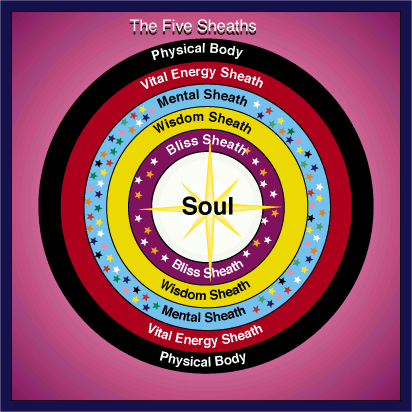
The cocoon of the silkworm covers the silkworm totally. The scabbard of the sword covers the sword. It is of the same shape as the sword. It indicates the presence of the sword, even though it covers the sword from one's sight. The scabbard is always different from the sword and does not affect the sword in any way. Similarly the Soul or the Self is covered by the 5 sheaths, as shown in the picture above.
What are the 5 Sheaths ?
Annamaya Kosam
'Annam' means food and 'maya' means modifications. The body is the result of modification of food and hence called 'Annamaya'. The food eaten is digested. Its very essence becomes the sperm in man and the ovum in woman. They combine to form the seed, from which the foetus is formed. It is nourished in the womb by the food eaten by the mother. At birth, the child emerges from the womb and is nourished by the mother's milk. It grows up and develops in strength and size due to the food eaten. We consume mountains of food in our lifetime. Finally, we die to merge into food (Earth). The earth itself becomes the food we eat. So, we are born from food (earth) and go back to food (earth). Food is that which is eaten by beings and which eats beings.
We eat food and food in turn eats us. Many die by overeating. Many die by undereating. Also the body gets eaten by many viruses and bacteria, even while we are alive; and by worms and other beings when we die.Identifying with the Annamaya Kosa, I say-"I am tall, fair,vaisya, healthy, beautiful, strong etc."
Annamaya Kosam is our Gross Body (Sthula Sariram)
Pranamaya Kosam
The Vital Air Sheath pervades the Food Sheath. It is subtler than the food sheath.The 5 modifications of air, which control the main physiological functions of the body are called 'Pranas'. They are:
a) Prana- Breathing is governed by the Prana. When the inhalation and exhalation are slow, deep, rhythmic and even, then the breathing is proper and good. The slower, deeper, more rhythmic and even the exhalation, the better the breathing.
b) Apana- The evacuation and elimination of all wastes from the body is taken care of by 'Apana'. Otherwise, the toxic chemicals and waste would gather in the body.
c) Vyana- The circulation of blood and nourishment to every cell of the body is the work of 'Vyana'.
d) Udana- All reactions and reverse processes are done by 'Udana'. Eg. Vomiting, Sneezing, shedding tears etc. It is responsible for the mind rejecting one thought and taking another. It supplies the necessary power to the subtle body to leave the gross body at death.
e) Samana- The food eaten is digested and assimilated by 'Samana'.
The 5 Pranas are vital to life. They function silently from birth to death, even while we sleep. If even one of them were to stop completely, we would die. They connect the subtle body to the gross body and energise both. When they function efficiently, the body remains healthy, the sense organs are keen, the organs of action strong and the mind alert. When they malfunction, the body becomes ill, imbalanced, weak, dull and diseased. Hence, the emphasis of Pranayama in the Yoga Sastras. Normally, they function naturally. Fortunately, one does not have to learn how to breathe or digest and keep doing them consciously.
The 5 Pranas and the 5 sense organs of action together are called the 'Pranamaya Kosam'. Identified with it, a man says-" I am hungry, thirsty etc."
Manomaya Kosam
The Mind and the 5 sense organs of perception together form the mental sheath.
The mind is the seat of emotions like anger, love, jealousy, compassion etc. It is constituted of thoughts in a state of volition. It is the mind that perceives the objects of the world through the senses. If the mind does not back the sense organs, they cannot receive any stimuli. My eyes may be open; but I miss to see the object in front of me if my mind is elsewhere. It is only through the mind that the organs of action also respond to the world.
Identified with the mental sheath, I say "I am happy, I am sad, I cannot hear etc.". The Self is neither happy nor unhappy. It is always of the nature of pure bliss.
Vijnanamaya Kosam
The intellect and the 5 sense organs of perception together is the Intellectual Sheath. It is subtler than and pervades the former 3 sheaths. It controls them as well. The 5 senses are common to both the mental and intellectual sheaths, as perception involves both the mind and the intellect.
Thoughts in a framework of decision-making is the intellect. Ignorance of the Self manifests first as the decision of the intellect as " I am the doer, I am finite etc.". This then gives rise to the notions -"I am tall, I am hungry, I am happy etc.".
Knowledge of the Self also takes place in the intellect as "I am infinite, I am pure happiness etc.". The intellect is the seat of the values of life. What we value, we try to emulate, run after or cherish. The intellect discriminates between right and wrong, real and unreal, good and bad etc. To innovate, create, discover, visualise, imagine, observe, conclude, inquire, question, recognize, assimilate etc. are intellectual abilities. The mind carries the sense perception to the intellect. Based on previous experience, it recognizes, understands and decides on the course of action. It conveys the same, through the mind, to the organs of action and the body to act accordingly. Hence, the intellect is called the 'Driver' of this vehicle of the body.
The Pranamaya Kosam, Manomaya Kosam and the Vijnanamaya Kosam together form our Subtle Body (Sukshma Sariram).
Anandamaya Kosam
The subtlest and the most pervasive of the 5 sheaths is the Bliss Sheath. It is otherwise called the Causal Body (Karana sariram). It is of the nature of ignorance of the world and the Self, yet endowed with the bliss of the Self.
When night falls, the world is covered by darkness. All objects and their distinctive characteristics merge into it.The objects are not destroyed. Only they are not perceived. As the day dawns, the distinctions manifest. Similarly, in deep sleep when only the causal body is at play, all dualities, the ego, anxiety, agitation, the world, the subtle and gross bodies etc. merge into total ignorance.Due to ignorance, it is said to be of impure nature.Even in the waking state, the mind which is pure and calm (satvic) experiences a greater joy than one which is agitated (rajasic) or dull (tamasic).It should be noted that all experienced joys are reflections of the bliss of the Self alone. In the deep sleep state, there are no degrees in this bliss. But, in the waking and dream states, we experience various qualities and intensities of joy. There is the satvic joy of watching a sunrise, the rajasic joy of watching or reading a thriller and the tamasic joy of hurting another.
The 5 sheaths form the covering, which conceals the jewel of the Self in its folds. They are modifications of the elements, born to die and are known to be different from 'I'-the pure Self. The self is beyond all modifications, unborn, immortal and the witness of all.We are thus different from the 5 sheaths.
Beyond the 5 Sheaths
The 5 sheaths are known by the Self as 'my body','my prana', 'my mind', 'my intellect', 'my bliss' and are, therefore, not the Self. The fact that 'I am not the 5 sheaths' is simple. But the most simple facts are the most difficult to grasp and accept. Our mind is so complicated and the habits of the past so strong that one does not see the Truth. Even if the Truth is appreciated, it is not accepted. Even if it is accepted, it is not owned up to. Therefore, through continuous discrimination and firm resolve, one must uncover the Self and get liberated from the shackles of the 5 sheaths.
Nature of the Self
This can be indicated in two ways:
1. 'Tatastha Lakshana': Indicated with respect to the world and its conditioning as the cause of the world, the witness of the thoughts etc.
2. 'Svaroopa Lakshana': Indicated directly as infinite, eternal etc.
Here, the Self is indicated by the 'Svaroopa Lakshana' as "Sat-Chit-Ananda" or "Existence-Consciousness-Bliss". Each is now explained:
Sat (Existence)
That which remains unchanged in the 3 periods of time (past, present and future) is Existence. The past and the future are named only with respect to the present. The Self is 'present' in all the three periods of time. It means that it was always there and will ever be. Self is, therefore, birthless(ajanma), deathless(amara), beginingless(anadi) and endless(ananta).
Chit (Consciousness)
It is of the nature of absolute knowledge. Knowledge of the world is gained as thoughts. Without me the thoughts cannot be known. 'I' illumine all my thoughts, remaining different from them. I not only illumine my thoughts, but also their absence. Thoughts come and go, but I remain unchanging and shining. Then who illumines the Self ? None can illumine the Self. It being the subject, it can never be known as an object of knowledge. Also, there is no need to illumine it, as it is self-shining. The sun does not need a torch light to illumine it. This self-shining, ever-shining knowledge principle is called 'Chit' or Consciousness, which is my own true nature.
Ananda (Bliss)
It is of the nature of absolute happiness. A thing is dear to me only when it gives me joy. I love my house, as it is a place that gives me comfort and joy. I love myself the most. I love others for my sake. But, I love myself unconditionally, totally and eternally. So I must be the source of absolute happiness. The Self is beyond time, space and objects. It is infinite and hence of the nature of the absolute happiness. The desires in my mind for objects veil this happiness. In moments when I am peaceful, I do experience joy within myself.
Thus, the Self is of the nature of Existence-Consciousness-Bliss. A rose is fragrant to smell, red in colour and soft to feel. The smell, colour and touch are 3 aspects of the same rose. Similarly, Existence-Consciousness-Bliss are aspects of the one Self. A quality always belongs to a substance and the substance always has a name and form. The Self is beyond all names, forms and qualities. The Self is partless. So Existence is Consciousness and Existence-Consciousness is Bliss. The Self is infinite and there can be no two infinites. Therefore also they are one. Then why 3 names ? They are 3 indicators of the nature of the Self and hence enumerated differently.
One should know one's infinite nature, for getting liberated from all sorrows for all time to come. How can one know it ? The Self should be known by listening, reflecting and meditating on it. One may have heard about it, reflected upon it and even attempted meditation; yet one may not realize the Self. It may still be only at an intellectual level. This is because the initial preparation of the mind is not sufficient. By Karma Yoga, Bhakti Yoga etc., the mind should be made pure, subtle and single-pointed. Knowledge gets firmly rooted in such a mind and the Self is directly experienced (Aparokshanubhuti).
The cocoon of the silkworm covers the silkworm totally. The scabbard of the sword covers the sword. It is of the same shape as the sword. It indicates the presence of the sword, even though it covers the sword from one's sight. The scabbard is always different from the sword and does not affect the sword in any way. Similarly the Soul or the Self is covered by the 5 sheaths, as shown in the picture above.
What are the 5 Sheaths ?
- Annamaya Kosam (Food Sheath)
- Pranamaya Kosam (Vital-Air Sheath)
- Manomaya Kosam (Mental Sheath)
- Vijnanamaya Kosam (Intellectual Sheath)
- Anandamaya Kosam (Bliss Sheath)
Annamaya Kosam
'Annam' means food and 'maya' means modifications. The body is the result of modification of food and hence called 'Annamaya'. The food eaten is digested. Its very essence becomes the sperm in man and the ovum in woman. They combine to form the seed, from which the foetus is formed. It is nourished in the womb by the food eaten by the mother. At birth, the child emerges from the womb and is nourished by the mother's milk. It grows up and develops in strength and size due to the food eaten. We consume mountains of food in our lifetime. Finally, we die to merge into food (Earth). The earth itself becomes the food we eat. So, we are born from food (earth) and go back to food (earth). Food is that which is eaten by beings and which eats beings.
We eat food and food in turn eats us. Many die by overeating. Many die by undereating. Also the body gets eaten by many viruses and bacteria, even while we are alive; and by worms and other beings when we die.Identifying with the Annamaya Kosa, I say-"I am tall, fair,vaisya, healthy, beautiful, strong etc."
Annamaya Kosam is our Gross Body (Sthula Sariram)
Pranamaya Kosam
The Vital Air Sheath pervades the Food Sheath. It is subtler than the food sheath.The 5 modifications of air, which control the main physiological functions of the body are called 'Pranas'. They are:
a) Prana- Breathing is governed by the Prana. When the inhalation and exhalation are slow, deep, rhythmic and even, then the breathing is proper and good. The slower, deeper, more rhythmic and even the exhalation, the better the breathing.
b) Apana- The evacuation and elimination of all wastes from the body is taken care of by 'Apana'. Otherwise, the toxic chemicals and waste would gather in the body.
c) Vyana- The circulation of blood and nourishment to every cell of the body is the work of 'Vyana'.
d) Udana- All reactions and reverse processes are done by 'Udana'. Eg. Vomiting, Sneezing, shedding tears etc. It is responsible for the mind rejecting one thought and taking another. It supplies the necessary power to the subtle body to leave the gross body at death.
e) Samana- The food eaten is digested and assimilated by 'Samana'.
The 5 Pranas are vital to life. They function silently from birth to death, even while we sleep. If even one of them were to stop completely, we would die. They connect the subtle body to the gross body and energise both. When they function efficiently, the body remains healthy, the sense organs are keen, the organs of action strong and the mind alert. When they malfunction, the body becomes ill, imbalanced, weak, dull and diseased. Hence, the emphasis of Pranayama in the Yoga Sastras. Normally, they function naturally. Fortunately, one does not have to learn how to breathe or digest and keep doing them consciously.
The 5 Pranas and the 5 sense organs of action together are called the 'Pranamaya Kosam'. Identified with it, a man says-" I am hungry, thirsty etc."
Manomaya Kosam
The Mind and the 5 sense organs of perception together form the mental sheath.
The mind is the seat of emotions like anger, love, jealousy, compassion etc. It is constituted of thoughts in a state of volition. It is the mind that perceives the objects of the world through the senses. If the mind does not back the sense organs, they cannot receive any stimuli. My eyes may be open; but I miss to see the object in front of me if my mind is elsewhere. It is only through the mind that the organs of action also respond to the world.
Identified with the mental sheath, I say "I am happy, I am sad, I cannot hear etc.". The Self is neither happy nor unhappy. It is always of the nature of pure bliss.
Vijnanamaya Kosam
The intellect and the 5 sense organs of perception together is the Intellectual Sheath. It is subtler than and pervades the former 3 sheaths. It controls them as well. The 5 senses are common to both the mental and intellectual sheaths, as perception involves both the mind and the intellect.
Thoughts in a framework of decision-making is the intellect. Ignorance of the Self manifests first as the decision of the intellect as " I am the doer, I am finite etc.". This then gives rise to the notions -"I am tall, I am hungry, I am happy etc.".
Knowledge of the Self also takes place in the intellect as "I am infinite, I am pure happiness etc.". The intellect is the seat of the values of life. What we value, we try to emulate, run after or cherish. The intellect discriminates between right and wrong, real and unreal, good and bad etc. To innovate, create, discover, visualise, imagine, observe, conclude, inquire, question, recognize, assimilate etc. are intellectual abilities. The mind carries the sense perception to the intellect. Based on previous experience, it recognizes, understands and decides on the course of action. It conveys the same, through the mind, to the organs of action and the body to act accordingly. Hence, the intellect is called the 'Driver' of this vehicle of the body.
The Pranamaya Kosam, Manomaya Kosam and the Vijnanamaya Kosam together form our Subtle Body (Sukshma Sariram).
Anandamaya Kosam
The subtlest and the most pervasive of the 5 sheaths is the Bliss Sheath. It is otherwise called the Causal Body (Karana sariram). It is of the nature of ignorance of the world and the Self, yet endowed with the bliss of the Self.
When night falls, the world is covered by darkness. All objects and their distinctive characteristics merge into it.The objects are not destroyed. Only they are not perceived. As the day dawns, the distinctions manifest. Similarly, in deep sleep when only the causal body is at play, all dualities, the ego, anxiety, agitation, the world, the subtle and gross bodies etc. merge into total ignorance.Due to ignorance, it is said to be of impure nature.Even in the waking state, the mind which is pure and calm (satvic) experiences a greater joy than one which is agitated (rajasic) or dull (tamasic).It should be noted that all experienced joys are reflections of the bliss of the Self alone. In the deep sleep state, there are no degrees in this bliss. But, in the waking and dream states, we experience various qualities and intensities of joy. There is the satvic joy of watching a sunrise, the rajasic joy of watching or reading a thriller and the tamasic joy of hurting another.
The 5 sheaths form the covering, which conceals the jewel of the Self in its folds. They are modifications of the elements, born to die and are known to be different from 'I'-the pure Self. The self is beyond all modifications, unborn, immortal and the witness of all.We are thus different from the 5 sheaths.
Beyond the 5 Sheaths
The 5 sheaths are known by the Self as 'my body','my prana', 'my mind', 'my intellect', 'my bliss' and are, therefore, not the Self. The fact that 'I am not the 5 sheaths' is simple. But the most simple facts are the most difficult to grasp and accept. Our mind is so complicated and the habits of the past so strong that one does not see the Truth. Even if the Truth is appreciated, it is not accepted. Even if it is accepted, it is not owned up to. Therefore, through continuous discrimination and firm resolve, one must uncover the Self and get liberated from the shackles of the 5 sheaths.
Nature of the Self
This can be indicated in two ways:
1. 'Tatastha Lakshana': Indicated with respect to the world and its conditioning as the cause of the world, the witness of the thoughts etc.
2. 'Svaroopa Lakshana': Indicated directly as infinite, eternal etc.
Here, the Self is indicated by the 'Svaroopa Lakshana' as "Sat-Chit-Ananda" or "Existence-Consciousness-Bliss". Each is now explained:
Sat (Existence)
That which remains unchanged in the 3 periods of time (past, present and future) is Existence. The past and the future are named only with respect to the present. The Self is 'present' in all the three periods of time. It means that it was always there and will ever be. Self is, therefore, birthless(ajanma), deathless(amara), beginingless(anadi) and endless(ananta).
Chit (Consciousness)
It is of the nature of absolute knowledge. Knowledge of the world is gained as thoughts. Without me the thoughts cannot be known. 'I' illumine all my thoughts, remaining different from them. I not only illumine my thoughts, but also their absence. Thoughts come and go, but I remain unchanging and shining. Then who illumines the Self ? None can illumine the Self. It being the subject, it can never be known as an object of knowledge. Also, there is no need to illumine it, as it is self-shining. The sun does not need a torch light to illumine it. This self-shining, ever-shining knowledge principle is called 'Chit' or Consciousness, which is my own true nature.
Ananda (Bliss)
It is of the nature of absolute happiness. A thing is dear to me only when it gives me joy. I love my house, as it is a place that gives me comfort and joy. I love myself the most. I love others for my sake. But, I love myself unconditionally, totally and eternally. So I must be the source of absolute happiness. The Self is beyond time, space and objects. It is infinite and hence of the nature of the absolute happiness. The desires in my mind for objects veil this happiness. In moments when I am peaceful, I do experience joy within myself.
Thus, the Self is of the nature of Existence-Consciousness-Bliss. A rose is fragrant to smell, red in colour and soft to feel. The smell, colour and touch are 3 aspects of the same rose. Similarly, Existence-Consciousness-Bliss are aspects of the one Self. A quality always belongs to a substance and the substance always has a name and form. The Self is beyond all names, forms and qualities. The Self is partless. So Existence is Consciousness and Existence-Consciousness is Bliss. The Self is infinite and there can be no two infinites. Therefore also they are one. Then why 3 names ? They are 3 indicators of the nature of the Self and hence enumerated differently.
One should know one's infinite nature, for getting liberated from all sorrows for all time to come. How can one know it ? The Self should be known by listening, reflecting and meditating on it. One may have heard about it, reflected upon it and even attempted meditation; yet one may not realize the Self. It may still be only at an intellectual level. This is because the initial preparation of the mind is not sufficient. By Karma Yoga, Bhakti Yoga etc., the mind should be made pure, subtle and single-pointed. Knowledge gets firmly rooted in such a mind and the Self is directly experienced (Aparokshanubhuti).

