The "Churning of Knowledge" is elaborately
described in the Kaivalya upanishad. In the ancient days, for the purpose of the
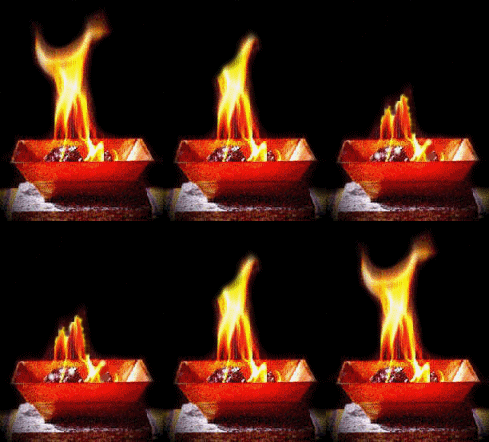
rituals, fire was produced by churning a wooden rod on two wooden pieces
hollowed out (sockets) for the ends of the rod to rest. When the rod is churned
in these sockets (Aranis), pressed down firmly, the fire is created due to
friction and heat. Adi Sankara uses this beautiful metaphor in his Aatma Bodha.
The lower ego and the higher Self are pressed to the Mahaamantra "Aham
Brahmaasmi" (I am the Supreme Self) . When through reflection it is churned
properly, the "fire of knowledge" is generated. Meditation fans it into a
conflagration. Finally all our 'ignorance" and misconceptions are burnt down in
that fire of knowledge. You become a realised person.
The 'Mahaa Vaakyas' are no mere aphorisms. They are the
golden keys which open the gateways to a richer experience, which is beyond
words and equally beyond the comprehension by our intellect. By a process of
negation of the false and the assertion of the positive Truth, one reaches the
holy land of the full and pregnant spiritual experience: 'I am Brahman' (Aham
Brahmaasmi).
Kaivalya Upanishad is the explanation
of the 'Kaivalya' – the result of liberation. We have all heard of liberation,
but what is the result of liberation? All Upanishads teach us that through jnana
we gain liberation. This Upanishad teaches us what comes after liberation. That
is why this Upanishad should be read after learning some major Upanishads.
Kaivalya is a very orderly and nicely presented Upanishad.
The word ‘kaivalya’ comes from kevala. After liberation
there is only one status for us. Before liberation we were tied up with so many
things in order to have liberation. After liberation there is only ‘kevala’.
That kevala status is known as Kaivalya – the result of the entire struggle, the
fruits of liberation.
Our ignorance projects
our ego-centric existence and its world of diversity. In this confused state, we
spin and weave in us for ourselves a cobweb of our own creation. Thereafter we
get ourselves identified with our body, mind and intellect. We are caught thus
entirely in a net of our own creation, hatched from our own ignorance.
A
liberated person (Jeevan-mukta) is one who has realised the infinitude of his
existence, as the Self-realisation has become completely free from ignorance
(Avidya). He continues to live in his body as long as its experiences
(Praaraabdha) last. He is one of the fortunate few who has died the "mystic
death" - the death of his personal limited individuality. This is possible only
when the devilish forces of likes and dislikes are destroyed and eliminated
within the individual seeker's bosom.
Having crossed over the ocean of
delusion and having destroyed all the monsters (Raakshasas) of negative
tendencies, the meditator enters the realm of the Self, to rediscover for
himself the voiceless peace which he has but temporarily lost. Self is of the
nature of Peace-Auspiciousness-Beauty (Shaantam-Shivam-Sundaram). And this
experience of the Self, the Eternal, is permanent. He, thereafter, ever lives in
himself, in unbroken experience of endless peace and bliss. He is the one who
revels in the Aatman (Aatma-raama).
Just as a blind man cannot see the
Sun, so also an unprepared person is not sharp enough to grasp the Truth or
experience the Presence of the Eternal self. The unprepared man is the one
:
Who has not developed in himself the eye of wisdom (Jnaana
Chakshush), Who is not discriminative enough to reject the unreal from the
real, Whose mind is not Pure, Who has not the serene light of knowledge
within him, Who cannot make right judgement of things, Who has not done
sufficient penance to acquire single-pointed devotion, Who still
superimposes the finite qualities of the outer world of objects on the Infinite
Self.
It is not that the Aatman is not Supreme; but
it is the limiting factors in the seekers after Truth that veil and distort the
beauty of the Absolute Reality. It is the blindness of the person that makes the
sun dark to him, even though the sun shines ever bright and brilliant.
Contemplative power alone can apprehend the Reality. The Aatman, the Sun of
knowledge that rises in the sky of the heart (Hridaya), destroys the darkness of
the ignorance, pervades and sustains all and shines and makes everything to
shine.
Become a Seeker (Saadhaka)
Childhood is wasted in ignorance; youth is wasted in
lusting after pleasures; and the rest of one's life is spent in family worries.
What does a stupid person achieve in this life. Even if one performs great
religious rites, one may go to heaven; nothing more.
When a person
starts feeling: " I have enjoyed and suffered all kinds of experiences. Now I
shall rest. I shall not grieve any more. I have been awakened. I shall slay this
thief (the mind) who has stolen my wisdom. I have been well instructed by the
sages now and I shall seek Self-knowledge." - then he is ready to become a
seeker.
How to make a
person prepared ? (Upaasana)
First there must be an intention to walk in the spiritual path.
This intention is in the form of a thought; it is a decision, which has to be
made by the physical mind. An intention to go into spiritualism is an emotion.
We do not know whether it is a right emotion or a wrong emotion. When a person
understands the meaning of the word ‘spiritualism’ and then has an intention, he
understands and makes it right. When he convinces himself that it is right to
walk on this path, his intention becomes firm. After this he starts praying.
During the prayer he intensifies his intention and confirms and contemplates
that it is right. Meanwhile disturbances try to distract him from further
progress in spiritualism. He prays constantly so that disturbance should not
disturb him. There should not be any break in the prayer because then the other
intentions can easily influence the prayer.
Everything starts from you. You must have an
intention; you must take a decision; you must be firm, you have to pray and then
alone you can devote that you want nothing else but this. To have devotion you
have to release the ego of attraction towards other matters through your
emotion. You have to forcefully remove the attachments of the materialistic
world. When you decide to go into devotion it is not necessary that you are
extremely good. Devotion only indicates that you are ready to dedicate your
self. So far you have only devoted your time, your money and your energy. In
whichever form you feel comfortable, you devote. When the devotion becomes very
intense and you feel that devotion is perfect (anything is perfect only after
total surrender), then you come to the stage of dedication. Because of devotion
you are able to dedicate.
After
you have surrendered to certain limits there is absolute belief, which is
followed by renunciation. From the stage of intention to the stage of
dedication, you release a number of egos. When you reach dedication you are
still left with one ego – I AM DEDICATING MYSELF FOR GOD. This ego also has to
be renounced. When you renounce this ego, the self is renounced. Total merging
takes place; jnana comes. The jnana then intensifies into bhakthi. These are the
stages in which to proceed for 'Upaasana'.
How to Meditate ?
In a secluded place, sitting in an easy posture, pure,
with a neck, head, and body erect, living in the last of the orders of religious
life, having controlled all the sense, saluting his own preceptor with
reverence, meditating within the lotus of the heart (on Brahman), untainted,
pure, clear and griefless. (Verses 4 & 5 of Kaivalya Upanishad).
Let
this world-appearance be real or unreal, let it arise or set; but do not let its
merits and demerits disturb your equanimity. Dont have a real relationship with
this world-appearance. The mind is false; this world-appearance also is false.
There is a mysterious relationship between the two.
When the mind ceases
to entertain the notions "I do this', 'I enjoy this' etc. in regard to the
actions performed, action becomes 'non-action'. You then reach the state of
equanimity. It is in such equanimity that you will experience Peace, Bliss and
the Truth. Weigh in the balance of your wisdom, the sense pleasures on one side
and the bliss of peace on the other, before starting any experience.
Realise the Self in the inner light. Be like Janaka.