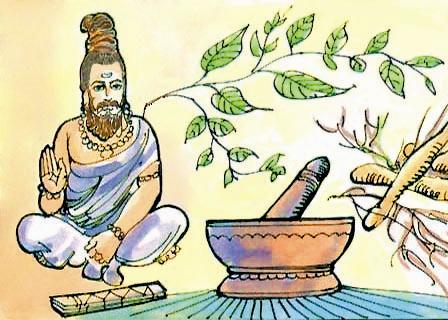
Ayurveda is the world's oldest system of health.
Ayu=Life; Veda=Knowledge or Science. It upholds the intimate connection between
human life and cosmic life. There are 7 basic concepts that make Ayurveda a
unique and complete 'Science of Life' : 1. The unchanging nature even for the
last thousands of years 2. The subjective methods of understanding 3. The
Five-Element theory- Pancha Bhutas- Space, Air, Fire, Water and Earth (Cosmic
Elements) are common to both man and nature.
4. Theory of Three Doshas- Vata, Pitta and
Kapha. 5. Prakriti-constitutional type. Each human being is born with a
unique combination of the 3 doshas. 6. Effects of the seasons. 7.
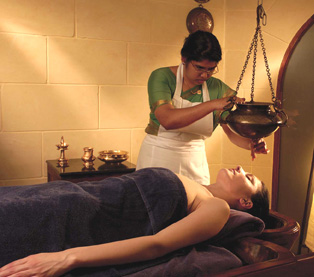
Panchakarma- Science of Rejuvenation.
The miracle of
the human body is that it has a natural healing intelligence, which is capable
of rejuvenating itself. Panchakarma purifies the body from degenerating
influence of the foreign substances. Panchakarma also works to eliminate the
cause of disease.
Ayu - 4 Aspects of
Life:
a) Atma - Soul b) Manas - Mind c)
Indriyas - Senses d) Sarira - Body Ayurveda focusses on maintaining a
balanced, integrated relationship among the above 4
aspects.
Atma - Soul
The Atma is the least tangible part of life. Each soul's inherent
preferences lead to make choices which are consistent with its dharma. A life
that is lived in accord with dharma is a life that is in harmony with Ayu, the
totality of life. The most obvious sign that life is being lived in accord with
dharma is the joy that comes from doing those things that are most closely
aligned with our soul's purpose. Pregnant woman will have different food habits,
influenced by the soul of the baby in the womb. Similarly, just before dying,
the food habits change, as the soul gradually withdraws from the body. Soul is
the Director of Life.
Manas -
Mind
Mind is the controller of the senses and
the body. Mind is responsible for maintaining the harmony between the parts of
human life and the universal intelligence. The 3 Gunas - Sattva, Rajas and Tamas
- regulate our mind. Creative thinkingg - Sattva Building Activity -
Rajas Completion of work - Tamas The Sattvic Mind always chooses those
things that promote growth and fulfillment. It is in the improper functioning
of the mind that the seeds of disease are sown. Frustrated mind makes the man
less efficient. He loses clarity, inspiration and motivation. Finally, he
becomes an anchorless , rudderless ship, set adrift on a stormy
ocean. Ayurveda's gift is the removal of the 'Tamas' or Ignorance. What we
eat and what we do play a very important role in who we are. The physician
first assesses the nature of a patient's mind . Then he can design a suitable
treatment for the patient.
Indriyas - The 5
Senses
The Indriyas act as a bridge between the
non-physical atma and mind on one side and the physical body and prakriti on the
other. Primary cause of disease is the improper use of the senses. Indriyas
gather informations from the outer world. Insufficient sensory inputs is another
cause. The third cause is sensory intakes which are morally or emotionally
repugnant.
Function
Sense
Organ of perception
Element
Sound
Hearing
Ear
Akash
Movement
Touch
Skin
Vayu
Conversion
Sight
Eye
Agni
Liquidity
Taste
Tongue
Jala
Solidity
Smell
Nose
Prithvi
Each
sense organ is highly specialised, which no other organ can do. The senses
carry information from the outside to the inside and back again, with remarkable
ease and speed. Accordingly, mind can act or react. Proper functioning of the
Indriyas is crucial to the maintenance of good health. With a sattvic mind,
the senses are finely tuned receptors. Guided by the soul, the sattvic mind
selects things which protect, nourish and strengthen the parts of life and their
connections. Ayurveda sees this vital, integrated mode of functioning as the
basis of health and happiness.
Sarira - The
Body
The body serves as the vehicle for the
senses.
The sequential flow of elements is from: Akash to
Vayu to Agni to Jala to
Prithvi Space Air
Fire Water Earth
The flow
is from subtle to material nature.
Akash
Akash has the most expansive and least
concrete value. Jala and Earth are more concrete than the other preceding
elements. When a seed grows to become a tree, it follows these 5 stages.
Similarly the sperm to become man as well. Akash is non-resistant. It is the
subtlest of the bhutas. It serves as a medium in which other bhutas can
manifest. Without Akash, nothing in the universe can exist nor can any process
take place. After non-resistance, Sound is the second fundamental quality of
Akash. Sound propagates by virtue of space. Actually, sound is born out of the
creation of space.
Vayu
Movement is
the essential principle behind the bhuta-Vayu. Movement implies direction also.
Vayu originates and gives direction to all motion and change and as a result to
all processes and functions in creation. Movement also generates a drying
influence, which in turn produces separation or disintegration. Colon, uterus,
urinary bladder, heart, muscular movement, blinking of eyes, transmission of
impulses to and from brain- are all Vayu.
Agni
Agni causes all conversions or transformation
in creation. This manifests as the qualities of heat and light as well as that
which gives colour and visual form to all things. Digestion is Agni. Radiance,
lustre, complexion, shine, dynamism, dull, brilliance of the eyes, sight,
colour- are all Agni.
Without Akash, Agni and Vayu cannot
function.
Jala
Jala embodies liquidity
and cohesion. It governs a substance's ability to change shape, without
separating or losing its integrity. Jala's nature is to bind or hold together.
Volcanic lava, gasolene, blood in vein- all represent Jala. Jala acts as a
medium through which vayu carries nutrients to leaves and branches. Blood,
saliva, digestive secretions- are all Jala. Jala protects mucous membranes of
the body and lubricates the joints. Ability to taste depends on the liquidity as
saliva in the tongue. It gauges the proportion of solids to liquids.
The
body favours those foods that reflect its specific elemental make
up.
Prithvi
The sequential
manifestation of elements moves from subtle and abstract to gross and concrete.
Prithvi is most solid and hence the last to emerge. Any substance or particle
with shape indicates the presence of Prithvi bhuta. Atom, molecule, rock,
mountain, planet, solar system, galaxy, leaf, flower, tendon, muscle, bone- are
all Prithvi. When Vayu's drying influence removes the cohesion of Jala,
particles begin to separate and give more smell. Dry and powdered items have
more smell. Whenever an odour is detected, Prithvi is there.Prithvi's presence
can be determined by hardness and shape of things also. Prithvi helps us to
reject harmful things.
The 5 universal elements and their corresponding
physical elements allow the Ayurvedic physician to use his senses to diagnose,
avoiding costlier and invasive procedures. The most versatile of all senses, for
diagnostic purposes, is the 'Touch'. In addition to its own functioning, it can
inform the physician of the state of the other 4 elements. This is 'Nadi
Vigyan'- the most exceptional diagnostic tool. It is based on the principle that
(Quantum Physics) the physical universe is essentially vibrational in nature.
Every organ and tissue in the body has its own unique vibrational signature,
which carries the information of its state of functioning. The fluid forms of
lymph and blood circulate throughout the body, picking up these vibrations and
conducting them through Vayu's 5 different functions in the body.
Visual
inspection of patient's body-eyes, tongue, stool, urine samples etc- determine
deficiency or excess of Agni. Odour occurs as the Earth element loses its
cohesion. The Pancha Maha Bhuta theory gives us a theoritical framework for
understanding sarira. Human physiology is determined by the 3 Doshas, which help
diagnosis and treatment.
The 5 bhutas have a natural balance in the body.
Jala and Prithvi predominate.
Dosha, Dhatu and
Mala
Ayurveda explains the body composition by 3 basic
systems- Dosha, Dhatu and Mala. Dhatu covers function, structure and substance.
Mala is defined as substance. Dosha is not easily objectifiable. It needs
extensive observation. It compares the happenings in nature to what is going on
in the body. Dhatus are those substances which are retained in the body and
always rejuvenated or replenished. Mala are substances naturally expelled from
the body. Only Dhatus support the body's functioning. Extensive loss of dhatus
lead to death; as in injuries, illness, accidents etc.
The 7 Dhatus and their functions.
Dhatu
Function
Rasa
Nutritional fluid - Plasma
Rakta
Blood - Life Force
Mamsa
Muscles - Cover bones
Meda
Adipose Tissue - Lubrication
Asthi
Bone - Help to stand and
walk
Majja
Bone Marrow - Nerve tissue
nourishment
Shukra
Semen / Ovaries -
Reproduction
Each
succeeding dhatu is a metabolic refinement of the previous dhatu and gets
nourished by it. Asthi is most solid and Shukra the most refined.
Malas
They are the eliminated wastes- substances
discharged during the processing and maintenance of dhatus. The 3 malas and
their functions are given below:
Mala
Function
Purisha (Feces)
Eliminates toxins in solid form through
colon
Mutra (Urine)
Eliminates toxins in liquid form through
kidney
Sweda (Sweat)
Eliminates toxins through pores of
skin
Malas naturally arise
as the unusable by-products of the digestive process, associated with the
formation of each of the 7 dhatus. The action of the doshas separates these
waste materials from the dhatus at each stage of metabolism. Accumulation of
malas causes imbalance that damages functioning of the dhatus. Their elimination
is essential. We should not restrain any bodily urge to eliminate the
malas.
The 3 Doshas - Vata, Pitta,
Kapha.
The Tridosha theory is unique to Ayurveda. Of the 5
great elements, Akash and Prithvi do not change. Hence, the Vayu, Agni and Jala
represent the 3 Doshas: Akash + Vayu - Vata Dosha Agni
- Pitta " Jala +
Prithvi - Kapha "
Human body can be divided into 3
parts, w.r.t. the 3 Doshas: a) Upper portion - Kapha zone : consists of Sense
organs, tongue, larynx, pherynx, esophagus, trachea, lungs, bronchi, heart,
pericardium and upper part of stomach. Kapha does moisturing, mixing, binding,
lubricating etc- Jala quality. It constitutes most of the heavy item- nature of
Prithvi. Also secretions are Jala nature- saliva, mucus (dull whitish
colour).
b) Middle portion - Pitta zone : Diaphragm, lower part of
stomach, small intestine, liver, pancreas, gall bladder, spleen - nature of
Agni. They produce acids, enzymes, juices, bile etc. Primary function of this
part is Conversion - Pitta Dosha. The secretions in this zone change the
structure, colour and quality of whatever they contact with. Pitta zone produces
substances in variety of coloures - yellow, red, green - nature of Agni. Foods
such as spices have high level of Agni.
c) Lower portion - Vata zone :
Navel downwards- large intestine, reproductive organs, organs of elimination,
legs etc. Porosity, space, dryness, lightness and movement are the functions
here. No secretions- actually, they re-absorbs fluids back into the body or hold
fluids to be excreted from it. Here bones and organs are larger and spacious-
nature of Akash and Vayu. Darker colour. Vata controls the mechanism involved in
drying and separating food. Brown, purple and black colours. Beans, water melons
etc are Vata foods. Vata is responsible for moving Kapha and Pitta throughout
the body. Vata animates life. It initiates and maintains all of life's essential
processes. All energy expenditure is orchestrated by Vata. When a baby is born,
it first cries. Crying uses the energy that was stored in the baby's dhatu. This
energy must be expended before the baby can draw in air to begin breathing
on its own.
The usual Life
Cycle
Dosha
Kapha
Pitta
Vata
Age
Child - upto puberty
Middle Age
Old Age
Activity
Growth
Grow
Reproduction Ambition Courage Energy Motivation
Reproduce
Drive reduces Skin begins to dry and
wrinkle Body loses weight Muscles lose flexibility
Die
The 3
Doshas - Vata, Pitta and Kapha are the unseen forces that do all the
transporting, transforming and packaging function in the body. Unlike the
Dhatus, the Doshas can move from dhatus to gastro-intestinal tract The
following 4 premises describe Dosha's functioning: 1. Doshas can move
anywhere in the body. 2. Dosha's intelligence discriminates- what should be
retained and what should be eliminated 3. Each dosha is most efficient in
eliminating in its zone. 4. The dosha's twice daily migration periods are the
best times for the movement of waste products.
Digestion - The Key to Health
Only
Vayu, Agni and Jala, acting as Vata, Pitta and Kapha, possess the specific
intelligence sufficient to conduct the digestion. Agni and Pitta - the digestive
fire- is the process responsible for metabolic conversion within the body. In
the context of the digestive processes that occur in the G.I.Tract, Agni bhuta
is called 'Jathara Agni'.
Indigestion and
Ama
Ama is the undigested food stuff. First Ama forms in the
G.I.Tract. It is different from Mala. Ama is later transported to dhatus by the
'dosha gati'. This will weaken the dhatus and cause infection. Ama formation
leads to constipation.
Ojas
There are
2 phases of digestion: 1. Prapaka metabolism - Digestion in the
G.I.Tract. 2. Vipaka metabolism - Digestion in the dhatus. In Vipaka
Metabolism, the food passes through each dhatu after leaving the G.I.Tract, in
order. Each dhatu gets nourished by this. The final stage is in Shukra Dhatu,
where 'Ojas' is produced. Ojas represents the essence of the entire digestive
process and it is responsible for the body's immunity to disease. Ojas is a
highly refined bio-chemical and is responsible for nourishing the non-physical
parts of life- like senses, mind and soul. It creates spiritual
feeling.
For more details, please read the book: Ayurveda and
Panchakarma by Dr. Sunil.V.Joshi M.D.(Ayu)