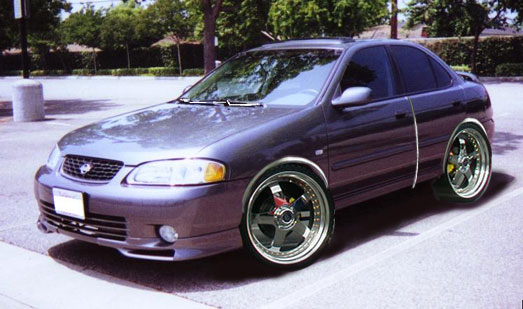
'Slamming' Your Ride
'Slamming,' or lowering your car, is one of the first modifications enthusiasts do to their car. It makes average cars look more aggressive and stylish, as can be seen every day on street-driven Honda Civics and Acura Integras:
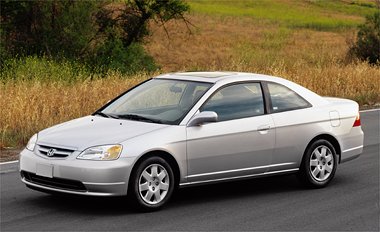

Acura Integra
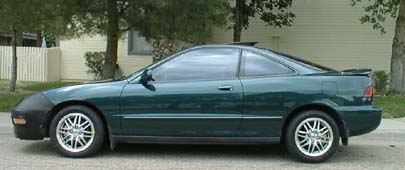
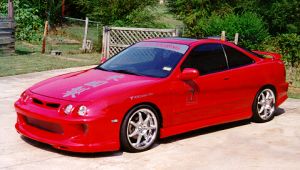
Granted, the 'after' pics include new paint, wheels, and bodykits, but the difference is clear nonetheless. The later cars look more 'finished,' as the wheels fill up the fenderwell much better than before. Appearance-wise, dropping a car 1~2 inches makes a world of difference.
Lowering cars really began as an attempt to make everyday cars look and perform like more expensive sports cars and race cars, such as the McLaren F1 and Lamborghini Diablo.


These expensive cars (as well as professional race cars) have a low profile in order to keep a low center of gravity. This allows them to accelerate faster and corner at incredible speeds. While Integras and Civics are nowhere near the caliber of these cars, lowering does give them a performance look and allows them to accelerate more quickly and attack turns.
For many drivers, appearance is what really counts (myself included).
HOWEVER...
Lowered imports have, as of late, become a matter of trendiness. Wanna-be racers (affectionately known as 'rice-boys') have played out this modification, and lowered Civics and Integras prowl the streets everywhere you look. Many of these cars do not have performance springs, they simply cut their stock springs. Doing so is extremely dangerous, as the factory springs were designed to carry the car's weight in its original form, and were NOT meant to be cut. Should this happen, the suspension bottoms out and the car winds up riding on its bumpstops, with little to no input from the driver anymore. Saving money by cutting stock springs results in a lowered appearance for a dangerous car with unpredictable handling.
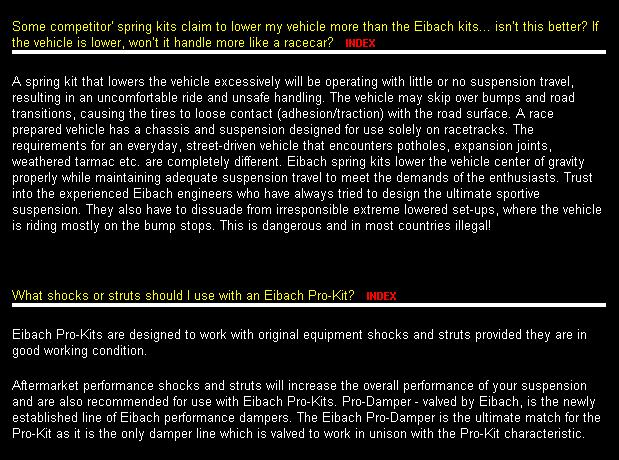
Proper lowering involves the use of coil-overs or quality aftermarket springs paired with high-performance shocks & struts. Coil-overs are adjustable shocks/springs combinations that allow the height to be changed at will (well, with a little work). The real advantage to these is that the shocks and springs are selected specifically for each other, so the springs won't wear out the shocks because of a higher spring rate, for example. The downside is a high cost (>$1000) for a decent coil-over shock setup.
The other choice is to go with a quality set of lowering springs from a reputable manufacturer like Eibach or H&R. The quality of springs cannot be stressed enough, because manufacturers are now capitalizing on the lowering 'trend' by mass-producing inferior springs at cheap prices for poor rice-boys who want to fix up their car. Quality springs are often designed to go with factory shocks & struts. At around $200 a set, aftermarket springs are a cheap alternative to coil-overs. Even though they are designed as a direct replacement for factory springs, however, the engineers recommend upgrading to performance shocks (such as Tokico or Koni) at some point because the higher spring rate (a shorter spring supporting the same weight) will wear out stock shocks more quickly. This upgrade is not immediately necessary, however, is still cheaper than getting a full coil-over setup.
I've installed an Eibach Pro-Kit set on my Sentra, and you can read the review here.
Depending on your budget, few modifications make a statement like dropping your car (to a lesser effect for Hondas and Acuras, since everyone is slamming them these days). A set of springs isn't incredibly expensive, considering stylish new 18-inch rims cost over $1000 apiece. The aggressive look you get from the new springs is worth the $200 you'd spend on the kit, and as a result, you get awesome handling, too.