I realize now that, if that is what you wish to read into Plato's philosophy, then that is what you will find. It was convenient for my high school teachers to chose this interpretation of Plato writings on the subject. But, in order to do so, one must ignore all of the other Greek writings on the subject and read Plato in a vacuum.
But Plato was not writing in a vacuum. He knew that the pederasty practiced by the Athenians was not sexless and probably indulged in some un-platonic pederasty himself. Plato was not an ordinary man. He was a philosopher with high-minded tastes and seemed not to like the rather earthy and unromantic attitude of the ordinary man towards man-boy love.
Perhaps my view of Plato is influenced by own attitude toward contemporary homosexuality. I don't like the "gay scene." It seems to be so silly and unimaginative. I'll paraphrase Somerset Maugham: "Homosexuals have the ability to plunge to the depths of the ocean and return with lost treasures but all they bring back are trinkets."
"Homosexuality," Plato wrote, "is regarded as shameful by barbarians and by those who live under despotic governments just as philosophy is regarded as shameful by them, because it is apparently not in the interest of such rulers to have great ideas engendered in their subjects, or powerful friendships or passionate love - all of which homosexuality is particularly apt to produce."
Plato seemed to me to be idealizing homosexuality. He saw it as a divine and sacred love - but not sexless. He had experienced plunging to the depths of the ocean and bringing back lost treasures while his ordinary fellow citizens seemed only to be interested in boasting to each other that they had buggered the most hairless and handsome boys in a competition of status and one-up-manship. To the ancient Greek jocks beautiful boys were merely trophies - trinkets.
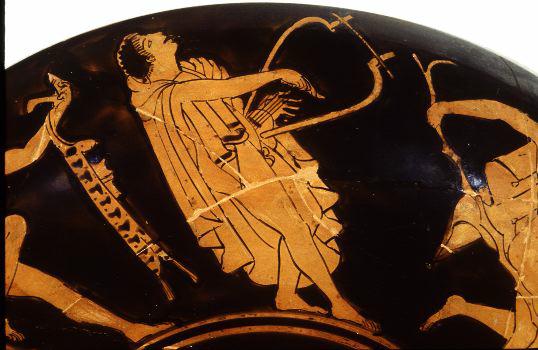
Intercrural intercourse seemed to be commom and was often depicted on pottery. But, when you begin to study the pottery more closely, not in a vacuum but in conjunction with reading the documents of the time, you begin to see that intercrural intercourse was simply the accepted form of sex to be done openly in public. You seldom see a depiction of it on pottery where the man and boy are alone. They are usually surrounded by other men and boys and sometimes even women. It seems to be taking place in public.
True, Greek pottery is not accurate and weighty historical evidence. It was after all simply decorated tableware not high art. But it could not have been too far from the truth. Many documents make it clear that anal intercourse was quite commonly practiced in private. There are many depictions of anal intercourse on pottery and not only of a man and a boy or two youths but often adult men engaging in orgies.
But, Greek pottery was often crude. It was made by potters living in the red-light district of Athens. Quite a few of the wine flasks were probably commissioned especially for drinking parties. Perhaps one took one's new wine-flask, with its pornographic depictions of homosexual orgies and randy satyrs, to a drinking party to get a few laughs from the other guests. Perhaps they were not accurate descriptions of real life but were meant to be the equivalent of our Playboy cartoons and simply reflect the ordinary man's sense of humor.
Aristophanes, the comic playwright, also depicts homosexuality bawdily. He playfully described the ideal of a beautiful boy as having "a muscular chest, healthy skin, broad shoulders, a big butt and a small cock." Satyrs it may be noted are depicted as contrary to this in every particular. They were bearded, obese and had large ugly penises. Slaves and foreigners were depicted as having large endowments too. Egyptians were circumcised and therefore regarded as having very unattractive penises. The Greeks liked their boys to have small penises with long thin tubes of foreskin - the "funnel" shape.