HOMOSEXUALITY IN
ANCIENT GREECE
In E.M. Forster's novel, "Maurice," the Dean of a Cambridge college tells a student who is translating from an unnamed Greek author: "Omit: a reference to the unspeakable vice of the Greeks." That was very much the tone of voice adopted by the books that were available to me in those days.
The message conveyed was: "How could the codifiers of democratic government, the perfecters of philosophy, the originators of logic, the pioneers of scientific investigation, the founding fathers of modern civilization have indulged in anything so filthy and perverse as homosexuality?"
Later, while I was in pharmacy school, I had the good luck to befriend someone who was studying the classics at the university. Through her I found slightly more frank books on the subject and discovered that the "unspeakable vice" was pederasty.
When I moved to England I found slightly less evasive books in the libraries in London. Still the topic was not frankly discussed and the naughty bits were always left in Greek (which I did not know.) But over the years I have read quite a bit on the subject and this essay is mostly to sort out my thoughts for myself.
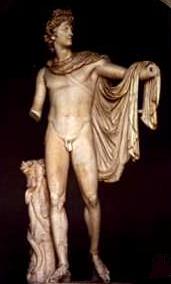
If you have already taken a look at the sculpture and pottery galleries, you will have seen that there can be no doubt that the Greeks not only practiced pederasty but also adult homosexuality. Of all the civilizations that have arisen theirs is the only one in which the male nude is portrayed in art more often than the female nude.
Solon, the Lawgiver of Athens, who laid the basis for democratic law, wrote as one of his laws: "You shall love young boys, with all your body and mind, until the hair grows on their faces." He also wrote: "Lucky is the man who loves; who, after playing sports, by which his body is made supple and strong, retires to his house with wine and song and plays with a beautiful boy on his breast all day long!"
Pindar, the Greek poet, once wrote of himself, "I, like wax of the sacred bees when smitten by the sun, am melted when I look at the fresh young limbs of boys." His beloved was a beautiful young boy, Theoxenus of Tenedos, in whose arms he is said to have died in the theater at Argos.
These Greeks also knew and enjoyed the myth of Zeus becoming infatuated with the human youth, Ganymede, whom he kidnapped. The Colchian Women speak of Ganymede as "setting Zeus's majesty aflame with his thighs."
Apollo loved Hyacinth whom he killed accidentally with a quoit. From the blood of the dying Hyacinthus sprang a flower on whose petals are the letters "AI" (meaning "alas.") Homer told a similar story about Ajax. Ajax had fought to recover the bodies of Achilles and his beloved Patroclus (who was killed because Apollo had removed his armor.) When Ajax died a hyacinth grew from his blood. The letters "AI" written on the petals also stood for the first two letters of Ajax's name.
The Romans called homosexuality the "Greek vice" (Horace). They protested that it was unknown in more ancient Roman times; that it was something totally foreign to the traditional Roman mentality; therefore they absolutely condemned it. However in Horace's time it had gained a certain acceptance in Rome.
Cicero, the Roman orator, wrote: "It seems to me that this habit of loving boys originated in the Greek gymnasiums, where these love affairs are free and tolerated." His theory was that it developed from the custom of completely separating men from "decent" women, who were kept secluded in the living quarters reserved for their use. The Romans, unlike the Greeks, allowed their women free entree into society. In Greece the boys were educated in the city gymnasiums, from which girls were excluded.
The midis in the journal section of this site are short piano pieces by Schumann.