| Master Brake Cylinder Upgrade |
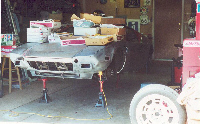
| When my car is not acting as a hand-made Italian desk, and storage shelf, it gets my attention as a hobby-in-progress. During the restoration, my car sat for over two years. There are two systems that I consider �most� important for safety, steering and brakes. I felt I should take a good look at these systems to insure they are working properly. It came as no surprise that the seals in the master brake cylinder no longer functioned. |
 |
 |
| As I sat looking at my completely stock brake system, I considered that it might be an appropriate time to upgrade part or all of the system. My impression of the stock brake system is that it is �marginal� for serious (read as �spirited�) street-driving or track sessions over a few hot laps. I know that others, such as Mike Drew, advocate that the stock system is acceptable, for all but hard track use. My response to Mike is to point out that his brake system is no longer a stock! |
 |
| It may be a good suggestion to review the brake system one step at a time, and then fixing or upgrading only what is really necessary. For some cars just a good strong flush of the system is sufficient, others find one or more caliper pistons stuck in the bore requiring some cleaning or repair work. Many drivers notice a benefit by removing the stock non-adjustable proportioning valve that limits the front brakes. Personally, I have experienced brake fade at least once, and if you have experienced that feeling too, you know it can be real scary ! Having just spent what I consider big bucks on the bodywork, I don�t want to run into anything (again). |
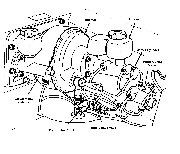 |
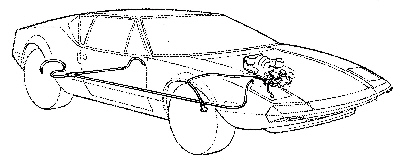
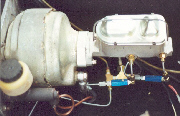
| What I have to work with: The stock system, designed over 30 years ago, may have been a decent match for the performance envelop of the time, but improvements in tires, upgrades in engine power, and the availability of better brake components make an upgrade seem reasonable. The stock system consists of a 23 mm bore master cylinder, with an 8� diameter vacuum booster. From the master cylinder, the brake lines are plumbed to a brass distribution block, which contains a shuttle valve and a port for a brake pressure switch (to activate the brake lights). The shuttle valve �may� detect a brake failure (If you had not noticed it already !) and activate the brake warning light (located between the two gauge pods on my early dash.) From the distribution block the front brake line then runs to a non-adjustable proportioning valve, designed to limit front braking pressure, here it also splits into two lines running to each of the front calipers. The rear line runs down under the front trunk, and back along the center of the car where it splits in two, to the rear calipers. |
| There are several complete brake packages (master, calipers, rotors, etc) available from the vendors, priced from around $2,000 on up, but finances limit my ability to upgrade the complete system at this time. I chose to upgrade just the master cylinder, as rebuilding the stock unit is not currently possible, and replacing the stock unit is actually more expensive than the other upgrade options available. Some considerations and limitations now come into play when mixing and matching components. Knowing that �someday� I�d like to upgrade to larger calipers, larger vented rotors and such, I would like to only have to replace the master cylinder once. That may not be possible, as what works well for the stock system may not work well for a higher performance system. A brake system is designed such that the amount of fluid moved by the master is balanced to the size of the (combined) caliper piston volumes. A master bore diameter and the bore length should move enough fluid to completely activate the calipers with some margin, but not move fluid in such rapid volume that the distance the pedal moves is too short. A short pedal travel will cause the brakes to be very sensitive to locking up the wheels. Braking should be a range, not an all-or-nothing choice. A master brake cylinder with a too-small diameter bore on the other hand, will require the pedal to be pushed too far. Who likes brakes that you must press all the way to the floor before they begin to work ? |
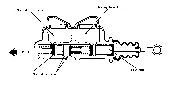 |
| Our master is of a tandem design, meaning that there is one piston shaft, separated into two pistons by rubber seals. Each section serves either the front brakes, or the rear brakes. Some racing brake systems are of the dual design, where there are two side-by-side pistons, one for the front brakes and one for the rear brakes. How have other Panteraphiles solved this master cylinder upgrade issue ? I posted a brake survey on the DeTomaso Forum (list server), asked a lot of questions, looked at a lot of cars, and took numerous photos of �non-stock� brake components. |
| Mike Drew's car |

|