
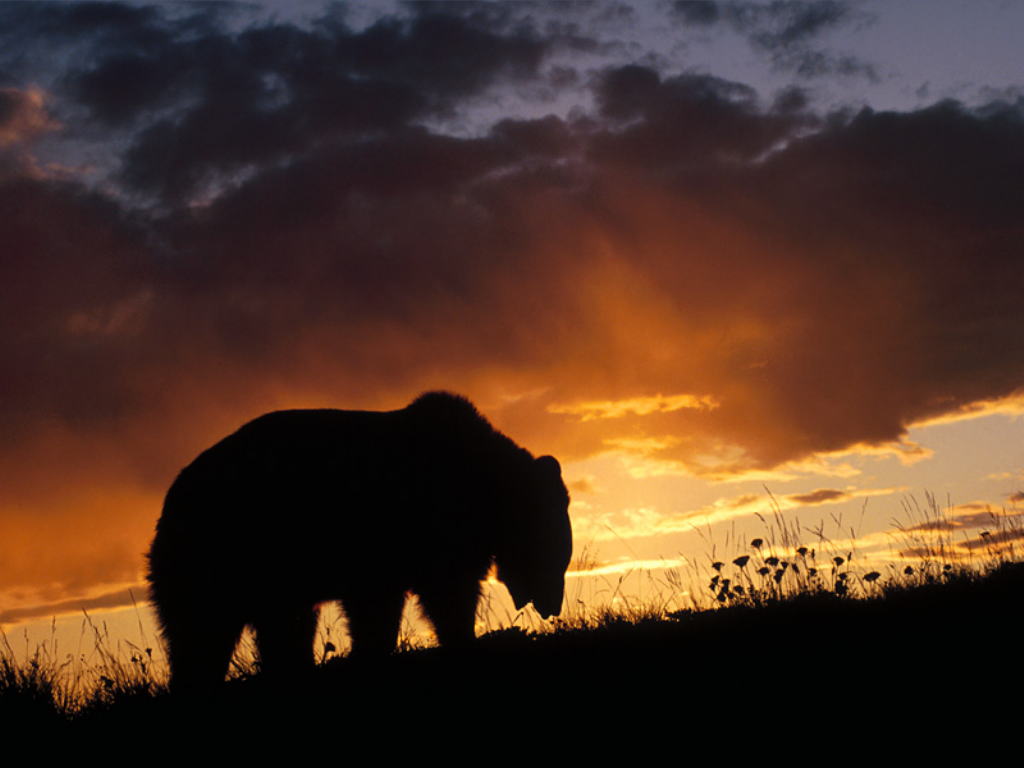
3. Movements
Craighead (1976) provides extensive information
on daily movements within Yellowstone. One
female habitually made a 5 km trip to a refuse
dump, taking 1.5 hours. Brown bears often
made trips of 16 km of straight line distance
in a 12-hour period and one covered 25.6
km. Movements of 14 km in a single afternoon
were also recorded. Other authors have reported
regular movements ranging between 14.5 and
80 km in 2-3 days (Berns et al. 1980, Knight
1980).
Several authors (Miller and Ballard 1982,
Judd and Knight 1980) report movements of
brown bears that have been transplanted up
to 258 km away from the site of capture.
Extreme movements were recorded such as one
male which was transplanted 215 km away from
where he returned to his original locality
in 13 days. These movements exhibit the potential
mobility of brown bears but they were undoubtedly
unnatural and took place after the bear's
homing instinct was triggered by the relocation.
Weber (1987) reports that Romanian brown
bears in Hargita mountains travelled through
their home ranges on clearly developed trail
systems. Brown bear trails generally were
the shortest distance between feeding and
resting areas, apparently offering security
and ease of travel. Undisturbed bears regularly
used these trails for most of their travel.
Parts of trails, especially near preferred
feeding sites, were frequently used by several
bears concurrently. Up to 12 bears were observed
on a single trail during one afternoon. Bears
used trails with a certain punctuality. The
first bears that appeared on a path, beginning
in the afternoon, were young animals. They
moved cautiously, stopping frequently to
examine their surroundings. After a bear
travelled the route, others moved more confidently,
hesitating less than the first one. Before
a bear walked into an exposed area, it often
paused for more than 20 minutes to evaluate
the situation from cover.
Weber (1987) also found that brown bears
defecate throughout their home range, with
scats concentrated in areas where they linger,
e.g. feeding and resting sites, and along
the border of thickets where they hesitate
before entering exposed areas. In the later
situation, defecation appears to be spontaneous,
perhaps a nervous response, and certainly
not as a result of examining existing scats.
He also noticed that bears defecate while
fleeing, particularly at the beginning of
flight, with excrement being spread over
1.5 m. Bears often passed the fresh scats
of other bears without reaction, indicating
that scats are of little if any social importance
on these occasions.
BIBLIOGRAPHY
Berns, V.D., Atwell, G.C. & Boone, D.L.
(1980) Brown bear movements and habitat use
at Karluk Lake, Kodiak Island. Bears-Their
biology and management. (Eds. C.J. Martinka
& K.L. McArthur). Bear Biology Association
Conference Series No 3. Washington D.C.,
pp. 291-296.
Craighead, F.C.Jr. (1976) Grizzly bear ranges
and movement as determined by radiotracking.
Bears-Their biology and management. (Eds
M. Pelton, J.W. Lentfer & G.E. Folk)
IUCN, Morges, Switzerland, New Series Publication
40, pp. 97-109.
Judd S.L. & Knight, R.R. (1980) Movements
of a radio instrumented grizzly bear within
the Yellowstone area. Bears-Their biology
and management. (Eds. C.J. Martinka, K.L.,
McArthur). Bear Biology Association Conference
Series No 3. Washington D.C., pp. 359-367.
Knight, R.R. (1980) Biological considerations
in the delineation of critical habitat. Bear
Biology Association Conference Series No
3. Washington D.C. (see Ball), pp. 1-3.
Miller, S.D. & Ballard, W.B. (1982) Homing
of transplanted Alaskan brown bears. Journal
of Wildlife Management 46, 869-876.
Weber, P. (1987) Observations of brown bear
movements in the Hargita mountains, Romania.
International Conference on Bear Research
and Management 7, pp. 19-21.