
Monte-Carlo simulation is used to create a model of gamma rays counts and a map of gamma ray counts vs particle location is made for every strategically mounted Scintillation detector (NaI). By comparing the counts sent by our spy in an experiment with our map, we can find out the exact location and movement of our spy and hence the movement of the gang of other particles as well.
I hope that I am sounding too boring, well frankly, I am bored with it too but then this is my job. This technique can be used for many different applications, which I will be investigating at a later stage.
This project had four phases, I will describe each one of it in detail.
Phase 1
This phase involved selection and ordering of equipment to be used in the RPT system. Although this kind of system has been designed twice before but both research groups used different equipments and it was done almost 10 years ago. With the advent of high powered computer and electronics, many new equipments have entered the market. My job was to review all the equipments related to Gamma ray detection and counting and then choose something which is both efficient and economical.
I contacted two companies Canberra and Ortec, both are market leaders in this area. After lots of discussions, price quotes and reviews, we finally settled for Ortec DigiSpec, its a new generation Gamma ray multi-channel analyzer. Its a compact equipment which draws its power from a USB port and includes everything, which eliminates the need for high voltag and discriminator devices. We chose NaI Scintillation detectors because they are very efficient and economical and lot of data is available on their properties and behavior. They are the most commonly used detectors for Gamma ray spectroscopy.
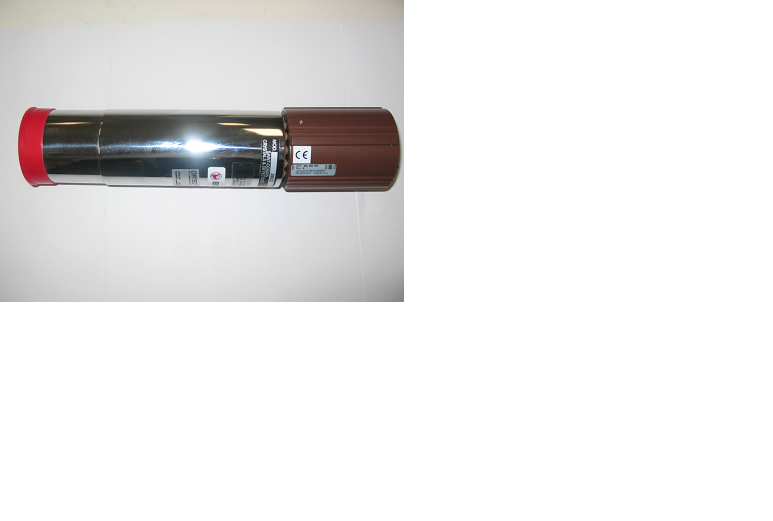
Hence, instead of buying whole stack of equipment, one set had only two pieces of equipment, one Scintillation detector which is coupled with photomultiplier tube and the other MCA. We bought 12 such sets because in RPT multiple detectors are required to achieve required accuracy.Ortec also provided two copies of Maestro, a software for Gamma ray spectroscopy. This software gave us a lot of trouble later on. That is another story, which I will describle later.
Picture of Scintillation detector and MCA
Phase -2
It involved fabrication of tracer particles i.e. our spy. Now tracer particle should be dynamically similar to the phase under investigation so that we can get accurate information of its movement. After reviewing literature, a technique used by Godfroy et al. was selected to be used for tracer fabrication.

