| |
Rather than writing about a trip in space, or a nostalgia-filled trip back in time, I thought I would write about a slightly different sort of journey that I have been taking for a long time – a Zen trip.
The interesting thing about Zen is that it seems to be so many different things to different people. To me, Zen is its sayings, the lessons, the books, the teachers, the experiencing, the attempts at the practice, and even the accompanying doubts – “is this really Zen?”
Zen just has appealed to me for a long time, probably because it seems to be made up entirely of nugget-sized aphorisms. So I will start with a couple of those, and then go along, roughly paralleling the way Zen things unfolded in my personal journey.
There seem to be an endless supply of pithy Zen sayings, and it is difficult to pass up a book of them without at least flipping through it. The earliest aphorism that I can recall encountering (and one that I took to heart) is the idea that “the journey is the destination.” When I first heard it, it boggled my mind. After various trips to different places, I have entirely bought into the inherent truth of this idea. There isn’t anything all that different to see, it is the going itself that is the fun.
“Go with the flow,” is a very popular Zen saying – spirituality’s equivalent of the path of least resistance. If you come upon a river, you can stand on the side and watch it flow by, or you can jump in and try battling going upstream. But the Zen way is to wade in and go along with the flow. There are also some great Zen metaphors that are often used to make the intended point. One that I came across recently was that life should be “like a pearl in a silver bowl.” It is a way of indicating frictionlessness, the perfectly rounded pearl being swirled in the rounded silver bowl – the way life is meant to be – nothing to resist, nothing to fight against.
When I first moved to Chicago back in 1996, Michael Jordan had just come back to the game, out of his first retirement. He was just getting started on his repeat of the “three-peat” wins. Even more than by MJ, I was awed by the Bulls’ coach, Phil Jackson. I started to read up on Phil Jackson. That was when I learned that he was a big follower of Zen. My library carried an audio version of his book “Sacred Hoops” and though the contents of the book have long since departed from my memory, I do remember that I had some wonderful commutes to work and back, listening to his sonorous voice. 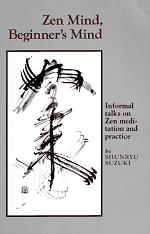 In his book, he was recommending the book “Zen Mind, Beginner’s Mind” to several of the NBA players whom he was coaching. So I immediately bought a copy for myself. In his book, he was recommending the book “Zen Mind, Beginner’s Mind” to several of the NBA players whom he was coaching. So I immediately bought a copy for myself.
Zen Mind, Beginner’s Mind is probably the Zen book whose ideas have had the deepest impact on me. This book is the reason that I won’t usually mention to others that I have an advanced degree in something or the other. To oversimplify, a beginner sees many possibilities, the master sees none (or maybe one.) When I can, I try to remember this, especially in my workplace.
That book led to others. I was running into the same names often, and Alan Watts’ was one of them.
Alan Watts was one of the first American masters, and he had a lot to do with popularizing Zen in the US. I own a book of his with the daunting title of The Art of Contemplation. Here’s how the book begins: “The individual is an aperture through which the whole energy of the universe is aware of itself.” Despite its name, it is a very readable 16-page hand-written work, with the author’s doodles thrown in for good measure.
I find it very interesting that Alan Watts, a Westerner, traveled to the East to pick up Zen and Eastern spirituality. Then folks like me from the East, came all the way here to America to learn about Eastern spiritualism from interested Westerners like Watts.
Soon, I start to read and browse many Zen books, some easy to follow and some very dense.
From my local library, I picked up a book purely for its title 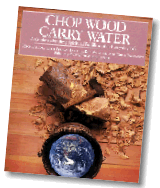 – Chop Wood, Carry Water. There is one story that I remember well from that book. An ancient tortoise lives at the bottom of a vast ocean. Once every thousand years, this tortoise comes up to the surface, sticks its neck out and takes a breath of air, and goes back down for another 1000 years. There is also a small wooden ring, floating in the same vast ocean. According to the story, the odds of getting a life and being born are smaller than that of the floating ring landing on the neck of that tortoise that comes up for air once every thousand years. From time to time, when I see someone taking life for granted, I am reminded of this particular story though, of course, I don’t say anything. – Chop Wood, Carry Water. There is one story that I remember well from that book. An ancient tortoise lives at the bottom of a vast ocean. Once every thousand years, this tortoise comes up to the surface, sticks its neck out and takes a breath of air, and goes back down for another 1000 years. There is also a small wooden ring, floating in the same vast ocean. According to the story, the odds of getting a life and being born are smaller than that of the floating ring landing on the neck of that tortoise that comes up for air once every thousand years. From time to time, when I see someone taking life for granted, I am reminded of this particular story though, of course, I don’t say anything.
The next Zen book I heard about was by Natalie Goldberg, a writer I respected for her clear and simple writing on writing. I was surprised to learn that she had written a book on Zen called Long Quiet Highway. I got the audio version of the book and coincidentally, ended up listening to it on a highway, during a solo road trip to Indiana that I did. The book is a glowing (and obsessive) tribute by Natalie to Katagiri Roshi –a great Zen master. Katagiri came over to San Fransisco from Japan when he was practically a boy, grew up, and ended up moving to Minnesota so that he could guide all those earnest Americans in the Midwest struggling with their own notions of spirituality.
In my cubicle at work, where only I can see it, I have two of Katagiri’s commands pinned to the wall behind my computer. 1. Eat the experience 2. Make great effort.
The first one instructs me not to merely skim the surface but to pay attention to everything and to experience things fully. The second one is Katagiri’s way of telling me not to be lazy, but to give each task my all.
Mainly through these books, I ran into Zen koans. For a brief while, I was a big fan of koans. Koans are the instant-coffee version of Zen. Technically, they are dense questions that someone ponders over and over and over until the answer hits them in a burst of enlightenment. The reason it took so long was that they were thinking literally instead of thinking laterally – they had to cut through a lot of stuff to arrive at the magic answer.
Even koans have been over-popularized, and some have even attained cliché status. “What is the sound of one-hand clapping?” is one. Another one asks, “What was your face like, before you were born?” In the days of Zen schools, the master would give out just one koan to a student at a time, and when the student solved that one, they could get one more. For the student, it was kind of like graduating through levels and earning Boy Scout merit badges.
Right around this time, when I was struggling with exalted topics like zazen and satori, I came across guided meditations. I was overjoyed, for now I could simply follow along while someone else guided me. I found that I could relate to Zin-Kabat Zinn, a Massachusetts physician and Zen master. He spoke very simply and eloquently, and his guided meditations worked for me. Like hypnosis, this only works if you let it and don’t fight it. I can vouch for the fact that I have listened to and attempted to follow the directions – pleasantly given. The relaxation has worked so well that I have often fallen asleep during the meditation. (“Is this really Zen?”)
One day I noticed in my Community College’s course catalog that there was a Zen course being offered. This was for the Winter quarter in January of 2001. Out of curiosity, I went to the first day of class, without registering for it. The teacher was Margaret, an earnest American woman in her late fifties. She was genuine, so I signed up for the 12 week class. Margaret ended up being a good teacher for me because she was able to pass on a lot of stuff that she had discovered over the years. A good teacher must be able to direct willing students to material that they can learn by themselves. Margaret was able to direct me to a lot of sources that I didn’t know of before.
In the class, we did a lot of sitting and walking meditations. That class opened up Zen concepts to me that were well beyond the stereotypical things that I had picked up sporadically on my own. I even had to keep a meditation journal, another new concept to me. Margaret had studied under, and was a follower of a Korean school of Zen. Towards the end of the course, she announced that there was an all-day retreat being held and that interested students could sign up for it.
So one Saturday morning in February, when it was cold enough that I could see my every breath, I drove up close to the Wisconsin border. The retreat was being held in a church. It started at 7.30 and went on until 3 or 4 p.m. There were around 15 of us, and we weren’t allowed to speak to each other until after the retreat finished. It was all regimented, and it was a novel experience being just with myself and my thoughts for close to eight hours. In the church’s wooden floor, with socked feet, we all sat Indian-style and did sitting meditations of varying durations. We followed this by silent walking on the bare carpet and some chanting. Even during lunch, there was an exact order to eat everything mindfully, and we had to finish everything on the plate without wasting. We even had to wash our plate and dishes in a certain prescribed way mindfully. Then it was back to more sitting meditations. Every once in a while, the master of the retreat would pick up a long wooden paddle and walk in front of the circle of those meditating. Those who wished to, could bow down, and he would then use the paddle and firmly swat the lower back of the bowed person once. After long periods of sitting still, those swats just felt great. (“Is this really Zen?”) To complete the retreat felt like an achievement in itself.
After that class, I wanted to practice by myself for a little while before signing up for a follow-up class. And then September 11th happened and I got very busy at work and I never ended up going back for a follow-up class.
I have written enough, and it is time to end my Zen travelogue now. The temptation is strong, the temptation to say something superficially profound and end abruptly. That would be the “Zen way,” but I won’t do that. I am also tempted to end by quoting one of those typical Zen sayings. For example, I could end by quoting another that I came across: If you understand, things are just as they are; if you do not understand, things are just as they are. Or, I could end with my favorite Zen saying: “The obstacle is the path.” That one takes a little while to fully grasp. But I don’t want to resort to any of those cutesy tricks. That would be too easy, and more importantly, it would be insincere. There are many ways to spirituality, and at the stage where I currently am, Zen just seems to resonate better. I wish I could say that I have achieved a Zen breakthrough of some sort, but of course I have done no such thing. All I know is that there is something there in Zen, and that I am drawn towards it.
Ram Prasad
December 2004
|
