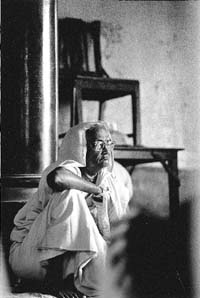
The memory disturbs me from time to time though it is almost a year now since I saw her. Why is it that a half hour conversation with a complete stranger continues to trouble me so?
Frail and well-dressed, she was seated on a raised platform outside the prakara of a huge temple in the city. A little distance away, I was impatiently waiting for the car to pick me up. We slowly got talking.
She said she lived all by herself in an apartment close to the temple. Her only son had bought the flat for her but he was away in England with his family. She had gone there recently on a six month visa but had returned after barely six weeks unable to bear the cold. Her daughters were in Chennai but they lived at the other end of the city - busy with their families, involved in their own lives. She was able to visit them just once or twice a month.
Her air of complete loneliness allied with a quiet dignity touched me. When I got up to leave, I blurted out impulsively "Why don't you visit us some day?"
Of course she never came.
The old lady is one of thousands who now form part of the fast swelling segment of the elderly - the parents of Non-Resident Indians who are left here to fend for themselves. Some of them mark the hours at sabhas and temples while halfway across the globe, the time races by for their children.
Says a couple in their seventies whose children have migrated, "Both our son and daughter-in-law are so busy in the States that when we go there we feel we are a burden to them. We preferred to come back though we have to bear the responsibility of maintaining our house and property, and day-to-day life is very hard."
The youngsters leave when they are in their late teens or early twenties. The parents are then just in their late forties or early fifties. They want the best for their children and it is often they who encourage the young to go abroad. When educational opportunities are blocked or denied, the best option seems to be to leave for universities outside the country. A section of the students and job seekers intends to return home. As the years go by, they get entrenched in fulfilling careers in the country of their migration and get used to a much better standard of living. And it becomes more and more difficult to come back.
The parents meanwhile are no longer as fit as before. The aches and pains begin as the ageing process inexorably sets in. Retirement brings plenty of leisure but where are the grandchildren whose company they looked forward to? Pride in the children's achievements is overtaken by the yearning to be with them. Spacious homes that once seemed too small for the children and their friends to play in now mean more drudgery, to dust and maintain. Those who move to smaller flats manage better but the ties that bind the elderly to their own home are strong and many of them are reluctant to move. Owing to the mass migration, one comes across rows of houses in certain parts of Chennai inhabited only by the elderly.
Life in old age continues to be work and worry. One has to manage the finances, take care of one's health and home without the help of children.
"Love" is the voice on the telephone talking to old mum and dad, concerned definitely but unable to help them tide over the problems and pinpricks of each day.
"Concern" is the message on the Internet, affectionate, teasing and anecdotal, yet merely black print on white screen. It is not the golden tones, the warm smile or even the disapproving frown one wants to hear and see. All caring is by proxy - the nurse engaged when ill, the arrangements made, the money paid through the bank account.
The children too wish that they were with their parents but their job and circumstances keep them apart. If they have siblings in India, the responsibility of caring for the parents is borne by them. They resent it sometimes and make it evident.
The yearly or the biennial visit is the rainbow on the horizon. The house is spruced up and it is springtime for the parents. When grandchildren come home, at first the alien feeling is striking, the drawl in their voices, the shrug of the shoulders, the too expressive faces - not unattractive, but different. It is not a relationship one can flow instantly into. (Some parents of NRI's fret that in a generation or two, their families will completely lose their Indian identity). Before one gets to really know them, the visit is over and they are gone. One waits for the next visit. Perhaps next year, or the next, or the next...
Settling down with the migrants abroad poses its own difficulties. One has to while away the long, solitary hours when the young are busy at work. "A gilded cage" is how many parents view it. Unless one knows to drive, the lack of mobility confines you to the four walls of the house, and there are very few people you can talk to. Neighbours have no time, for other than a brief "Good morning" or "Hello".
"Generally, most of the parents who visit their children are lonely," says Padmini, a resident of Houston. "In certain areas and cities however they are happier than in others because of the high concentration of Indians living there. They visit one another and meet at concerts and temples.
Sujatha, a resident of Toronto speaks of the loneliness of the parents of migrants from North India who are not very educated. Their homes are small and the old fathers are literally forced out of the small flats in the evenings, she says. They sit in groups on the lawns of the shopping malls chatting and playing cards. They have no money to even buy themselves a cup of tea. Because of their distinctive dress and appearance they are viewed with hostility by the locals who sometimes pass derisive remarks. "Male rats" they call them. The old women fare better because their daughters-in-law or sons ensure that they are engaged as shop assistants or baby sitters.
Parents of those who live in other Indian cities or in other areas of the same city nowadays often lead lonely lives. But the best of the children can and do visit their parents often. Distress calls can bring them to one's side overnight or in an hour if they are so inclined. Both distance and expense separate the NRI son or daughter from the parents.
Each family tackles these problems in its own way. The visits of children to India and those of the parents abroad are staggered so that they meet at regular intervals. A section of the parents of NRIs spend six months in India and six months with their children abroad. Others reluctant to leave the comfort and familiarity of their home and country rarely venture on the long journey by air. As they grow older and more feeble, the journey is less inviting. (For the elderly the dread of falling ill or becoming bed-ridden in their own home is bad enough; the inconvenience and expense their children would be put to abroad is frightening).
They manage well enough when they are young. It is no problem when fit and agile to fetch the plumber, run up to the shop to buy the extra kilogramme of sugar or climb up the ladder to replace the fused bulb. In a country where most of us do not learn to deal with practical chores, each little task seems fraught with difficulty as faculties weaken and household help and skilled labour are increasingly difficult to obtain. The ineffective infrastructure makes life arduous for the aged who live alone.
The average Indian's life is totally centred around the family. Since till a generation ago, joint families were the norm, and we are unprepared for being left alone or in pairs. The quality of detachment is not developed.
Highly emotional and talkative, we find silence unnerving. Couples who have not developed any hobby feel lost once they retire. Children provide the sole bonding sometimes between couples and as conversation usually revolves around them, a thick fog of silence surrounds the elderly who live alone.
Old couples whose children seldom visit them also face greater risk of crime. The aged who are unprotected by younger family members are vulnerable to robbery and assault.
Though the parents of NRIs who were interviewed admitted to feeling lonely and finding life difficult, many of them were sensitive of hurting their children's feelings and did not want their names revealed. "My son has been away for seven years and I have not yet started missing him", says Dr. Vijay Kumar, anaesthesiologist whose son went to the U.S. soon after he graduated. "My daughter is going there soon to do her Phd. We have to let the children go so that they acquire good education there and are able to stand on their own feet."
For the Ramamurthys, their little grandchild is the person they miss the most. "My only son left for the U.S. in May and we miss him dreadfully," says Mrs. Ramamurthy. "Since we long for our four-month-old granddaughter our son sends us her photographs and video film and we also hear her voice on the telephone."
"My wife and I accepted long ago that considering the global level opportunities now available, our children will be employed elsewhere, so it hasn't come as a surprise that both our son and daughter are in the U.S. I will not call them back as they have fulfilling careers", says Dr. V. C. Kulandaisamy, former Vice-Chancellor of the Anna University. "I haven't thought of settling abroad as I'm deeply involved in what is happening in the country in the political, social and educational spheres."
Attachment to her own country keeps Mrs. Dyanasekharan happy too though her only daughter has been away in the U.S. for many years. Mrs. Dyanasekharan visits her now and then but prefers to stay in her own large house in Chennai. "Though I'm comfortable in the U.S., I'm too Indian to live abroad. I see very little of my daughter and her family when I visit her. My many interests and friends keep me cheerful and happy here."
The Ramaswamys** regret that both their married daughters are settled in the U.S. "We did not know that life would be so bleak without them here and so lonely for us when we visit them there. We are financially well off but lack of companionship is depressing." They do not like life in the West "Although we have complete freedom in our daughter's houses we do not feel at home.
"During the summer holidays our children are desperate that we visit them and care for their children. At our age, it is physically exhausting to take care of lively six and seven year olds." Thanks to the help of good household staff we are able to carry on in India. But what will happen when one of us predeceases the other?," they worry.
Some parents of NRIs turn to old age homes. The Naya Jyoti Charities Trust has established an old age home at Panaiyur near Chennai which offers all facilities for those used to a certain standard of living. Dr. M. S. Srinivasan, the founder of the home who stayed for nearly two decades in the U.S. before settling down in Chennai says the home is advertised on the website too so that NRIs can spot it. A fine location near the sea, excellent food, comfortable rooms, medical and recreational facilities keep the residents happy.
Mrs. Rajalakshmi's son who lives abroad has contributed Rs. one lakh so that his mother and sister can move in here.
Mr. Eswaran (89) also does not mind the fact that he is in a home for the aged. His wife died 20 years ago and he stayed with his son in New Jersey for 10 years before returning to India. He would not like his son to come back though he misses his grandchildren.
There are couples whose ideological differences result in one of them moving to the West and the other remaining behind in the country. Mr. Shailendra** is a resident at the Naya Jyoti home; his wife is in the U.S. with their son.
"I did not want him to go abroad as the country has spent so much on educating him," says the father of the ITI graduate. "People are attracted to money, and so he left."
The Subramanians** however feel that they would not like their two daughters to return to India unless conditions change here. They are disillusioned with their country.
They are very happy on their long visits to their daughter and find Americans more friendly and helpful than the Indians here," The system works perfectly and medical help is readily available. There are senior citizen clubs we can go to and we enjoy the long walks and drives. We feel much safer there." It is only because they do not want to deprive their daughters of a home in India they continue to stay here.
The Subramanians are exceptions rather than the rule. Most parents of NRIs would love to have their children with them. Knowing that their children will not return, and unable to integrate with the lifestyle of the West, they stoically stay back reconciled to their lot.
* Names changed on request
KAUSALYA SANTHANAM
From Folio Magazine of The Hindu dated 18th October 1998
