| |
Recently, during my morning commute, the thought of work made me want to abandon everything and flee to a distant place -- a place in imagination that would bring me both joy and comfort. So, to amuse myself, I went to my earliest childhood days, back when my consciousness was just beginning to take shape, and tried to recollect my favorite food.
Long, slender potato wedges shallow fried in vegetable oil with cumin seeds.
That is perhaps the starting point for my culinary journey. I recall this from my days in Orissa, a coastal state in eastern India, where my dad was posted as the Director of Postal Services. He traveled extensively across the state on inspection and frequently took the entire family along with him. Sometimes our relatives visited us from the south and my dad would plan an �official tour,� which would include the tourist spots such as the sun temple of Konark and the holy city of Puri. We would stay at the postal Inspection Quarters on these visits. I think a cook at one of these quarters prepared the dish for our family. I am not able tell for sure, but I do remember that I took an immediate liking to it and the taste still lingers in my mouth. This is unmistakably the favorite dish from my early childhood.
Despite an intense, concentrated effort to recall the names of my schoolmates, or the kids from the neighborhood with whom I played cricket in Orissa, I am only drawing a blank. But I can still remember the smell and taste of some of the dishes that my mother cooked back then.
It was a very peculiar sight: To see a big, bulbous eggplant on flames. My mother would never give us a hint in advance. Dad would be reading the newspaper in the living room and my older brother and I would be busy with our homeworks. All of a sudden, this strange burning smell would come floating in and wreck our concentration. Both anxious and curious, we would dash to the kitchen to see what was on fire. But the sight of a purple eggplant squatting on the stove would bring us great delight. We would realize, immediately, that it was going to be chapatti and baigan bartha for dinner that night.
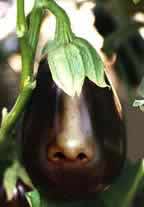 Baingan Bartha � smoked eggplant cooked with red onions and the juiciest of red tomatoes is an irresistible dish. And my mother Baingan Bartha � smoked eggplant cooked with red onions and the juiciest of red tomatoes is an irresistible dish. And my mother  excelled at it. We ate the bartha with ghee-covered chapattis to our heart�s content. After we were done complimenting her, she would tell us that the trick was to add half a teaspoon of sugar to bring out the full flavor. This dish was a rare one for us. She only cooked it when the family was in need of a surprise. Mom had a knack for knowing when the time was right for the baingan bartha. excelled at it. We ate the bartha with ghee-covered chapattis to our heart�s content. After we were done complimenting her, she would tell us that the trick was to add half a teaspoon of sugar to bring out the full flavor. This dish was a rare one for us. She only cooked it when the family was in need of a surprise. Mom had a knack for knowing when the time was right for the baingan bartha.
Every once in a while, when dad was in a good mood, he would remove the cover off his gramophone record player, patiently wipe off the dust from his LP collection, and play a nostalgic Hindi song for all of us to listen. That signaled to us that he was in the mood for celebration. He would sing along and whistle and clap and even do a small dance. He never explained the reason behind this behavior to us. We could not foresee this at home. He did it so rarely that it was a pleasant surprise every time he did it. My mother was the same way, too. She did not cook the bartha because dad had received a pay raise at work or because my brother had topped the �unit test� in school. That would have made it very predictable. It would be a treat, then. But she liked it to be a surprise. The purpose was to lift everyone�s mood in the house; to beat the blues caused by the daily routine and find a way to celebrate life.
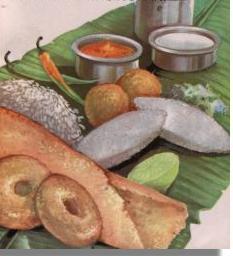
When I got to the fourth grade my father was transferred from Orissa to Madras. Suddenly I was pushed into an entirely new world. People spoke to me in Tamil, when I was only fluent in Oriya. I had a new set of classmates and teachers. I found it very difficult to adjust to this new surrounding. I hated it in Madras and asked my parents to take me back to Orissa. �But this is where we belong. All our relatives are here,� my dad reasoned with me. Slowly I did start to adapt to the place. I made friends in the postal colony in which we lived. During summer vacation months I stayed with my cousins and we would play cards and watch movies together. With time, the warmth and hospitality of my friends and family made me like Madras. However, without a doubt, it was the authentic South Indian cuisine that made me love the new place to which my father had been transferred.
It is hard to imagine that a banana flower� vazhapoo, as it is known in Tamil, can be used to prepare a dish. Collecting its white tendrils and chopping them into fine pieces involves lot of labor for very little yield. And it has a strong, bitter taste that needs to be tempered carefully for it to become palatable.
My mother cooked vazhapoo paruppu-usli only on the weekends because of all the upfront preparation that the dish required. During the week, when the banana flower had come to a full bloom in the backyard of our house in Ashok Nagar, she would employ some local help to cut it from the plant and place it in a basket in the kitchen. On the following Sunday, immediately after serving us our morning cups of coffee, she would get on with the task of preparing the dish. First, she would painstakingly peel the purple sheath and collect the tendrils. To keep it fresh, and also take some of the bitterness off of it, she would chop them into fine pieces and immediately soak it in water and let it sit for a few hours. Then she would steam cook the chopped pieces. In a large wok she would add vegetable oil, mustard seed, and a pinch of the pungent asafetida, red chilies and let it fry till the mustard seeds started to crackle. To this she would add the ground lentil paste and fry till it turned golden brown. Then she would add the steamed vazhapoo and two teaspoons of salt to the wok and mix all the ingredients to make sure that contents were evenly distributed without forming any lumps. That is how she prepared my favorite dish.
Others in the family did not care much for this dish because of the lingering bitter taste of vazhapoo. So mom prepared this dish mainly for me. Paruppu-usli was the catalyst that made me forget Orissa and embrace the new life in Madras. I felt as though I belonged here after all. To this day I dream about settling down somewhere in the tropics after retirement just so my wife can prepare this dish for me on the weekends. Ah, the very thought brings me such comfort. Wouldn�t it be grand if it were to come true?
I have always been intrigued by the fact that although many of them can cook the same dish, only a few can make it taste perfect. It is as if for that item they are the experts; when they prepare it, the dish stands out. It is true that the same item can have a variety of different flavors in different households. For example, no two housewives prepare coffee that tastes exactly the same. Similarly, rasam tastes ever so slightly different depending on who prepares it. But that is not the point I am trying to make. My cousin Chitra  excelled at making vegetable cutlets. No one else could compete with her on this tiffin item. I have had the opportunity to eat vegetable cutlets very many times at lot of different homes, and I can vouch with great degree of confidence that Chitra�s cutlets are the best in the world. Likewise, my mother makes the best tasting paal puris, excelled at making vegetable cutlets. No one else could compete with her on this tiffin item. I have had the opportunity to eat vegetable cutlets very many times at lot of different homes, and I can vouch with great degree of confidence that Chitra�s cutlets are the best in the world. Likewise, my mother makes the best tasting paal puris,  Aunt Chooda makes the best eggplant curry with grated coconut, Aunt Rukku makes the best tasting appam with kurma, Aunt Pushpa makes the best bisi-beda bath, Aunt Amritha makes the best bread rolls, Aunt Kausalya Aunt Chooda makes the best eggplant curry with grated coconut, Aunt Rukku makes the best tasting appam with kurma, Aunt Pushpa makes the best bisi-beda bath, Aunt Amritha makes the best bread rolls, Aunt Kausalya  makes the best tomato soup and my grandma made the best mor-kozhambu (she rarely cooks anymore). Here I must confess that I, too, have tried to cook all of these items, but have repeatedly failed in achieving the desired standard. It has always struck me that no matter how hard I try, I can never match them when it comes to the taste. It is as if theirs is the original and mine a cheap imitation. I try to convince myself that it is a scientific experiment that will have an expected outcome if all the inputs are carefully controlled. However, the basic assumption is flawed: cooking is not a science but an art. Therefore I am doomed for failure. And that�s just fine for there is great pleasure in trying to create something to high standards � even if I frequently miss the mark. makes the best tomato soup and my grandma made the best mor-kozhambu (she rarely cooks anymore). Here I must confess that I, too, have tried to cook all of these items, but have repeatedly failed in achieving the desired standard. It has always struck me that no matter how hard I try, I can never match them when it comes to the taste. It is as if theirs is the original and mine a cheap imitation. I try to convince myself that it is a scientific experiment that will have an expected outcome if all the inputs are carefully controlled. However, the basic assumption is flawed: cooking is not a science but an art. Therefore I am doomed for failure. And that�s just fine for there is great pleasure in trying to create something to high standards � even if I frequently miss the mark.
T.N.Mukund
August 2004
To be continued ��
|