Within two days of reading about a bird called quetzal (pronounced kek-saal) it became the most important thing for us to try and view it. That’s way it goes when certain would-be-nice-to-do things morph into obsessions.
We had just pulled up outside the Santa Elena Biological Preserve in Costa Rica. When trying to buy tickets for the “Skywalk,” we learned that only once a day an English-speaking nature guide accompanied visitors as they tried to view the wildlife. The guided walk was starting in fifteen minutes. In addition to the non-trivial entrance fee, we were being asked to pay an extra ten dollars per head extra. My wife and I debated it for a few minutes.
We had caught two flights, flown down an entire continent, rented a car and driven up horrendous gravel roads to reach the cloudforest, and now we were hesitating about ten bucks. It didn’t make any sense, of course, this hesitation. But when you are in a country where things are very inexpensive ten dollars apiece can start to feel like a large amount.
However, we both knew that we had a near-zero knowledge about nature, and the guidebooks had been unanimous in suggesting that we avail of a guide. And that was how we met Gustavo the tour guide.
Costa Rica is a small country, “smaller than West Virginia” as the brochures invariably pointed out. That small area is liberally strewn with volcanoes and beaches and rainforests. No place in the world can really live up to its color-brochure version, and Costa Rica was no exception. 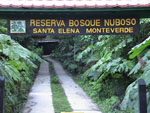 However, Monteverde, the town at the entrance of the Biological Preserve, came close, real close to the brochure.
The only road that winds its way to Monteverde from the Inter-Americana highway is referred to both as “unpaved” as well as a “dirt road.” The truth was that it was a road made entirely with white rock chips, and it would have actually looked quaint on some 50-yard patch. But when you have to rattle along these chips for 30 miles, it lost all its quaintness in a hurry.
Monteverde has acquired the status of a peaceful oasis in the middle of the mountains. Hence the allure, and that was the reason that we had rattled along in the first and second gears for four hours on unpaved roads to get there. It was frustrating, but the simple truth is that if it had been a paved road, people would be doing day trips from San Jose, and the birds and trees and entire preserve would have vanished entirely by now.
It turned out the most people chose not to pay the ten dollars and avail the guide. Besides us, there were just two Germans who had signed up for the guided trek.
My wife and I have laughed many times about a guy who was with us in another tour. It was in a bus tour in the Denali National Park in Alaska. The wildlife was plentiful there and it was tough to keep all the animals straight. This guy turned around, spotted a fox that our guide had already finished describing, and shouted enthusiastically to the whole bus pointing, “Look, an animal!” It could have very well been me shouting that. I have no illusions about my ability to identify birds. As a city dweller, all I am confident about spotting are pigeons and an occasional sparrow.
Just before the trek began, the two Germans introduced themselves and one of them said, “You know Stuttgart?! We are from Stuttgart.”
We started off. Gustavo told us that we might be gone for 2.5 to 3 hrs. I am always happy to have someone who knows more show me stuff.
“Maybe we see quetzal?” the more hopeful of the two Germans asked.
“Yes, maybe,” Gustavo replied.
A quetzal is multi-colored bird, whose existence I didn’t even know until I got to Costa Rica. I had only the vaguest notion that there are many varieties of parakeets and macaws. I didn’t know anything specific about quetzals. The postcards universally labeled the colorful bird the “resplendent” quetzal. The two Germans had been in the area for three days, but they hadn’t seen one, and that was the reason they had signed up for the guided trek.
Our guide, Gustavo, was around twenty-five. Though he was short and wiry he easily carried a tripod that was taller than him, on which was mounted what looked like a huge telescope. In his belt-bag, he had picture cards of the birds and animals his clients might encounter.
“First, we go there,” Gustavo said, pointing away from the bio-reserve. We all trekked around 50 meters along the mud wall running alongside the unpaved road that all cars used to get to the Biopreserve. He stopped abruptly by the side of the road and waited for all of us to get close to him, motioning us to be quiet. He pointed to a marble-sized hole in the mud wall. “See? A tarantula!” he said. 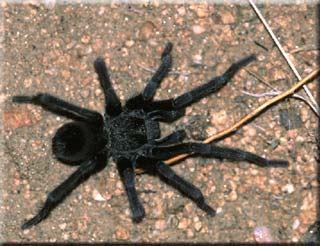 I couldn’t see anything. Gustavo pulled out a small flashlight and directed it at the hole. We then saw the creature, retracting one of its fangs that had been hanging out of the hole. Gustavo made each one of us peer into the hole while he played the flashlight inside it, and sure enough, we saw the huge black spider there.
Gustavo had a flair for drama which he delivered in an understated manner. He was telling us about Tarantulas. Apparently, there exists a certain species of wasp that is the enemy of the tarantula. This wasp, when it finds a tarantula, stings it and paralyzes the spider. The wasp then carriers it off to its nest, and there it lays it eggs in the body of the tarantula, which is alive all along but immobilized from the wasp sting. These wasp eggs hatch, and while the little wasps are growing, the body of the tarantula becomes food that is readily available to the little ones.
We walked into the Monteverde park, to an area that had five or six black birds fluttering about. There were inverted clear plastic bottles hanging from many trees with what appeared to be a sticky sugar solution in them. The contraption had been designed to release the fluid one drop at a time. The black and violet birds were all hummingbirds, come to partake in the free food.
It was a little disconcerting to watch these birds hang in the air, their body completely still, except for the wings that flapped at a dizzying speed. Then they would peck at the liquid and go still in the air again, until they were ready to fly away. Gustavo began to educate us about this amazing bird.
“Each humming bird visits over 2000 flowers in a single day,” he said. The bird eats practically its own weight on a daily basis, which warranted the visit to such a large number of flowers. Also, Gustavo told us this bird had muscles even in the back – he patted his own shoulder – and that was the reason it could hover in place. Every year, the hummingbird flew thousands of miles from up in Alaska down to Latin America and then back. “And when they cross the Gulf of Mexico,” – you could sense the admiration in his voice – “they fly nonstop for eight days and nights. They eat, eat, eat before they start, and they lose half their body weight in crossing the Gulf.”
I had learned quite a few things, and we hadn’t even started walking into the proper Bioreserve.
It seemed to me that Costa Rica, simply by luck of its geography, had not one or two, but hundreds of every type of plant, animal or bird.
We were walking on steel suspension bridges, painted green to blend in with the forest all around us. There were six such bridges in all, connecting one hill to another, constructed just above the canopy of the trees. These trees rose to a height of 60 feet, and the bridges afforded a wonderful vantage point for the tourists, without wreaking havoc on the delicate flora of the park.
We were watching a lot of stuff, and I was learning a lot, but the main attraction seemed to be the quetzals. Gustavo was personally fanning the quetzal anticipation that already existed in all of us. “The quetzals love avocadoes. You eat guacamole? These are the same avocadoes they eat!” he told us when we passed some avocado trees.
The way Gustavo explained things in his accented English was very captivating. Some people have the storyteller’s knack and they make good teachers. He was educating us on the silent tree battles that were being waged all around us. These battles lasted decades and sometimes over a century. This was the story of the epiphytes – very similar to plant parasites – that Gustavo told us.
One seed lands on the right spot on a tree branch – usually dropped by a bird. In a few days, that seed germinates. The new plant (the epiphyte) starts grabbing a lot of the nourishment meant for the very tree it is squatting on. Over time, it produces creepers that slowly strangle the older tree. As the new plant grows, it starts to consume so much of the other tree, that the main big tree begins to grow hollow, hapless to do anything about this invasion. Once the new plant’s creepers touch the ground, the epiphyte has already won the battle. It starts growing at a rapid rate, and soon the old tree is completely destroyed, a shell of its former self. And in this way the epiphyte wins.
The trees below us were centuries old. Some, he told us were anywhere from 200 to 800 years old. The Costa Rican botanists were denied one reliable tool for estimating a tree’s age – the annual rings. This technique does not work very well in Costa Rica because there are no formal seasons, and thus these rings (outer bark) never quite close. So one could never really be sure of the age of these trees.
We were seeing every living creature except the quetzal. Gustavo had a habit which I initially found amusing. Whenever he heard a bird call, no matter which bird it was, he would mimic that exact same call back to that bird. I admit that I did think it was corny. But then, I heard some birds responding. It was amazing. “Listen to this bird call, it is like a metal door opening,” he would say. To my city ears, they all sounded pretty much the same. The birds get curious and come out to check out what’s going on, he told us. He wanted us to see a quetzal, and he was willing to work for it, and I found his earnestness admirable.
Like all tour guides and hosts who have a prepared verbal spiel that they have to deliver over and over again, Gustavo had his share of jokes. He would unleash them in his accented English in his most serious tone, and laugh at our surprise.
One example: He was telling us about how different birds used different techniques to attract their mates. The males of certain bird species had very colorful plumage, and thus they attracted the females. Other males of certain other species didn’t have the good looks, but they possessed wonderful voices, and so they wooed their mates simply by singing to them.
“But there are some birds that are not beautiful, and they don’t have a very good voice. How they attract the females?” Gustavo paused for effect. “They have a lot of money!” Laughs at our surprise.
Turned out that there was a wee bit of truth behind his joke after all. Gustavo explained that this one bird (a marmot as I recollect it), lacked both pretty feathers or a melodious voice. So it came up with a very good idea given its limitations. It went out and built as huge of a nest as it possibly could. Each female marmot would then be shown several nests by several males, and the lady marmot would chose as her partner the builder of whichever nest she liked the most.
We had been in the park for close to two hours. “Not everyone see a quetzal,” Gustavo told us. At that point, it finally dawned on me that the quetzals might in fact elude us. Strangely, I didn’t mind it too much. I hadn’t even known about the name of this bird a couple of days ago, and it seemed irrational to obsess about spotting it. In the Bioreserve, I had seen tons of other flora and fauna that I’d have never otherwise seen. I could always see a video of the quetzal from my local library. I could read about it and see spectacular photos on the Web. And in a sense, it seemed fitting that we wouldn’t see it. We hadn’t worked hard enough for it. Also, an unsuccessful quest had an undeniable cachet to it.
We walked about 30 feet ahead on the steel bridge. “You like snakes?!” Gustavo asked.
“Ja,” said they Germans, almost in chorus.
“There is a snake in this tree.” He pointed to one tree.
Due to our unique vantage point in the bridge, we were actually looking down on the top of trees. Nervous tittering by all of us, but it seemed that Gustavo was serious. “It is in that branch. Can you see?” he challenged us. Four pairs of eyes scanned the leaves and the branches minutely. Nothing. “It is green,” he said, revealing broader and broader hints. We still couldn’t see anything.
While dropping those hints, he had been setting up his telescope and aiming it at a particular spot on the tree. I looked very carefully but couldn’t see anything unusual, certainly not a snake.
“It is all coiled, about this size,” Gustavo said, fanning this palms out to the size of a dinner plate. Still nothing, nothing to see.
“Take a look,” he offered, and I peered into his monocular on the tripod. And sure enough, there is was. It was huge, and there was no mistaking the snake with all its scales. The only difference was that its skin was bright green, instead of the stereotypical black-brown snakeskin.
“The pit-viper,” Gustavo said, though with his accent it sounded more like bit-biper. The snake wanted the warmth of the sun, and hence had to be in the uppermost branch of the tree. We later learned that the snake was so perfectly camouflaged so that it could elude the eyes of falcons and eagles that were looking for it from the air.
Once I had seen its location from the telescope, it was very easy to see with the naked eye. It had been there for years, Gustavo told us, eluding hawk-eyed predators. And in fact, it had only been discovered a couple of weeks earlier by someone and now all the guides were pointing it out to visitors.
One Spanish-speaking lady tourist walked up to him. I figured out that she was asking him where the quetzals were. From Gustavo’s answer, I could make out the word “tarde” which meant later, or afternoon. He was telling her she’d have to wait.
Gustavo, however, wasn’t done with snakes yet. He was stalling, hoping that a quetzal might fly by, but he was doing it in a rather interesting manner. “Let’s talk about snake bites,” he said and asked what we would do if a snake bit us. No one responded, so he answered himself.
“What about an extractor?” I didn’t even know such a thing existed, but apparently many souvenir shops were selling it. By the time you get it set up, you only get 3-5% of the poison, Gustavo told us, dismissing the idea.
“What about cutting the bite area and sucking out the poison?” he asked. He immediately told that it was a ridiculous idea, since there was now also the danger of the poison being injested by the mouth.
“A tourniquet, maybe?” and I nodded that Yes, that sounded like the general idea. Then he told us that the trouble with tourniquets was that when they were undone, the poison shot to the heart in a huge jolt which might itself prove fatal. Also, typically, the portion of the limb from the tied tourniquet down would have to be amputated. Gustavo had made his point. Just rush to the nearest first-aid facility and get yourself to the nearest hospital and they will know what to do about snakebites.
He was continuously scanning the sky for birds. He managed to continue on the subject of snakes. “Do you know how they make poison antidotes?” he asked us. None of us had even a remote clue.
It turned out that there was a certain breed of horse that could handle snakebites. So a snake was made to bite the horse, and soon the horse produced a lot of anti-venom in its body, which was then extracted from it.
It was getting late, we were winding back having given up on the sighting. I was sticking close to Gustavo, more intrigued by his efforts than by any colorful bird that might or might not show up. He kept up his bird calls, as if he could through his willpower make the bird materialize before us. And sure enough, it happened. I was looking up above the trees, and one lone bird emerged up out of the trees, flying clumsily, like a pair of scissors cutting the blue sky. After three to four seconds max, it was gone. I was the only one who had seen it besides Gustavo. Excited, he motioned the others in our group over. He kept calling for the bird.
I wanted the others in our group to see. I had seen it from 100 meters away, and that hardly counted. And again, it happened. 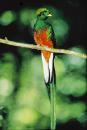 One beautiful quetzal, a lovely specimen came over and sat in a branch no more than twenty-five feet from us. Its scarlet chest was easily visible, as were its unbelievable colors. It was tough to imagine a bird such as this surviving in the wild.
“The most beautiful bird in the world,” Gustavo proclaimed as if it were a scientific fact, and I had a sense that if he had a crimson chest, it too would have puffed up with pride. His mission for the day was accomplished.
We hung around some more, delighting in the liberal viewing of this rare bird. The bird posed, preened, turned around. All around me people were whirring their cameras, and digital zooms were finally earning their value.
As I saw this bird, brightly colored red and blue against the completely green foliage, I remember thinking that in addition to being beautiful it was also a little ridiculous. Unlike the green pit-viper, this bird, the quetzal, had absolutely no concept of a camouflage. I remember being somewhat surprised that this bird wasn’t extinct as yet.
Even the rarest of wonders begins to jade in time, and we trekked out of the Santa Elena preserve, looking forward to our dinners and the quetzal stories we would tell others.
Ram Prasad
June 2004
