Marina's vignettes of the middle class have always captivated the audience. KAUSALYA SANTHANAM talks to the playwright whose Rasika Ranga completes its silver jubilee this year. .
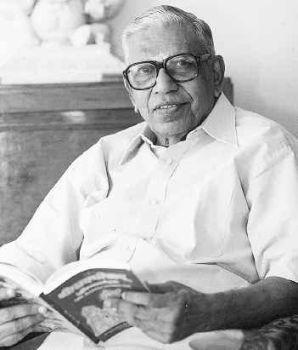
"NOTHING WE achieve is through our talent. It is all through God's grace and His blessings," says Marina, whose troupe Rasika Ranga completes its silver jubilee this year.
Hamsadhwani inaugurated the staging of plays at its venue by presenting Marina 's "Sweekaram" at the Youth Hostel premises recently. The vast open space was packed with viewers, and why not? Defining the stage experience of a generation of viewers were Marina's plays.
The viewer was transfixed by the portraits of middle class life captured with a rare authenticity. Both the situations and the characters were so infused with realism that the spectator could feel a thrill of recognition. "That is me. And there is the gossiping grandmother, the quarrelsome aunt, the meek daughter-in-law, the meddling woman next door, the retired wag, all the characters we meet in the course of our daily life."
And they were all painted with such humour and wit that they brought the audiences back to the hall time and again. "We put up precisely 815 performances," Marina (now 80) says during the interview at his rehearsal space-cum-office. "My friend Vittal Rao has noted it all meticulously down," he points out, opening a faded notebook.
"See here is the date of the show at the Brahma Gana Sabha, this was at the Mylapore Fine Arts. Believe it or not, there were 75 sabhas in Madras in the Seventies while there are just 10 or 12 now. The sabhas encouraged us and the stage flourished. I did not put up plays for the past few years because some of the actors I had trained left the troupe to act in television soaps. But TV serials are just like cinema for they are made by directors from that field. People watch them because there is nothing else available."
T. S. Sridhar never expected that he would transform into Marina, the writer of hugely popular plays and as Bharaneetharan who would take his readers on a fulfilling journey to the bhakti kshetrams.
"I owe it all to the divine blessings of the Mahaswami, Sri Chandrasekharendra Saraswati of the Kanchi Kamakoti peetam," says Marina reverentially. "Have you seen Chakiyar Koothu, the Mahaswami once asked me," he continues.
" `The form of this performing art of Kerala has undergone a change, but the content is the same � about family life. It is social satire like what Cho does today,' Periyava explained."
Sridhar happened to see a Chakiyar Koothu performance in Tiruvottriyur and soon after wrote a novel in 1964. `"Kadal Enna Kathirikaaya?' was followed by ``Vadapazhaniyil Valmiki," a satire on what sage Valmiki would feel if he visited modern day Madras. Then came ``Thani Kudithanam." The response was overwhelming. Kala Nilayam staged it with K. S. Nagarajan and Poornam Viswanathan playing key roles.
The troupe also dramatised ``Vadapazhaniyil..."
"The other plays came after I severed my connection with Kala Nilayam and founded Rasika Ranga. `Oor Vambu' and `Kal Kattu' completed the trilogy. All the plays centred around the institution of marriage and the cycle of rituals and celebrations of Brahmin life. `Thani Kudithanam' centred around the desire of a just-married young man to break from his parental home and set up house on his own with his innocent bride.
"He tutors her to alienate her mother-in-law though she wants to be friends with the older woman," says Marina recalling the amusing scenes with gusto. "Finally, it is the old couple who leave. I was only taking a humorous look at the social phenomenon of that time and documenting the changes in society, not being preachy about the joint family system There was not a big story development � it was just two and a half hours of laughter. `Oor Vambu,' about how a middle-aged man and woman engage in mutual slander but reconcile when the younger members of the family decide to get married to each other also aroused gales of laughter as did `Kal Kattu' which portrayed the animosity and one-upmanship between daughters-in-law. The clash when tradition and modernity are juxtoposed generally provides the humour in my plays."
Were his plays not catering to a niche Brahmin audience that belonged to a certain class and section of society? "Not at all. An artiste has no caste. The problems are the same everywhere and this is the milieu I know best.
``There has to be honesty in the writing. Life was reflected in them and most of my plays were staged at the Annamalai Manram and drew huge audiences from other sections too."
To counter the criticism, he wrote another trilogy ``Engamma," ``Saamiyaarin Maamiyaar," and "Maapillai Murukku," which dealt with another caste, repeating the success of the first one. "Saamiyarin Maamiyaar" based on a news item of how a young girl is harassed by her in-laws for dowry ("this was rare then") was a runaway success with more than 100 shows being performed. So was "61 Vayadhinile" which again examined the institution of marriage. "My plays were written to provide me relief between the travelogues on temples. But a play like `Sweekaram' on a man's Dharma is not easy to write unless you have divine blessings." Marina's professionalism is such that when you ring him up for an interview he says, "Can we put it off? I have to attend to the lights for the show today." It is this professionalism that has him singing paeans when he sees it in a meticulous artiste like veteran Karur Rangaraj who can excel in a complex role such that of the protagonist of "Sweekaram."
A seasoned journalist, Marina was with Ananda Vikatan till he opted for retirement in 1984. "I used to review plays while I was working there. I was so impressed by Komal Swaminathan's `Thanneer Thanneer' that I rushed backstage to congratulate him. Balachander was present that evening and I have an inkling that this also contributed to his decision to make the play into a film." Marina is a great believer in the power of heredity. As a child he would watch his father T.N. Seshachalam train artistes for his productions. "Father was a great scholar. He founded a literary journal called Kala Nilayam in which he translated the plays of Shakespeare and Sheridan. I learnt a lot by keeping my eyes open." Marina's keen power of observation is visible in every scene of his 18 plays which reflect the highs, the lows, the celebrations and the sorrows that complete the circle of life from generation to generation and bind successive members in a thread of continuity that provides them strength
KAUSALYA SANTHANAM
From The Hindu dated 16th April 2004
