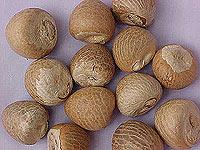
 Are arecanuts or betel nuts important enough for there to be Agmark rules on them? Evidently, they are, because we have the Arecanuts (Grading and Marking) Rules of 1952. These rules are extremely confusing and there are separate grade designations for whole dried nuts and cut boiled nuts.
Let's concentrate on whole dried nuts for the moment. The basic rules suggest there are four categories of nuts - Moti, Shrivardhan, Jamnagar and Jeeni. Each category has three sub-grades - special, AI and AII.
Special nuts must be labelled white, AI nuts must be labelled red and AII nuts must be labelled blue. Labels must indicate year of harvest, packing centre, date of packing and net weight. "The arecanuts shall be packed in gunny bags which are clean, dry and in good sound condition.
"Containers which have been previously used for commodities likely to cause damage or impart any flavour, odour or other undesirable characteristics to the arecanuts shall not be employed."
When you look at the detailed grades specified, you discover that there are not four categories for whole dried nuts, but seven. The three additional categories are Meetupalayam, Pooja and Koka.
For each category and grade, there are specifications on diameter, minimum percentage of Topiwali nuts, colour of pith and maximum percentage of damaged nuts. A Topiwali nut is "a nut having a portion of its endocarp adhering to it."
Let's consider diameter first. Moti nuts must be 25 mm and over, but less than 30 mm. What happens if a Moti nut is less than 25 mm or more than 30 mm? Presumably it will not be called a Moti nut.
Shrivardhan nuts must be more than 25 mm and less than 25 mm. I swear I am not making this up, this is what the rules say. There may of course have been a printing mistake.
Jamnagar nuts must be more than 20 mm and less than 23 mm. Jeeni nuts must be less than 20 mm. The three grades of Meetupalyam nuts will be between 12 and 15 mm, between 15 and 19 mm and between 19 and 23 mm. Koka nuts have two grades and these must be between 13 and 19 mm and between 19 and 23 mm. As for Pooja nuts, they must be below 12 mm. Topiwali nuts don't seem to matter for Meetupalyam, Pooja and Koka.
As for the others, in general, special categories must have 75 per cent Topiwali, AI must have 40 per cent Topiwali and AII must have 10 per cent Topiwali. In general, 90 per cent of the pith of special must be copra-white, with percentages of 60 for AI and 10 for AII. Special can have no yellow-brown in the pith, while the maximum percentage for AI is 60.
In general, the maximum percentage of damaged nuts is 1/2 per cent. "Damaged nuts include cracked and broken nuts, over size nuts (Bomda) pieces, nuts not fully husked and those the pith (Bhong) of which is black or otherwise damaged by moulds, insects etc."
Koka nuts are in a class of their own. Because for those, special can have 1 per cent damaged nuts, AI can have 2 per cent and AII can have 3 per cent.
"The arecanuts shall be whole fully husked, of light colour, reasonably well matured, free from blemish cracks, fissure, shrinkage and shall not be hollow inside. The arecanuts shall not be worm-eaten or otherwise damaged from outside or inside."
However, for Koka: "The arecanuts shall be whole and may be slightly immature. Small cracks and fissures allowed. Slight shrinkage is also permitted. In AI grade adherent skin is not permitted."
From "Going nuts about nothing" in the weekly column The Fine Print by Bibek Debroy in The Business Standard, Mumbai, 1 December 2000
Bibek Debroy's columns contained gems of legalese like this one:
We continue to retain the Prisons Act of 1894. Section 46 of the Prisons Act provides for punishments and this includes whipping, provided that the number of stripes shall not exceed thirty.
It also provides for the substitution of gunny or other coarse fabric for clothing of other material not being woollen for a period which shall not exceed three months and penal diet, that is, restriction of diet in such manner and subject to such conditions regarding labour as may be prescribed by the state government.
Provided that such restriction of diet shall in no case be applied to a prisoner for more than 96 consecutive hours, and shall not be repeated except for a fresh offence nor until after an interval of one week.
Are such forms of punishment still inflicted?
From "Whipping norms" The Business Standard, Mumbai, 6 April 2001
