Children find it hilarious and adults are impressed with the terrific timing. It is clowning at its best. KAUSALYA SANTHANAM talks to the performers .
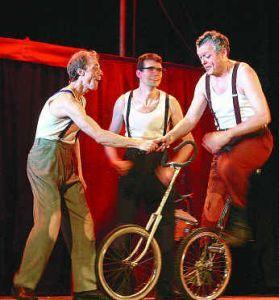
"Les Cousins" ... combining humour with acrobatic skills
Pic. by N. Sridharan.
ZANY AND skilful, they are musketeers who carry only the weapons of laughter � plastic balls, unicycles, (un)musical horns ... Rene, Julot and Lolo � can there be more perfect names for a trio of clowns and comedians?
With the Alexandre Dumasian slogan of "one for all,'' "Les Cousins" combine "all in one" in their show � dance, music, juggling, clowning, cycling and acrobatic skills. Children find the show hilarious while adults are impressed with the split second timing and the fine precision of a performance that crackles with energy.
The Cousins connect up with the audience instantly whether in Chile or "Cheennai." "He is a paithiyam (lunatic), a French paithiyam," says Julot pointing to Lolo and the audience's eyes light up in anticipation of the craziness in store. Bringing the skills of the circus to the proscenium stage and garnishing their act with some touches of verbal humour, Les Cousins made a riotous trip across the country visiting eight cities from March 25 to April 10. Organised by the Alliance Francaise, their performance at the Music Academy was on April 1. Their entrance is dramatic. The cousins make a noisy progress through the aisle blowing on their horns, bumping along with a black box and knocking each other out constantly with a red plank. Sporting huge white rosettes in their coats, they clamber on to the stage. Chairs crash and the mike seems to have turned into a wild, sinuous creature that lashes out at the trio constantly like something from a Roald Dahl story.
There is nothing outlandish about their costumes but the expressions on the India rubber faces and the agility and absurdity of their movements evoke merriment, especially from the children.
"Vanakkam" goes Julot and soon after, Lolo is hit by the plank and his "teeth" fall out in a shower of white beads which Rene picks up in a hat and solemnly hands over to him. "We are professional but French," announces Julot and the trio goes into a neat song and dance routine, the music in happy discord.
The show warms up as Rene gets on to his unicycle and does a skipping routine that has you going "wow". A little later, there is incredible juggling by Lolo as he creates more and more distance for the balls to bounce. After Lolo's comes Julot's show. The feats of balance reach a crescendo with the nonchalant, gum-chewing Julot literally travelling to greater heights. "Wasn't that fun!" sighs a five-year-old blissfully, as she leaves the hall.
How difficult is it to create fun? Or is it easy to be funny if making people laugh is what you want to do and do all the time? Five hundred shows in four continents in 15 years! How's that for a record in clowning? It's their second visit to India and their first to Chennai.
Just a couple of hours before the show, the three artistes take time off from supervising the arrangements on stage to talk to this correspondent by turn. Cool and relaxed, Julot is willing to give the chat quite a bit of time, Lolo would like to but is a trifle hampered by his rather halting English... "Make it five minutes," says Rene but stays on for ten.
Was it their childhood ambition to become clowns? No, say all three, it came much later.
Why "Les Cousins?" Are they related or do they belong to traditional circus families?
Julot: In France, all traditional circus family members call themselves cousins. We don't come from that background. Some 20 years ago, traditional circus companies in France opened their doors to outsiders to infuse new touches and bring "fresh power." There was a crisis with TV and cinema luring away the crowds. I was studying agriculture before I decided to train in the circus. I liked agriculture but I like this more. We perform a lot in street festivals and have participated in the Avignon theatre festival.
Rene: I went to a circus school. I tried a whole lot of things before that. I was an actor, worked in factories, dockyards, and as a nurse for children.
Lolo: I've worked in other circuses in France. For a long time in the Eighties, I was with a new kind of circus, the "Archaos," where we did death-defying feats on machines, cars, motorcycles... I stayed for one year in Paris and trained in a circus school. There were 40 of us but only two or three continue in this field. You have to have a lot of motivation to be in this.
Is it because its very difficult?
Julot: When you do what you like, it's not hard.
Lolo: It's like learning to drive a truck. It's difficult at first but you soon learn and get used to it. Then it's a job like any other.
Rene: (simply) I like it. We travel a lot and get to meet different kinds of people.
Are you constantly changing your act? What are your inspirations?
Julot: Just a little to suit the cultural milieu. Slapstick, traditional circus, pictures of performers of the Middle Ages, our own experience by observing people and situations. All of this form impressions in your mind. It's all not very clear but pops up when needed. We have five different shows in our repertoire.
Rene: Films, by performing again and again.
How did you come together? How well do you get along? Do you have arguments, disagreements, rivalry?
Julot: We worked together a few times and found we hit it off. Now we've been together for 15 years. We do argue but have a good understanding. So good in fact that we don't want to admit anyone into our group, not even our wives. (Julot's wife is a costume designer, Rene's is a painter and Lolo's a juggler.)
Lolo: We are complete as a team, we understand one another very well. Three is a perfect number, one more person will upset the balance.
Rene: It's a good partnership. It's like when you are married � boring but also very comfortable.
How much does the Government in France encourage troupes like yours?
Julot: When we started out, the Government did a lot for the arts. The circus had been considered a very minor art then and not very interesting. The Government encouraged new shows. Now the funding has come down a great deal but the Alliance Francaise and other French cultural centres have been of great support in helping us take our performances the world over.
What makes you happy?
We are most happy when the audience is happy. It's very satisfying � it's great � to make people laugh.
KAUSALYA SANTHANAM
From The Hindu dated 9th April 2004
