Annotations on Quotations
The idea is to write about my trip to India. But it mustn’t be a linear travelogue ( too many others have done that too well). Also, I cannot pull off an essay that is interesting successfully. So I came up with an alternative idea. Why not take 5-6 quotations that I heard while in Chennai, and use those as launching points (jumping off points?) to mull over things wherever they may lead?
These are not famous quotes, just things that were either said to me, or that I happened to overhear. Anyway, this is too much ado already. Time to plunge in. Come on, jump with me.
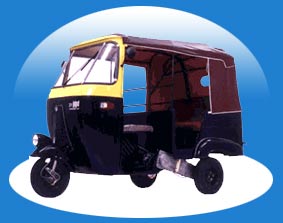 "1. Iruvadhu rubayukku vaayen. Happy New Year."
"(Why don’t you agree to 20 Rs. Happy New Year.)"
Said to an auto-rickshaw driver with folded hands by a drama patron outside Vani Mahal on Dec 31st, 2003.
Something about this sentence and how it was delivered made a big impact on me. The patron was a man in his sixties. He really stressed the word happy. Auto-drivers were always appealing to me, asking me not to haggle over 5 or 10 Rs. I loved the fact that this man was applying reverse psychology. He was drawing on the fact that it was New Year’s eve to get the auto-driver to agree to a lower fare than what was asked.
It is the same before every visit to India. I tell myself that the traffic can’t be all that bad, that I must simply be imagining it. Then, when I am in India, I see that the traffic has gotten worse. With any two approaching vehicles, there is a lot of maschismo in terms of who finally backs down to avoid the collision. I see this drama and realize that I cannot ever drive again. Well, maybe next time.
I found myself haggling with drivers. I cannot explain even to myself why I did it. While in Chennai, do as they do, I suppose. My algorithm was very simple. No matter what the driver quotes, I ask for Rs. 5 less. The amount by which the price was reduced is not important. What gave joy was the fact that I managed to back the auto-driver down. Maybe this is a little like driving in the chaotic traffic, after all.
This time, I noticed that distances seem to have shrunk. What was long distance in my mind turned out to be not-so-far after all. I think living in the widely spread out Chicago metropolitan area does this.
Also, I think auto-rickshaws have great potential to emerge as the next sight-seeing vehicles of choice. It is great to see everything floating by, not too fast, not too slow. It is not like being in a car, where you are cut off in your own environment.
That’s enough meandering. On Dec 31st, in front of Vani Mahal it was getting late. I was with both my brothers. We didn’t stay there long enough to learn whether the gentleman got his happy New Year ride for twenty rupees.
"2. Nari Kurava ellam kooda Limited Stop Bus_la pora!"
"(Even the wayside gypsies board the Limited Stop buses)"
Said to me by my aunt Hemalatha, as final proof of the increased buying power.
To everyone who chatted with me, I mentioned the increase in spending that I perceived. It wasn’t as if people were flaunting their money. They simply were being very matter of fact about spending money. I had read about India having the world’s largest middle class, and in Chennai I was seeing it in action.
Of course, my data in making any claim about spending is purely empirical. I see therefore I conclude. But my aunt is a banker and she must have real data to back up her statements. When she talks about people and their money, I listen.
We all have stereotypical images and notions. Part of expanding our horizons, I guess, is to learn for ourselves and shed those stereotypes. For the longest time, I believed that India was a poor country. Sure, I personally had no money worries, but then I was one of the lucky ones. However, overall the country was poor.
I had a friend in graduate school in Buffalo who was older than me by over ten years. He was visiting us to earn a Master’s degree before returning to his family in India. Late one night, we were shooting the breeze in the grad lab. I was vehemently arguing that the reason things were not as advanced as they could be in India was the lack of funds. To which, he made a statement rather casually. “There is plenty of money in India, Ram,” he said. So I updated my mental image of India as a wealthy country in which also lived the very poor class.
But only this time did I see for myself that there is also a huge “spending class” in India. Things have changed.
"3. Andha naal ellam maari ippo illa, Prasad"
"(It isn’t like those days anymore, Prasad")
My grandmother, reminiscing about my college days when I used to visit her home every weekend.
This time, I found out that I have something in common with my grandmother. I dwell in the past a lot, and with fondness. I listen to tons of songs from the early (“glorious”) 80s. I even have an appellation for myself – a Nostalgian.
There seems to be an eternal dilemma with nostalgia. When you have a really good experience, you wish you could freeze time and hold on to it forever. But that also means that you can’t be having other newer and nice experiences.
Here’s my theory on why I am still stuck in the 80s. I left Madras, a city I loved and love, in 1990. And in spite of short visits now and then, the mental image of Madras that I hold hasn’t been updated in over a dozen years. But the city has changed a lot.
While revisiting Chennai, every theater I go past causes me to recall movies that I saw there with my cousins and relatives in a previous lifetime. Srinivasa, Vijaya, Udhayam, Ganapathyram and the now-gone Eros and Safire. I can’t quite explain why, but I sure miss them. Even when ARR and his mp3’s are all the rage, some of us still miss MSV and long for LP records.
It is not just the theaters. Practically every road and building in South Madras that I go past dregs up a strand of long-forgotten memory. It is not unlike opening a box that you crammed with things when you were a child and discovering the box twenty years later. Kind of interesting, kind of scary. More such boxes remain to be discovered, but sadly many are gone forever.
Oh, well. Like my grandmother says, it isn’t like those days anymore.
"4. Wow, Ram, that’s only half a day’s work here in Bombay."
Said to me by my sister-in-law’s husband, Ashish, in response to my statement that I reached work at 10 a.m. and got out around 6.30 p.m.
My first reflex was to defend myself. But I managed to keep quiet and let it go. I am not that impressed with long work hours anymore. Also, in my company, we only count and expect 6 to 6.5 hours of productive work for every workday, no matter how long one stays in the office.
In Chennai, I saw that people are putting in really long hours in the office. I have my own doubts about how effective one can be working 12 hours, and working six or even seven days a week. Surely, efficiency takes a back seat. These days, the topic of “work/life balance” is a big deal. You work your tail off, and then your family life and your leisure suffer.
Ashish’s statement allowed me to indulge in some completely unsubstantiated speculation. Here my guess as to what goes on when folks spend over 10 hours in the office. Get to work, go looking for coffee, catch up on email (or the newspaper), do a couple of minor work-related things, start visualizing lunch, go with colleagues for lunch, have a cup of coffee/tea after lunch, do some work, if a cricket match is going on discuss the score and possibilities, time for an afternoon cup of tea, pretend to your colleagues to be busy, have one last round of vada-and-coffee, head homewards. Like I said, unsubstantiated, but I have never been able to shake the feeling that is what goes on.
"5. Because the aacharyan shows us God, he is more important than God."
Paraphasing Velakkudi Krishnan.
Because I was constantly jet-lagged and up really early, one day I decided to accompany my parents to the Thiruppavai discourse. Twenty years earlier, while living in Ashok Nagar I used to attend quite a few discourses.
What I saw and heard in the Velakkudi lecture surprised me. Mr. Krishnan’s scholarliness floored me. How can someone know and recall so much?! I didn’t follow all of what he was saying, but I do believe that every one of his lectures is a study in public speaking. The manner in which he presents his theories and gets people to buy into his point of view is remarkable.
It was also eye-opening (to me) how many Vaishnavites there were. People flooded the lecture even on work days. I didn’t even know it myself, but is it possible that I have been a closet-Vaishnavite all along?
 As a quick aside, it was in the Velukkudi lectures that I saw and heard about Divya Desams. The first time I recall hearing about the Divya Desams was when my uncle created a web-site for them and I took a look. This time, I see and hear a lot more about Divya Desams. The unasked question is: How many of the 108 have you visited? Unbeknownst to me, the Divya Desam race had begun, and I had missed the starting-gun.
People may have become very busy, things may have changed a whole lot, but what was truly interesting was how the Chennaiites have woven everything into their daily lives. Get up early, go to the lecture (or a walk), go to work, then fit in some form of evening entertainment before calling it a day; then start off all over again. I am unable to articulate it well, but there was something very unique and impressive about the way everyone seemed to be managing everything.
"6. “Nambo ellam saabavukku enge poga porom? Yedho indha velayinaala konjam sangeethamum Kedaikirathu.”
"I can't afford to go to a sabha. But thanks to my work, I can listen to music."
TTD temple night watchman during Kadari Gopalnath concert on 7th Jan 2004.
Maybe I have written too harshly about the long work hours, about the lack of leisure. A more accurate way to characterize what I saw would be to call it dutiful leisure. If you must go to a concert, or you must go to catch a movie or you must go to the beach for a walk daily, doesn’t that take away a little from the enjoyment?
I loved the attitude of this watchman, who had figured out a way to enjoy while working. Cliché: If you love what you do for a living, you don’t have to work a single day of your life.
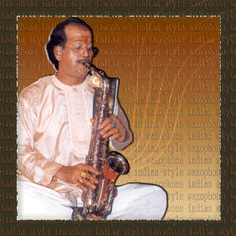 Mr. Gopalnath was giving a free concert, and I went there with my brother and his wife. I peeped into the concert hall, and it was packed to the gills with rasikas seated Indian-style on the floor. For the overflow crowd, they had set up huge speakers outside. There, this watchman started rolling out huge jamakkalams that released huge clouds of dust when unfurled. No sooner than one mat being laid out, it would be filled by two dozen or so listeners. It seemed magical to me.
The three of us sat on a concrete dias hoping to enjoy the music. There was a strong smell of paint, which I tried to ignore, not wanting to behave like a spoiled NRI. However, when the gentleman next to me wrinkled his nose and asked me, “Enna smell sir idhu?!” (What is this smell?) I realized that I was not the only one going giddy with the noxious fumes. I bravely persisted in trying to enjoy the music. I own one audio-cassette of Kadari’s which I have listened to over and over dozens of times in my car stereo. It seemed super-cool to be able to listen to Mr. Kadari live during the music season along with all these Chennaiites.
But boy, was the music loud? To my untrained ears, it looked like Mr. Gopalnath (Saxophone) and Ms. Kanyakumari (Violin) were trying to drown out one another through sheer volume. Maybe I was making this into too much of a duel. Or, maybe the TTD audio technician simply did not believe in safe sax. But I tell you, those speakers were loud.
I happened to glance above my brother’s head. Illuminated by the fluorescent light, I saw well over 200 mosquitoes circling there, as though waiting for clearance from an air-traffic controller to give them permission to land and feast on us. I then noticed that all three of us were busy scratching our arms and feet.
The paint smell, the loudness, the biting mosquitoes. So we finally relented and decided to head back home. I have grown too soft, but that has only made me admire even more those rasikas who endured everything to get their daily dose of music. Also, I was happy for the temple watchman.
I think you have to live without the Indian way of life for quite some time to appreciate it fully. Something about absence making the heart grow fonder. I still wish the days were the way my grandmother and I choose to remember them.
Ram Prasad
February 2004
