| FRANCESCA WOODMAN |
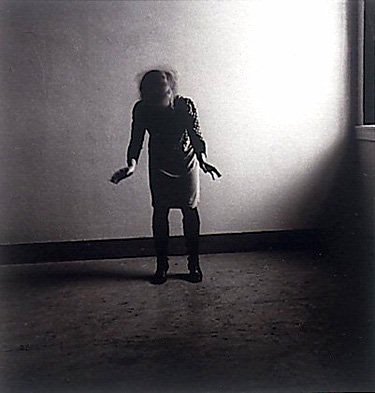
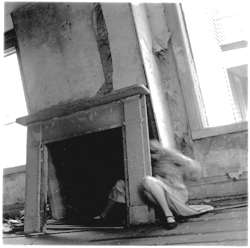
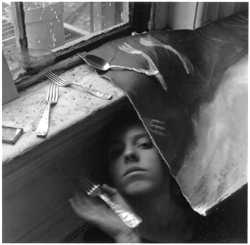
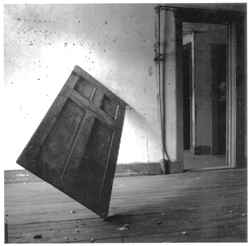
| Francesca Woodman The broken woman portraits Francesca Woodman threw herself out the window of her East Village loft in 1981, just two and a half months before her twenty-third birthday, taking her own life. Woodman was born into a family of artists in 1958 in Denver, Colorado and began to take photographs seriously at the age of 13, continuing her art until her premature death. Between 1975 and 1979 Woodman studied at Rhode Island School of Design in Providence, where she won a prestigious scholarship to Rome for a year. While in Rome, Woodman put on her first solo exhibition in the gallery-bookshop, Madador. After her year abroad, she moved back to the United States to complete her degree in Providence before moving to New York. During her short life, Woodman built up an amazingly coherent and profound body of work, consistently defined by a clear style and subject matter. Woodman became the photographer and model in her work and although in her early photographs friends sometimes appear, she, often appearing nude, was invariably her own subject. Woodman explained this quite simply: "It's a matter of convenience - I'm always available." Woodman appears in her work as an anonymous body, at times appearing in an almost apparitional or hallucinatory state of melodramatic self-hurt. The setting of the photographs is usually in dilapidated, decaying and abandoned spaces, with Woodman taking up flailing or hidden positions, often disappearing into an intentional blur. The images created, hold a definite sense of torment and hurt but also bring an exceptionally strong level of ambiguity between a fragmented reality and inner knowledge. It is indeed the pursuit of knowledge, and more explicitly self-knowledge, which possesses the utilisation and placement of the body within the works. The artist's own body become a vehicle to initiate dialog with herself, placed, as it is, somewhere between the artist's inner self and the surrounding world. Each image brings a novel angle, fertilised by the inclusion of symbols and images, adding to the voice of communication. The added images and symbols import a surreal air into the photographs, but these complex combinations have little to do with improvisation or chance, even if they seem initially to contain a scant concern for premeditated composition. More appropriately, Woodman fits into the feminist avant-garde of the late 1970s, alongside Hannah Wilke et al., almost a precursor to current favourites Nan Goldin and Cindy Sherman. Woodman worked during a period of art when the main theme under investigation was de-constructivism - but none of the concerns of this theory are share by Woodman. Instead, Woodman constructed scenes by superimposing differing levels of the real, rather than taking apart reality in order to illustrate an image's component parts. As critic Kathryn Hixon explained: "She [Woodman] added layers of reflection and mimicry within the photograph to confound the transparent recording of the real. The images become psychological portraits of the identity of the body, rather than identifying physical portraits that reveal the psyche." The symbolic reconstruction of the reality in Woodman's work allows for the examination of the recognition of reality itself - a quasi-paradox which suggests the artist's interest in the discovery of her own self, through the exhibition of her body which carries vulnerability, reaction and perception. This is an important psychological component of the portraits, illustrating the intimate expressive capabilities of the artist, rather than a mere record of daily existence. |