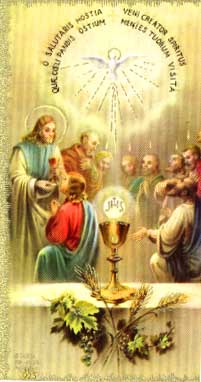
 Chapter XXXIII: THE FOURTH PASSOVER AND THE INSTITUTION
OF HOLY MASS BY OUR LORD JESUS CHRIST.
Chapter XXXIII: THE FOURTH PASSOVER AND THE INSTITUTION
OF HOLY MASS BY OUR LORD JESUS CHRIST.
1. Jesus joined His Apostles and disciples in Bethany
on Thursday the 24th of March of the year 34 after daybreak. What took
place shortly afterwards is related by the first three Evangelists (Matt.
XXVI, 17; Mark XIV, 12; Luke XXII 7). Let us now make a detailed study of
those texts. Saint Matthew says: "And
on the first day of the Azymes, the disciples came to Jesus, saying: Where
wilt Thou that we prepare for Thee to eat the Pasch?" (Matt.
XXVI, 17). Saint Mark relates: "Now
on the first day of the Unleavened Bread, when they sacrificed the Pasch,
the disciples say to Him: Whither wilt Thou that we go and prepare for
Thee to eat the Pasch?" (Mark XIV, 12). Both Evangelists identify
the feast of the Passover, which lasted for eight days, as that "of
the Azymes". With the expression "the
first day of the Azymes", they refer to the 14th of Nisan, which
in that Jewish Passover had begun after sunset on the 23rd of March. For,
as we know, although the azmyes were eaten during seven days, beginning on
the 15th of Nisan, nevertheless everything relating to those celebrations
was prepared the day before, the 14th of Nisan, on which the lambs were
slaughtered in the Temple. That is why Saint Mark says "when
they sacrificed the Pasch". We see how the Evangelists themselves,
in the texts cited, also speak of the Passover meal, which was eaten once
the 15th of Nisan had begun, and in which the azymes were eaten for the
first time. For the Jews called each of the days on which they were eaten
<
2. This Holy Council teaches that the Cenacle where
Jesus celebrated the last Passover in the city of Jerusalem belonged to
Joseph of Arimathea and Nicodemus, who after their conversion had been
entrusted by the Master to acquire it for pious ends. These secret
disciples, in turn, left its care in the hands of Obed and his wife Mary,
parents of the future Evangelist Saint Mark. As has already been stated in
this Treatise, beneath the vaults of this privileged place Most Holy
Malachias wrote His prophecies on the Perpetual sacrifice of the New Law.
Furthermore, we now affirm that the Ark of the Covenant rested for many
years on the site where the Cenacle was afterwards built, before being
borne to Solomon's Temple. The Cenacle, where later the Holy Ghost would
descend on the Apostles, is situated on Mount Sion. Although most of
city's buildings were afterwards razed by the Romans, Persians and other
invaders, the Cenacle, nonetheless, was spared from complete destruction,
wherefore the present-day building remains quite authentic. The fact that
Jesus did not disclose to the two Apostles the place where He desired to
celebrate the Passover, but made use of a countersign, was to conceal it
from Judas Iscariot; it was not convenient for the latter to know
beforehand, because he had displayed lively interest to discover it so as
to complete his treachery, as is seen in the revelations of Saint Mary of
Jesus of Agreda. Continuing our interpretation of the Gospel, we state
that the "man carrying a pitcher of water" whom the Apostles were
to follow was in fact Saint Mark. The master of the house, or head of the
household, was therefore Obed, who at certain times dwelt there, and at
others on Mount Olivet, at his home in Bethphage. Years later the Apostle
Peter was to seek refuge in the Cenacle, after having been freed by an
angel from his chains in prison (Acts XII, 12).
3. We now make the following clarification. In Chapter
XXX of this Treatise it was defined that in February of the year 32 Jesus
chose, among other disciples, «Obed, son of the aged Saint Simeon and
father of Mark the Evangelist». In Chapter XXXII, when speaking of the
ass and colt used by the Master in His triumphal Entry in Jerusalem, we
established the following: <
4. Saint Mark goes on to say: "And His disciples went their way and came into the city. And they
found as He had told them: and they prepared the Pasch" (Mark
XIV, 16). Saint Matthew (XXVI, 19) and Saint Luke (XXII, 13) speak
likewise. We see in the verb "came"
used by Saint Mark clear proof that the young man with the pitcher of
water was the Evangelist, since with this verbal term he tells us that the
two Apostles approached him. Following this clarification; we teach that
Jesus had instructed the two Apostles what should be prepared at the place
of the Last Supper for the mysteries He was to accomplish. Once John Mark
had led Peter and John to the mansion where lived his parents, namely
where the Cenacle was, the Apostles charged Obed to go to the Temple and
have a lamb sacrificed, and afterwards roasted at home, so that when Jesus
arrived it would be prepared for the meal of the Paschal lamb or legal
supper. They also entrusted him with everything required for the daily
supper, which was to be more solemn on account of the Passover. The great
hall of the Cenacle, as is seen in the Gospel (Mark XIV, 15; Luke XXII,
12), was already adorned for the solemnity. We interpret that it was also
fitted out with luxurious carpets, tapestries and lamps, as well as
provided with tables, chairs and other furniture, since Joseph of
Arimathea and Nicodemus, as likewise Obed, already advised by the Lord
that the Passover was to be celebrated there, had been unsparing in its
embellishment. While the head of the household went to the Temple, Peter
and John, helped by Mark and his mother, also prepared, in the centre of
the Cenacle, the table for Jesus and His twelve Apostles, with goblets and
other items. In another section, everything needed by the disciples, over
whom Agabus would preside. Then a suitable place was fittingly prepared
for the holy women, over whom the Divine Mary would preside. Everything
was arranged so that all would be able to see what Jesus did, for we teach
that besides Jesus and His Mother, there were some 120 persons gathered in
the Cenacle, counting Apostles, disciples, holy women and other followers
of the Master. On a small table they also prepared three amphoras
containing olive oil; and separately, a large washbowl and towel. Finally,
in a prominent part of the Cenacle, they set up another table covered with
linen cloths. Upon it the two Apostles and Mark secured a tabernacle which
they had fashioned by elegantly adapting a small piece of furniture,
extremely suitable for the purpose, and which they then covered with a
white silken veil. When Saint Mark says that "they prepared the Pasch" (Mark XIV, 16), as do the other
two Evangelists (Matt. XXVI, 19; Luke XXII, 13), it must be understood
that they left everything in readiness for the legal supper, the daily
supper and for the celebration of Holy Mass with other mysteries. Their
mission in the Cenacle ended, Peter and John returned to Bethany at nigh
on midday of Thursday the 24th of March and joined Jesus and the other
Apostles and disciples, without disclosing to their companions the place
of the Last Supper, exactly as He had instructed them. Shortly afterwards
the two formerly possessed men of Gerasa, now disciples, arrived at
Bethany. As we know, they had been fulfilling in secret their evangelical
mission at the command of the Master, Who, mysteriously, days previously
had summoned them to make themselves known to the Apostles and disciples,
and now to live in community with them.
5. After the midday meal at Bethany, before going to
the Cenacle to celebrate the Passover, Jesus retired to the Garden of
Olives to pray with His Apostles and a large group of His disciples. On
the way He instructed them about the Eucharistic mysteries and on the Holy
Orders the Twelve were to receive. When in the Garden, His Countenance
displaying a most sweet and loving tenderness, Jesus solemnly announced
that evening He would give them as inheritance His Body and Blood. In the
meantime, the Divine Mary instructed in the sacred mysteries the other
disciples who had remained in the house, as well as the women religious.
6. In the following text of Saint Mark, "And
when evening was come, He cometh with the Twelve" (Mark XIV, 17),
it must be understood that Jesus, together with the Apostles and the
others praying with Him in the Garden of Olives, departed thence for
Jerusalem at about five o'clock. At the same hour His Divine Mother left
Bethany with the pious women, including Martha and Mary, as well as Agabus
and the remaining disciples, and also Lazarus. When they all arrived at
the Cenacle, the secret disciples Nicodemus, Joseph of Arimathea and
Gamaliel were waiting for them, We teach that Mary Most Holy, on Her
joyful way to the place of the Institution of Holy Mass, brought the most
sacred Chalice of Melchisedech which She had cared for with great
veneration after receiving it, as we have already stated, from Saint John
the Baptist. It was to be used by Her Divine Son for the essence of the
Sacrifice He was to celebrate. For
his part, Agabus, notified by the Divine Mary, brought to the Cenacle two
sacred vessels, after the fashion of ciboria, traditionally used in
Essenian worship. In them, after His first Mass, Jesus would reserve the
Most Divine Sacrament in the tabernacle; in one, His Most Sacred Body, and
in the other, His Most Precious Blood. In addition, Agabus also brought
the half of the cape which the Holy Prophet Elias had bequeathed to
Eliseus, a sacred garment of the Essenes. When all had assembled in the
Cenacle, after sunset on that 24th of March, the celebration of the
Passover began. His Holiness Pope Gregory XVII has defined the order Jesus
observed in the Last Supper: he says, first the eating of the paschal lamb,
which pertained to the legal supper, and which all observed standing
according to the Old Law; the daily supper followed; finally Jesus
celebrated Holy Mass, with other mysteries, as will be explained.
7. Let us consider the places occupied by the Apostles
exactly as Jesus had arranged. As the table was rectangular, in the centre
of one of the longer side the Master presided, facing those present, Peter
at His right as Prince of the Apostles, James the Greater at His left;
beside Peter, John; beside James, Andrew. Each of the two lesser sides of
the table was occupied by two Apostles. The right wing by Philip, then
Matthew; the left wing by Bartholomew, then Thomas. At the longer side of
the table opposite Jesus were placed the remaining four. At the right,
James the Less, then Simon the Cananaean; at the left, Judas Thaddaeus,
then Judas Iscariot. An open section was left in the centre out of respect
for the presidency, Jesus being visible to all present in the Cenacle.
Given the form of the table, Judas Iscariot was seated almost facing Jesus
and therefore quite close to Him. Over their tunics all wore the festive
cream-coloured Carmelite cape which, by the Divine Mary's command, the
pious woman had made for them to wear at certain solemnities, though they
possessed others for everyday use, proper to the religious habit.
8. The first three Evangelists recount the daily supper
of Thursday night, as is seen in the following texts: "But
when it was evening, He sat down with His twelve disciples"(Matt
XXVI, 20); "And when they were at table and eating..." (Mark XIV,
18a); "And when the hour was
come, He sat down: and the twelve Apostles with Him" (Luke XXII,
14). Thus they point out that the supper immediately preceded the
Institution of Holy Mass, as chronologically is seen in the Gospel context.
During the daily supper there took place, as we interpret the three
Evangelists (Matt. XXVI, 21-25; Mark XIV, 18b-21; Luke XXII, 21-23), Jesus'
manifestation of pain at the betrayal the traitor Judas was to consummate.
Let us consider, for example, the text of Saint Matthew: "And
whilst they were eating, He said: Amen I say to you that one of you is
about to betray Me. And they being very much troubled began every one to
say: Is it I, Lord? But He answering, said: He that dippeth his hand with
Me in the dish, he shall betray Me. The Son of Man indeed goeth, as it is
written of Him. But woe to that man by whom the Son of Man shall betrayed.
It were better for him, if that man had not been born. And Judas that
betrayed Him answering, saith: Is it I, Rabbi? He saith to him: Thou hast
said it" (Matt. XXVI, 21-25), Christ announced that the traitor
was one of the twelve Apostles, as Saint Matthew affirms: "One
of you is about to betray Me" (Matt. XXVI, 21), that is to say,
one of those dining with Him at the same table, as we see in the sacred
text, and also those of Saint Mark and Saint Luke. Christ, therefore,
though referring to Judas Iscariot, did not indicate any one in
particular, since Saint Matthew's expression, "He
that dippeth his hand with Me in the dish" (Matt. XXVI, 23), or
Saint Mark's, "One of the Twelve, who dippeth with Me his hand in the dish"
(Mark XIV, 20), have to be understood as meaning that it was one of those
dining with Him at table, as we interpret Saint Luke: "But yet behold: the hand of him that betrayeth Me is with Me on
the table" (Luke XXII, 21). We therefore exclude that Christ
referred to the traitor Judas dipping his hand in the Lord's plate. For
Jewish custom was to place upon the table several trays of food for the
diners to use in common, as indeed was the case at that solemn supper of
Christ with His Apostles. Announcing His betrayal by one of the Twelve,
Jesus endeavoured once again to move Judas' heart to conversion, warning
him of the eternal disgrace that would befall him as a result of the
deicide he was planning, as is seen in the Gospel. Sadly, as is gathered
from the text of Saint Matthew, the traitor, far from reflecting,
reaffirmed even further his abominable attitude asking with refined
hypocrisy if it was he who would betray Him. And Jesus replied: "Thou
hast said it". Although the words were heard by the other
Apostles, only Judas Iscariot understood the meaning. Thus the others did
not learn by them the traitor's indentity. We teach that when the
Evangelists here use the Latin term that is translated literally as
<
9. The Evangelist Saint John, who omits the narrative
of the first Mass, nevertheless briefly summarizes the Eucharistic mystery
when he emphasizes the most generous and maximum degree of love of the
Deific Heart of Jesus in giving Himself as saving Food of souls. That is
why he says: "Before the
festival day of the Pasch, Jesus knowing that His hour was come, that He
should pass out of this world to the Father: having loved His own who were
in the world, He loved them unto the end" (John XIII, 1), that is,
to the fullest. With this text he also implicitly points out the day the
Master instituted Holy Mass, since the expression "before
the festival day of the Pasch" indicates prior to the solemnity
of the Sabbath. For whenever the 15th of Nisan fell on Friday, as occurred
in the year 34, even though the Jews ate the supper of the Paschal Lamb at
the time prescribed in the Law, that is, after sunset 14th of Nisan or the
beginning of the 15th, nevertheless the solemnity or festivity of that
15th was moved to the Sabbath or 16th of Nisan, with the object of
avoiding two successive days of rest. Thus Our Lord Jesus Christ
celebrated the Jewish Paschal Supper in the Cenacle at the beginning of
the 15th of Nisan, or in other words after sunset the 14th of Nisan, which
in that year fell on Holy Thursday, the 24th of March of the year 34
according to the Christian calendar. When in one of his Letters he tells
of the Institution of Holy Mass (1 Cor. XI, 23-26), Saint Paul puts the
mystery on the night Jesus was betrayed, namely when the night of Holy
Thursday began on the 15th of Nisan. Saint John goes on to say: "And when supper was done (the devil having now put into the heart
of Judas Iscariot, the son of Simon, to betray Him), knowing that the
Father had given Him all things into His hands and that He came from God
and goeth to God" (John XIII, 2-31. The Evangelist, before
narrating Jesus' washing of His Apostles' feet, which would take place
after supper, in those words highly praises the supreme grandeur and
humility of the Master, Who, being Lord and God of all, would bend the
knee before them, including the traitor Judas, to wash their feet, as we
shall see later. We place on record that, the daily supper ended, the
Apostles removed from their table with the Lord all that pertained to the
supper and set new cloths upon it, now to be used as the altar of
Sacrifice. The Holy Prophets Elias, Henoch and Moses then made their
appearance in the Cenacle, to be present at the Institution of Holy Mass
and the other sacred mysteries, to the great joy of Jesus and Mary.
However they were not seen by the others present, although they would
appear to some at the appropriate time, as we shall see. Saint Mary of
Jesus of Agreda says, according to our interpretation, that when all were
gathered, waiting with admiration for what the Author of life was to do,
there appeared in the Cenacle the Person of the Eternal Father and that of
the Holy Ghost. We teach that this apparition, which lasted from the
beginning of Holy Mass until reservation of the Blessed Sacrament in the
tabernacle, was contemplated not only by the Divine Mary and Her two
sisters, but also by Peter, James the Greater and John, although these
latter saw it only for a brief time. Nevertheless, all the others present,
especially the other Apostles, felt the spiritual effect in their souls,
with the exception of Judas Iscariot - given his perverse disposition, The
Cenacle could not be without Most Holy Joseph, who invisibly attended the
mysteries at the side of his Divine Spouse Mary, without being observed by
the rest.
10. We now proceed to a more profound study of Holy
Mass and of each of the other ceremonies performed by Jesus on that solemn
Holy Thursday night, bearing in mind the doctrine of His Holiness Pope
Gregory XVII, Holy Scripture and mystical- prophetic revelations. This
Holy Council teaches that on Thursday the 24th of March of the year 34, at
eight o'clock in the evening, once the daily supper was over, Jesus,
Eternal High Priest, blessing Himself, commenced the first Mass or
anticipation of the Holy Sacrifice of the Cross, He and the twelve
Apostles being seated at the Table. After blessing Himself, He prayed to
His Father in private and invited the Apostles to do likewise. After
addressing them luminous words, He rose from the table, and removing the
white robe He wore over His seamless tunic, fastened the towel around His
waist and proceeded to wash the feet of the Twelve. With this rite,
without uttering words, He ordained them deacons, who were aware of and in
agreement with what they received. The Evangelist Saint John (XIII, 4-11),
who narrates the washing of the feet, commences by saying that Jesus "riseth
from supper and layeth aside His garments and, having taken a towel,
girded Himself. After that, He putteth water into a basin and began to
wash the feet of the disciples and to wipe them with the towel wherewith
He was girded" (John XIII, 4-5). We teach that in the washing of
the feet Jesus began with Peter and ended with Judas Iscariot, keeping to
the order in which the Apostles were chosen. They were seated, and Jesus
knelt before each in turn.
11. Saint John, when he refers to this event, gives
some details of what took place when Jesus made ready to wash the feet of
Peter who, moved by an erroneous concept of humility, resisted: "He cometh therefore to Simon Peter. And Peter saith to Him: Lord,
dost Thou wash my feet? Jesus answered and said to him: What I do, thou
knowest not now; but thou shalt know hereafter"(John XIII, 6-7).
Thus He meant that the Apostle still did not comprehend the grandeur of
the Priesthood, but that he would receive sufficient light afterwards to
fathom the mystery. Despite this, allowing his impulsive character to get
the better of him, Peter said to the Master with greater resolution: "Thou
shalt never wash my feet. Jesus answered him: if I wash thee not, thou
shalt have no part with Me" (John XIII, 8), thereby treatening
him that, if he did not consent to the washing - which was in fact the
rite of the diaconate - he would not participate in the Eternal Priesthood
of the New Law, with grave risk to his salvation. Faced with the harsh
explanation of Jesus, Peter, who loved Him intensely and had not acted in
bad faith, understood by a special light the need for that ceremony. With
the same vehemence with which he had previously refused it, he now asked
to be washed, exclaiming: "Lord,
not only my feet, but also my hands and my head" (John XIII, 9),
whereby he manifested his complete surrender to the Lord. As is seen in
the Gospel, Jesus then gave the Apostles to understand that this washing
of the feet, being the rite of the diaconate, did not have as its object
cleanliness of body, nor that of soul, of which all were clean except
Judas Iscariot - and that is why He said that not all were clean. In this
way He also gave the traitor another opportunity to manifest repentance,
which the latter inwardly rejected, even as Jesus knelt at his feet. As we
see in Saint Mary of Jesus of Agreda, the most beautiful Person of Christ,
so amiable and venerable, was at Judas' feet giving him further proofs of
affability and greater interior graces. But such was the traitor's
perversity that nothing could soften his hardened heart. Rather the Lord's
gentleness irked him, and he did not wish even to look Him in the Face,
because from the time he had lost grace and the Faith he was possessed of
hatred for His Majesty and His Most Holy Mother.
12. The same Evangelist then relates that "after
He and washed their feet and taken His garments, being set down again, He
said to them: Know you what I have done to you?" (John XIII, 12).
As Saint John (XIII, 13-20) goes on to say, Jesus then elucidated further
the example He had given them, so that they might imitate Him in the same
spirit of humility and charitable servitude, by practicing it among
themselves. They would be blessed if they did so, something which was now
almost impossible for Judas who, obstinately despising grace, had
committed the sin against the Holy Ghost with a high degree of malice.
That is why He said: "I speak
not of you all: I know whom I have chosen. But that the Scripture may be
fulfilled: 'He that eateth bread with Me shall lift up his heel against
Me'" (John XIII, 18). In other words, He know perfectly well
those whom He had chosen; including the traitor and what he was to do, and
therefore, that one of those who where seated at the table, previously
partaking of the same meal, would afterwards, would eat of the heavenly
food and then betray Him. This prophecy, when later on fulfilled in the
betrayal by Judas Iscariot, was for the other Apostles another proof that
would further strengthen their faith in the Master, as is seen in the
following text: "At present I
tell you, before it come to pass: that when it shall come to pass, you may
believe that I am He" (John XIII, 19). We teach that it would be
absolutely incompatible with Infinite Justice to think that Judas was
predestined to betray Jesus, or that he carried out the betrayal because
it was foretold in Scripture that someone would do so. As we have already
seen, Judas acted in this way as a result of his conscious and obstinate
rejection of grace, despite the fact that at all times the Divine Saviour
endeavoured to show him the enormity of his crime so as to move him to
conversion; and God, in His Infinite Wisdom cognizant of this betrayal,
announced it beforehand through the Prophets. As a masterful summary of
all of the above, Jesus reminded them of the following maxim given by Him:
"He that receiveth whomsoever I
send receiveth Me: and he that receiveth Me receiveth Him that sent
Me"(John XIII, 20).
13. After the washing of the feet, while the others
were kneeling, Jesus went to the table upon which stood the three amphoras
containing olive oil. There He, and He alone, breathing thrice in form of
a cross over each of the oils, thus blessed them, in the following order:
Oil of the Sick, Oil of Catechumens and Oil of Holy Chrism, adoring them
as well, immediately after blessing each to serve as example in the Church;
and following Him, the Apostles adored likewise. At the conclusion of this
ceremony Jesus anointed the feet of the twelve Apostles, now deacons, with
the Oil of Catechumens, and then, in a brief sermon, taught them how to
prepare and to use the Oils. We teach that each of the three Holy Oils is
a sacramental of superior rank to those instituted by the Church. The Holy
Oils, in addition to being of divine institution, are for the exclusive
use of the priest and are reserved for the administration of the
Sacraments, the consecration of objects destined for use in Holy Mass and
for other sacred purposes. The fact that the Church, on Holy Thursday,
pays them worship of adoration, is in order to emphasize the most special
purpose for which they are intended, as well as the superior virtue they
possess with respect to the other sacramentals; and also because they are
blessed on that day. Our Lord Jesus Christ, blessing the Oil of the Sick,
instituted the Sacrament of Extreme Unction, and blessing the Holy Chrism,
instituted the Sacrament of Confirmation. We place on record that the
anointings with Holy Oils performed in the Sacrament of Baptism and in the
Sacrament of Holy Orders are not necessary for the validity of those
Sacraments, but are required for their licitude because thus it is
established in the Church; for, with these anointings, there is indicated
the mystery contained in the matter and form of those Sacraments.
Nevertheless, the one anointed thereby receives abundant graces.
14. Jesus then put on His white robe again, and
standing at the table of the supper, facing the people, continued Holy
Mass, the twelve Apostles kneeling in their places. The others, also
kneeling, witnessed the divine mysteries from their places. First we give
a brief description of how all things indispensable for the Eucharistic
Sacrifice were laid out on the table. Before Jesus, the Chalice of
Melchisedech and a tray, both intended for the essence of the Sacrifice; a
little behind them, the two ciboria: one for the administration of
Communion under the species of bread and subsequent reservation of the
Most Sacred Body in the tabernacle; the other for the reservation as well
of the Most Precious Blood. Somewhat apart, in a semicircle, twelve
goblets for Communion under the species of wine, for the twelve Apostles.
Let us consider the sacred texts that refer to the first Mass in the
Cenacle. Saint Matthew says: "And
whilst they were at supper, Jesus took bread and blessed and broke and
gave to His disciples and said: Take ye and eat. This is My Body. And
taking the Chalice, He gave thanks and gave to them, saying: Drink ye all
of this. For this is My Blood of the New Testament, which shall be shed
for many unto remission of sins" (Matt. XXVI, 26-28). Saint Mark
says: "And whilst they were
eating, Jesus took bread; and blessing, broke and gave it to them and said:
Take ye. This is My Body. And having taken the Chalice, giving thanks He
gave it to them. And they all drunk of it. And He said to them: This is My
Blood of the New Testament, which shall be shed for many" (Mark
XIV, 22-24). Saint Luke tells it thus: "And
taking the Chalice, He gave thanks and said. Take and divide it among you.
And taking bread, He gave thanks and brake and gave to them, saying : This
is My Body, which is given for you. Do this for a commemoration of Me. In
like manner, the Chalice also, after He had supped, saying: This is the
Chalice, the New Testament in My Blood, which shall be shed for you"
(Luke XXII 17, 19-20). We also cite here the following texts of Saint Paul:
"...took bread, and giving thanks, broke and said: Take ye and eat:
This is My Body, which shall be delivered for you...In like manner also
the Chalice, after He had supped, saying: This Chalice is the New
Testament in My Blood" (I Cor. XI,
23b, 24a, 25a). As can be
seen in these sacred texts, the Evangelists and Saint Paul were concerned
only with giving the briefest account of the Institution of Holy Mass and
the Sacrament of the Eucharist, and not with putting the parts in their
correct order. In the above Gospel texts, the sacramental aspect is
stressed more than the sacrificial, which was desired by God in order to
conceal the rite of Holy Mass from non- Christians.
15. We now go on to clarify these texts, putting their
contents in the correct order as befits the facts. When Saint Matthew says
"And whilst they were at
supper" (Matt. XXVI, 26a), and Saint Mark "And
whilst they were eating" (Mark XIV, 22a), they must be
interpreted according to the text of Saint Luke: "after
He had supped" (Luke XXII, 20b), meaning that the Mass began once
the daily supper had ended. Before beginning the Offertory, Christ placed
on the tray two hosts of unleavened bread, a large one for the essence of
the Sacrifice He was to offer, and a smaller one for the Communion of
Saint John the Evangelist, as we shall see later. He also deposited
numerous particles of bread in the corresponding ciborium. Next, He poured
into the Chalice to be used for the essence of the Sacrifice, as likewise
into one of the ciboria and into the twelve goblets, the required amounts
of wine. Saint Matthew (Y- XVI, 26c), Saint Mark (XIV, 22c) and Saint Luke
(XXII, 19b) as well as Salt Paul (I Cor. XI, 24b), express the moment of
the fractioning of the bread, and its placing upon the tray and in the
ciborium, when they say: "...and broke". However, in the Gospel expression there is
also contained implicitly the distribution of wine into its corresponding
sacred vessels.
16. It is fitting to clarify that the only time Saint
Matthew (XXVI, 26b), Saint Mark(XIV, 22b), Saint Luke(XXII, 19a) and Saint
Paul (1 Cor. XI, 23b) say that Jesus took bread into His hands, they
wished to indicate that He not only did so to break it, as we have seen,
but also that at the Offertory He took the tray with the hosts upon it,
and at the Consecration He took in His hands the large host reserved for
Himself, and that He afterwards took it anew to give Himself Communion;
and also that it was He Himself Who administered Communion to all the
others under this species. The only time Saint Matthew (XXVI, 27a), Saint
Mark(XIV, 23a) and Saint Paul (1 Cor. XI, 25a) say that Jesus took the
Chalice, they are indicating that He did so in order to offer it,
consecrate it and give Himself Communion under the species of wine. Twice
Saint Luke speaks of Jesus' taking the Chalice. The first time when he
says, "And having taken the
Chalice" (Luke XXII, 17a), which was for the Offertory; and the
second time using the words, "In
like manner, the Chalice also" (Luke XXII, 20a), which was for
the Consecration and His eucharistic immolation.
17. The Offertory or first essential part of the Mass
of the Lord is contained, according to our interpretation, in the
following texts. Saint Matthew speaks of the Offertory of the bread, when
he says: "Jesus took bread and
blessed" (Matt. XXVI, 26b); likewise Saint Mark when he says that
"Jesus took bread; and blessing" (Mark XIV, 22b); and also
Saint Luke, in these words: "And
taking bread, He gave thanks" (Luke XXII, 19a); while Saint Paul
relates it thus: "Took bread,
and giving thanks" ( I Cor. XI,
23b-24a). We teach
that Jesus anticipatedly offered the Host of His Most Sacred Body, first
blessing the host on His tray, then lifting up the latter in His hands at
the same time as He raised His eyes to Heaven in thanksgiving to the
Eternal Father. In this Offertory, Christ simultaneously offered all the
hosts prepared on the table, but with different intentions. The large host
on the tray He offered with sacrificial intention for Himself in this His
Mass. The small host on the same tray, reserved for the Communion of Saint
John, He offered with sacrificial intention to be immolated by the
Evangelist on Calvary the following day. The numerous particles in the
ciborium were offered destined for the Communion later of the others
present and for reservation in the tabernacle, and therefore without
sacrificial intention. The first three Evangelists also speak of the
Offertory of the wine. Saint Matthew and Saint Luke say of Jesus, "and
taking the Chalice, He gave thanks" (Matt. XXVI, 27a; Luke XXII,
17a). And Saint says: "And
having taken the Chalice, giving thanks" (Mark XIV, 23a). As for
Saint Paul, he merely says: "In
like manner also the Chalice" (1 Cor. XI, 25a). We teach that
Jesus anticipatedly offered His Most Precious Blood, first blessing the
Chalice containing wine, then lifting it up in His hands at the same time
as He raised His eyes to Heaven in thanksgiving to the Eternal Father. He
offered the Chalice with sacrificial intention for Himself in this His
Mass, and, without sacrificial intention, the twelve goblets for the
Communion of the Apostles and the ciborium containing wine for reservation
in the tabernacle. We make clear that when Jesus lifted up both species at
the Offertory, He did so without going beyond the level of His head; and,
moreover, that when the Evangelists say that Jesus blessed, He did so by
tracing with His hand the sign of the cross over the bread and over the
Chalice. In this way He prepared these for their purpose in the Mass. Even
though in other times it was established in the Church that the celebrant
pour a little water into the wine of his chalice, we rule out the belief
of some Holy Fathers and mystics that Christ did so.
18. The Offertory concluded, Jesus began the
Consecration or second essential part of the Mass. Let us consider how it
took place. First He took in His hands the large host on the tray and
pronounced over it the consecra-tory words; and thus it was
transubstantiated into His Deific Body, as were the small host on the tray
and the particles in the ciborium. Saint Luke cites the following formula
of that consecration: "This is
My Body, which is given for you" (Luke XXII, 19), while Saint
Matthew and Saint Mark merely relate that Jesus said: "This
is My Body" (Matt. XXVI, 26e; Mark
XIV, 22e). Saint Paul gives us
the formula exactly as Christ uttered it: "This
is My Body, which shall he delivered for you" (I Cor. XI, 24c),
although the four agree in the essential: "This
is My Body". Christ simultaneously consecrated all the hosts
reserved on the table, but with different intentions. The large host on
the tray, with sacrificial intention, for immolation by Him in this His
Mass. The small host on the same tray, with sacrificial inten-tion, for
Saint John's Communion in that Mass and immolation by him the following
day on Calvary. The numerous particles in the ciborium were consecrated
for the Communion of the others present and for reservation in the
tabernacle, and therefore without sacrificial intention. Jesus, after
pronouncing the words of consecration, lifted up with His hands the large
Host changed into His Most Sacred Body, raising His eyes to Heaven at the
same time. He then replaced It on the tray. Next He pronounced the words
of consecration over the Chalice containing wine, which was
transubstantiated into His Most Precious Blood as was the wine in the
twelve goblets and in the ciborium. We teach that these were the words
Jesus uttered in the consecration of the wine: "This
is the Chalice of My Blood of the New Testament, which shall be shed for
you and for many unto the remission of sins", formula we take
from what the first three Evangelists and also Saint Paul say, all of whom
agree in the essential, which is: "This
is My Blood" (Matt. XXVI, 28; Mark XIV, 24), although Saint Luke
(XXII, 20) and Saint Paul (I Cor. XI, 25) do not literally express it in
this way. Christ consecrated the wine in the Chalice with sacrificial
intention for immolation by Him in this His Mass; and, at the same time,
without sacrificial intention, that in the twelve goblets intended for the
Communion of the twelve Apostles, and that in the ciborium destined for
reservation in the tabernacle. After Jesus had pronounced the words of
consecration over the wine, He lifted up His hands the sacred Chalice of
His Most Precious Blood, raising His eyes to Heaven at the same time. He
then replaced it on the table and adored with a single genuflection His
Most Sacred Body and His Most Precious Blood in Sacramental form.
19. After the consecration of the wine, Our Lord Jesus
Christ, Eternal High Priest, seeing that the Apostles desired to receive
the Priesthood or Presbyterate - though Judas Iscariot desired it in order
that his malice be not exposed - conferred that holy Order on the Twelve
on addressing to them the following words: "As
often as you do this, you shall do it for a commemoration of Me",
as defined by Pope Gregory XVII (Dogma 203), Jesus alluding, with the term
"this" to the three
parts of the Sacrifice he was celebrating, two already concluded and the
third as yet unrealized. Saint Luke gives the formula of the priestly
ordination of the twelve Apostles in these words: "Do
this for a commemoration of Me" (Luke XXII, l9e), which verse is
considered also by the Council of Trent (Denz. 938, 949) as the formula
used by Jesus. We see, then, that the text of Saint Luke, and what has
been defined by the Council of Trent and by Gregory XVII, agree in the
essential, which is: "You shall
do this for a commemoration of me". Saint Paul cites the formula
of the Apostles' priestly ordination twice. The first is like Saint Luke: "This do for the commemoration of Me" (I Cor. XI, 24e);
and in the second he says "This
do ye, as often as you shall drink of it, for the commemoration of
Me" (I Cor. XI, 25d). He wishes to indicate, with the term "this", that the three essential parts of the Mass are
expressed therein, although literally it appears that only the sacrificial
Communion under the species of wine is thereto referred. We see how the
Apostle of the Gentiles in this way places the essence of the priestly
ordination of the Apostles at the exact moment it occurred - following the
consecration of the wine. The fact that Saint Paul cites the formula of
the Apostles' priestly ordination twice, one after narrating the
consecration of the bread, as does Saint Luke, and the other following the
consecration of the wine, was to place on record the absolute necessity of
offering, consecrating and immolating, in Holy Mass, under both species.
That is why he at once adds: "For
as often as you shall eat this Bread and drink the Chalice, you shall show
the death of the Lord, until He come" (I Cor. XI, 26). In these
words, which we teach Jesus said to His Apostles after ordaining them
priests, even though the three essential parts of the Mass are implicitly
understood, He wished to emphasize the third part, the sacrificial
Communion or unbloody immolation, in which the bloody immolation of
Calvary is perpetuated. Once Jesus had ordained the Apostles priests, He
anointed the hands of the Twelve with the Oil of Catechumens which Saint
John brought to the table from the place where the Holy Oils stood. The
twelve Apostles, beginning with Saint Peter and following the order in
which they were chosen, kneeling before the Divine Master Who was now
seated, each presented Him both hands to be anointed. Then Jesus, without
saying anything, placed His divine hands upon the head of each of the
twelve Apostles and thus consecrated them bishops, commencing with Saint
Peter and ending with Judas Iscariot, preserving the previous order, they
kneeling before Him, Who remained seated. Saint John then brought the Holy
Chrism, with which Jesus anointed the heads of the Twelve, now bishops, in
the same order as before. Let it be understood that Jesus performed the
enointings, both of the hands and of the head, by tracing a cross with the
respective Oil.
20. Then Jesus, standing, proceeded to the Communion or
third essential part of the Mass, immolating the Divine Victim when He
received Himself in Communion, first His Most Sacred Body and then His
Most Precious Blood. Before receiving each species He made the respective
sign of the cross with the Host and with the Chalice. He then gave
Communion to His Divine Mother, under the species of bread, taking one of
the consecrated particles from the ciborium to do so, while She received
the Most Divine Body of Her Son, and Her own, on the tongue and kneeling,
thus giving example to all, not only of how necessary it is to be
nourished with this heavenly Food, but also to teach with how much
adoration, love and reverence It must be received. Next Jesus gave
Communion to His Apostles. First He took the tray used for the essence of
the Sacrifice, and picking up the Host meant for Saint John, gave It in
Communion to the Evangelist, who was kneeling, depositing It on his
tongue. Saint John communicated before the others under the species of
bread because for him it was an anticipated sacrificial Communion for the
immolation he would afterwards realize on Calvary in his priestly heart.
Jesus then took the ciborium containing His Most Divine Body in
sacramental form under the appearance of multiple Hosts and administered
Communion to the other eleven Apostles in the established order, first to
Saint Peter and finally to Judas Iscariot, depositing the Most Divine
Sacrament on the tongue of each as he knelt. Though the Communion of Saint
John under the species of bread was sacrificial, that of the other
Apostles was only sacramental. Forthwith, Jesus administered Communion to
the Twelve under the species of wine. To do so He took one of the twelve
goblets and placed it in the hands of Saint Peter to drink while kneeling.
He then took each of the remaining goblets and did likewise with the other
eleven Apostles and in the customary order, and they received and drank
while kneeling. After administering to the twelve Apostles, He again took
the ciborium containing the Most Divine Sacrament under the species of
bread and administered Communion, first to the disciples, beginning with
Agabus, and including Obed and Mark; and then to the holy women, beginning
with Mary Salome and Mary Cleophas; and lasity to the tertiaries -
Lazaras, his sisters Martha and Mary Magdalen, and Mary the mother of
Mark.
21. We teach that when Jesus made ready to a minister
Holy Communion, He solemnly announced it to all, saying once only: "Take
ye and eat. This is My Body. " Then before depositing the Most
Divine Sacrament on the tongue of each communicant, He made the sign of
the cross with that heavenly Food. In the sacred texts this moment of the
administration of Communion is mentioned in a precise way, when the first
three Evangelists and Saint Paul refer to Jesus' giving His sacramental
Body to be eaten. Saint Matthew says: "and
gave to His disciples and said. Take ye and eat" (Matt. XXVI,
26d). Saint Mark: "and gave to them and said: Take ye" (Mark XIV, 22d).
Saint Luke: "and gave to them,
saying" (Luke XXII, 19c). Saint Paul relates it thus: "and
said: Take ye and eat" (I Cor. XI, 24c). As we see, the three
Evangelists and saint Paul at once add: "This
is My Body. " Consequently, these last words which they relate,
following those aforementioned, on the one hand contain, as we have seen,
the essence of the formula of the consecration of the bread; and on the
other, complement the words of the rite of administration of Communion by
Jesus, under the species of bread, which as we said were: "Take
ye and eat. This is My Body. " As for the Communion of the twelve
Apostles under the species of wine, Saint Matthew cites this moment for us
when he relates: "and gave to
them, saying: Drink ye all of this" (Matt. XXVI, 27b). Saint Mark
expresses it thus: "He gave it
to them. And they all drank of it" (Mark XIV, 23b). Saint Luke
puts it in these words: "and
said: Take" (Luke XXII, 17b). We teach that when Jesus made ready
to administer Holy Communion with His Most Precious Blood to the Apostles,
He announced it solemnly to the Twelve, saying once only "Take
ye, and drink: For this is My Blood. " Then, before giving each
his respective goblet, Jesus made with it the sign of the of cross. All
this is inferred from the three Evangelists, duly interpreted. For the
words, "This is My Blood",
which they relate immediately after those aforementioned, though Saint
Luke not literally so, on the one hand contain the essence of the formula
of the consecration of the wine; and on the other, complement the words of
the rite of administration of Communion under this species to the twelve
Apostles. We make clear that when in the Gospels, as we have just seen,
there appear the expressions that say that Jesus gave His Chalice to the
Apostles for them to drink thereof, this does not indicate in any way that
the Master did such a thing. Rather the Evangelists make evident that the
content drank by the Twelve from their corresponding goblets was identical
to that in the Chalice of the Sacrifice, that is to say, the Most Precious
Blood of Jesus. A profound study of Saint Mary of Jesus of Agreda gives us
light to interpret the words of Saint Luke when he relates that Jesus said
to the Apostles: "and divide it among you" (Luke XXII, 17c); for after
administering Communion to them, He warned them that, as priests they
were, they would be obliged to administer Holy Communion to the faithful
of the Church in the exercise of their ministry. Therefore, the words do
not indicate that in the Mass of Holy Thursday they administered Communion
among themselves or that they gave it to the others present.

