1. As we already have
explained in previous chapters, the Sacrament of the Triple Benediction
was deposited in the Tabernacle of the Temple of Jerusalem.
At the time chosen by God, this Most Blessed Sacrament was, by the
ministry of the Most Divine Soul of Christ, incor-porated in the body of
Most Holy Joachim, whose whole being thus became a most sublime and sacred
living Tabernacle of the Sacrament of the Triple Benedic-tion.
Shortly afterwards, Saint Joachim transmits the female ele-ment of
the Triple Benediction to his spouse Saint Anne, through the sublime
embrace under the Golden Gate, as is already defined.
2. The Holy Doctor
Catherine Emmerick speaks in her revelations of a blessed water, which we
interpret and define to have been by immersion in it of the chalice of
Melchise-dech with the Triple Bene-diction.
After a profound and detailed study, this Holy Council affirms and
defines, in the light of the Holy Ghost, that the miraculous water did not
possess the power to sanctify, that is, to erase original sin through the
communication of Sanctifying Grace, since such power was ex-clusive to the
Triple Benediction, the one perfect Sacrament of the Old Law.
The water blessed with this Most Sacred Mystery was a kind of
sacramental which was used for various holy purposes.
One of which was to grant fecundity to women who were sterile.
These drank it with faith, as, for example, the mother of the
Prophet Samuel, the mother of Saint Anne, Spouse of Saint Joachim, and the
mother of Saint John the Baptist. Another
of its properties was to fortify those who needed a special energy for a
particular mission, as in the case of Deborah, of whom we affirm and
define that she was sanctified on being anointed Prophetess by con-tact
with the Triple Benediction to her lips, through the ministry of the Soul
of Christ. Thus was prepared
this holy woman to govern and judge her people.
We affirm as well and define that the Prophet Samuel was
presanctified in the womb of his mother Anna, who was already sanctified.
3. The inspired Doctor
Saint Catherine Emmerick relates a beautiful passage on the incorporation
of the Mysterious Sacrament in the body of Saint Joachim, to read which is
a veritable delight. We have
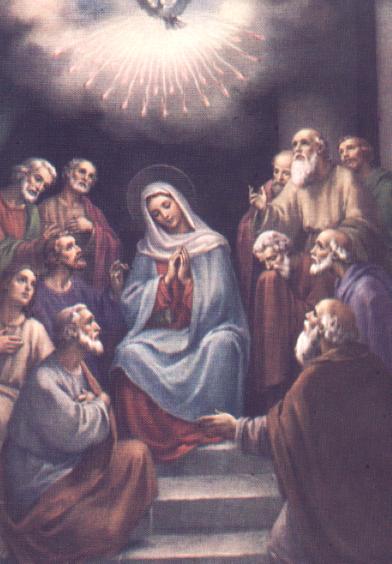
fixed our attention particularly on an apparently insignificant detail,
however one that reveals great mysteries. This we proceed to describe and interpret.
Before Saint Joachim received in his side the Triple Benedic-tion,
the Most Divine Soul of Christ signed his forehead, touched his lips with
the Most Sacred Mystery and gave him to drink of a blessed wa-ter, in the
way described in the following paragraph.
4. Having invoked the
Holy Ghost, this Holy Council re-lates
and defines as truth of faith: The Soul of Christ, under the ap-pearance
of an Angel, put a little water in the chalice of Melchisedech while this
still contained the Triple Benediction, - and before introduc-ing it into
the side of Saint Joachim, He gave him a little of this water to drink,
with the rites already mentioned.
5. Interpreting
correctly the revelations of the Exalt-ed Doctor Saint Catherine Emmerick,
we affirm and define that she does not say with certainty that afterwards
Saint Joachim took with him the chalice.
Therefore we affirm that this sacred vessel remained in the Tab-ernacle
of the Temple with a little of the water, reserved for other great
mysteries. Besides, given the
presence of the sacred chalice, the absence of the Most Holy Sacrament was
not noticed, since the time to notice its disap-pearance had not yet come.
6. The doctrine
expressed above is intimately connected with the mysterious conception of
the Precursor in the womb of Saint Elizabeth, spouse of Zachary.
Of this couple, the Gospel of Saint Luke relates that "they
were both just before God, walking in all the commandments and
justifications of the Lord without blame.
And they had no son, for that Elizabeth was barren, and they both
were well advanced in years" (Luke I: 6-7).
The same text of the Gospel speaks of the priest Zachary, who,
being in the Temple of the Lord to exercise his priestly ministry at the
altar of incense, received from the Archangel Saint Gabriel the good news
that his wife would bear him a son who was to be called John, and that he
would be great before the Lord. The
Holy Doctor Catherine Emme-rick, referring to this passage about Zachar-y,
adds that an angel placed beneath his garment a mysterious brilliant
object, which we affirm to have been the chalice of Melchisedech
containing some of the blessed wa-ter miraculously reserved since the
reception of Saint Joachim of the Triple Benediction.
Interpreting the text commented by the Holy Doctor, we add that the
Archangel Saint Gabriel revealed to the Holy Priest and Prophet Zachary
that the water would confer fecundity for his spouse, and for him
vitality, and that it was given to him for both to drink.
7. We explain the
sacred text of Saint Luke, adding that Saint Zachary was perplexed by this
promise from heaven and he ask-ed himself if the vision before him came
from God or was the work of the enemy, who can appear even as an angel of
light. He had never supposed
that his repeated supplications for the fecundity of his wife would be
rewarded with such magnanimity. He
did not doubt the words or the power of God.
But, fearing a diabolical deception, he asks the Angel for a sign
to guarantee his divine mission. In
the light of this doctrine are to be understood his question and the
Angel's reply. Saint Luke,
chapter I, verses 18, 19 and 20 relates, "And Zachary said to the
angel: Whereby shall I know this? for I am an old man, and my wife is
advanced in years. And the
angel answering, said to him: I am Gabriel, who stand before God;and am
sent to speak to thee, and to bring thee these good tidings.
And behold, thou shalt
be dumb, and shalt not be able to speak until the day wherein these things
shall come to pass, because thou hast not be-lieved my words, which shall
be fulfilled in their time". According
to the sacred text, the sign given him by the Archangel was for him to
re-main mute until the time following the birth of the Precursor, when he
would recover his voice on conferring the name of John.
In the light of our interpretation, we affirm and define that the
dumbness of Zachary, which (as deducible from the sacred text) was
accompanied by deafness, -- that this was not punishment but rather a sign
given by the celestial spirit for a twofold purpose.
The first was to show the truth of the promised miracle, and the
second, to prevent Zachary, through emotion for his future paternity, from
revealing the mystery hidden under his garments, with risk to his life.
Zachary was aware of the reason for such an embarrassing sign.
It remains to add that Saint Elizabeth drank the wa-ter and became
capable of conceiving, and that the chalice of Melchise-dech was presented
by Zachary to the Essenes. These
kept it in the Cave of Elias on Mount Carmel, whence it passed through the
hands of Saint John the Baptist to the Virgin Mary and from her to her
Divine Son. With the
present doctrine we reject what Saint Cather-ine Emmerick says of the
chalice, namely that it was found in an antique shop and purchased by
Veronica.
8. The Holy Doctor
Catherine Emmerick adds that "only later, following the event
described above, was the absence of the Mys-tery of the Triple Benediction
noticed by the priests of the Temple. Since then they went altogether astray and became
pharisaical".
9. We shall consider
now the presanctification of Saint John the Baptist, which took place in
the sixth month of his conception, as defined in the Palmarian Creed.
This Holy Council, referring to the Mystery of the Visitation
narrated in Saint Luke (I: 39-45), affirms and defines in the light of the
Holy Ghost that, at the moment when the Mo-ther of God saluted Saint
Elizabet-h, the Infant Jesus, from the virginal womb of Mary, blessed
Saint John as he reposed in the most privileged womb of Saint Elizabeth.
Thus was accomplished the presanctification of the Baptist, who
furthermore, was filled with extraordinary graces and gifts, such as
infused knowledge, enjoying the beatific vision, as in certain other
moments during his life. The
phrase of the sacred text, "And Elizabeth was filled with the Holy
Ghost" means that she received an increase of grace as well as of
light to understand great mysteries.
This is revealed by the Exalted Doctor Saint Mary of Jesus of
Agreda, of whom we extract the very beautiful words; "Elizabeth was
wrapt in spirit in the joy of the Holy Ghost".
10. In the light of
this doctrine, we also affirm and define that, during the time previous,
when the Triple Benedi-ction still remained in sacramental form, the
manner of being sanctified in the ma-ternal womb, in the Old Testament,
was through the appearance of
the Most Divine Soul of Christ, who conferred the Blessing with the
Mysteri-ous Sacrament upon the fruit enclosed in the womb of the mother.
Thus was accomplished as well the sanctification of the mother if
she bad not been sanctified previously.
11. We take this
opportunity to define that presanctification, that is, sanctification in
the womb prior to birth, is superior to sanctification after birth.
Both confer the indwelling of the Holy Ghost in the soul.
Presanctifi-cation adds confirmation in grace, which secures
eternal salvation and preserves from all personal sin.
It also confers the Beatific Vision, at least in the first instant.
It includes as well infused knowledge and the use of reason.
In presanctification there are distinct grades, in accord with
which the gifts received are of greater or lesser excellence.
Presanctification in the maternal womb is equivalent to
confirmation in grace received after birth.
12. Returning to the
Elian priesthood, we declare and define that its transmission ceased from
the moment in which the Triple Benediction was incorporated in Saint
Joachim, which mystery was reveal-ed by God to the High Priest Eliud for
him to know that the Immaculate Conception of Mary was at hand.
When that incorporation had taken place, and when, shortly
afterwards, the Triple Benediction, from its previous sacramental form,
was clothed in immaculate flesh in the most holy womb of Saint Anne, there
then lacked the requisite sanctifying agent in the rite of conferring the
Elian Priesthood. The
exceptional case was that of Saint John the Baptist previously mentioned.
Before this was to occur, the High Priest Eliud, inspired by God,
provided himself with a suffi-cient number of priests to compensate for
the lack of future transmis-sion of the priesthood.
Thanks to this foresight on the part of heaven, the Essenes did not
come to lack the priests they needed.
Furthermore, it was necessary for that priesthood to diminish
inasmuch as the insti-tution of the Priesth-ood of the New Law was shortly
to come.
13. Saint Catherine
Emmerick, referring to the fu-neral rites of Saint John the Baptist, says
that they were presided over by an aged priest.
She also mentions other men, also advanced in years, with long
white vestments, who had come to the help of the Precursor in early years.
These stood out prominently, and we interpret that they were Elian
priests.
14. This Holy Council
affirms and defines that the Elian priests who survived and who
acknowledged Christ, received later, through the hands of the Apostles,
the New Priesthood according to the Order of Melchisede-ch.
15. Another question
which we wish to explain is that of the presanctifications and
sanctifications after the incorporation in Saint Joachim of the Perfect
Sacrament of the Old Law. For
our exposi-tion of the doctrine, let there serve as
basis the expression used in the previous chapter, "The living
represen-tation of the Triple Benediction Incarnate, Jesus and His Most
Holy Mother". It is
logical that if the es-sential elements sacramentaliz-ed of the corporeal
human nature of Christ and Mary worked so great marvels during five
thousand years, then, once the moment had come for that Most Sacred
Mystery to be manifest alive for all to see, the extraordinary graces did
not diminish. On the contrary
they became more abundant. This
is seen in the many presanctifications and numerous sanctifications worked
through the mere presence of Jesus and Mary.
We have an example of this in the presanctif-ication of the
Pre-cursor. Another in the
sanctific-ations at the Cave of Elias on Mount Car-mel when, as we have
related previously, Christ blessed the Essenes who were gathered there.
This Holy Council affirms and defines the following:
16. That in the brief
period that Saint Joachim bore in his body the Triple Benediction, it
sancti-fied privileged persons.
17. That, during the
time the Divine and Most Holy Infant Mary was within the womb of her
Mother Saint Anne, Sanctua-ry of the Tabernacle of God, sanctifications
were worked, and one or other pre-sanctification.
18. That the
Immaculate Virgin Mary, before the Concep-tion of the Word, worked many
sanctifications and some presanctifications.
19. That, during the
time the Infant Jesus was in the most pure womb of the Most Holy Virgin
Mary, as also during His lifetime, numerous sanctifications and some
presanctifications were worked through the sole presence of Our Lord Jesus
Christ and of His Most Holy Mother. It
is to be understood that we are referring to the time before the
in-stitution of the Sacrament of Baptism.
After its institution, all who received Baptism within the true
Church were sanctified, while cases of presanctification did not cease.
20. This Holy Council
also affirms and defines that the shepherds of Bethlehem, the Royal Magi,
- Melchor, Gaspar and Balthasar, - as well as others, were sanctified when
they visited the Child Jesus at Bethlehem.
21. In the previous
chapter we explained and defined matter pertaining to the genealogies of
the Lord. Now we shall speak
of the family and relations of Jesus. For this we take as basis Sacred Scripture, messages given to
the present Pope, Gregory XVII, the revela-tions of Saint Catherine
Emmerick and the Martyrology.
22. It has already
been defined that Saint Ismeria and Saint Eliud were the parents of Saint
Anne. We go on to speak of
the daugh-ters of Saint Anne in her additional two
marriages. After the
death of Saint Joachim, Saint Anne, obeying the will of God, was married
to Cleophas. Of this marriage
was born Saint Mary Cleophas, who married the widower Alpheus, with whom
she had 4 children: the Apostles Saint Judas Thaddeus, Saint Simon Zelotes
and Saint James the Less, as well as a daughter Susanne, who is mentioned
in the Gospel of Saint Luke (VIII: 3) as one of the holy women who
followed Jesus. In a previous
marriage of Alpheus was born the Apostle Saint Matthew.
23. Saint Anne, when
Cleophas had died, married Salome. Of
this union was born a daughter Saint Mary Salome, who married Zebe-dee.
These were the parents of the Apostle Saint James the Greater and
Saint John the Evangelist.
24. Saint Mary
Cleophas, daughter of the second marriage of Saint Anne, when Alpheus had
died, married the widower Sabas. Of
this marriage was born Saint Joseph Barsabas the Just, who was one of the
can-didates for the place left vacant by Judas Iscariot, to which
succeeded Saint Matthias (Acts I: 23).
In regard to Saint Joseph Barsabas, the Evangelist Saint Mark
referr-ing to Saint Mary Cleophas, who stood by the Cross, says that she
was the mother of Saint James the Less and Joseph (Mark XV: 40), which
latter we interpret to be Joseph the Just, of whom we are speaking.
The Evangelist Saint Matthew refers to the same, but with less
detail. This proves the
second marriage of Mary Cleoph-as. Of
the first marriage of Sabas, that is, before he married Mary Cleophas, was
born Saint Judas Barsabas, mentioned in the Acts of the Apostles (XV: 22). Mary Cleophas, after her second husband, Sabas had died,
mar-ried the widower Jonas, of which union Saint Simeon, martyr, second
bish-op of Jerusalem was born, in proof of which the Martyrology names him
as
son of Mary Cleophas and blood relation of the Lord.
Through a previous marriage Jonas was father of the Apostles Saint
Peter and Saint Andrew.
25. We shall now
consider the descendants of Rhode (Rose), daughter of Saint Emerentia and
sister of Saint Elizabeth. Rhode
was married to Cleophas before he became the second husband of Saint Anna.
Of this marriage of Rhode with Cleophas were born Anna Cleophas,
Eliud and others.
26. Anna Cleophas
married Tolomeus, of which union was born Nathanael of Cana, better known
as the Apostle Saint Bartholomew, and mentioned in the Gospel of Saint
John (XXI: 2). Bartholomew
means son of Tolomeus.
27. Eliud, brother of
Anna Cleophas, in his first mar-riage was father of Saint Philip the
Apostle. When his wife had
died, Eliud married Maroni, the widow of Naim, of which union was born
Saint Martial, the child raised from the dead by Christ and who later
became Bishop of Limoges (France). He
was related to Saint Stephen.
28. Another daughter
of Rhode was the mother-in-law of
Saint Peter, whose fever Jesus cured, which miracle is
related by the Evangelists.
29. This Holy Council
affirms and defines the truth of the data given above about the family and
relatives of Jesus.
30. We also affirm and
define the presanctif-ication in the maternal womb of the two daughters of
Saint Anne in her later mar-riages, Mary Cleophas and Mary Salome, and as
well of the two later hus-bands of Saint Anne, Cleophas and Salome.
31. We enrich the
doctrine given above on the subsequent husbands of Saint Anne, as also on
their respective daughters, recal-ling the transcendental message given by
Our Lord Jesus Christ on 10 De-cember 1977 to the then Father Ferdinand,
today Pope Gregory XVII. Since
it is not possible in this Treati-se to cite the whole text of that
reve-lation, we select the thoughts that more particularly pertain to the
ex-alted and Most Holy Anne, spouse of the exalted and Most Holy Joachim,
Parents of the Divine Virgin Mary. The
Lord says with all clarity that, after the death of Saint Joachim, Saint
Anne, complying with the will of God, remarried, first with Cleophas, and
then, after his death, with Salome;and that of these unions, were born,
respec-tively, Mary Cleophas and Mary Salome, sisters of the Most Holy
Virgin Mary. In addition, He
gives the reason for these remar-riages of Saint Anne in these words:
"These later marriages were necessary in the divine plan.
It was necessary and logical for her, who was to be the Mother of
the Most High, to have in those crucial moments on Calvary sisters who
would give her human conso-lation. This
was the divine plan: to give her sisters who would be united with her in
her sorrow... "Later on He speaks of the priestly mission of the Most
Holy Mother on Calvary, when she offered the Victim to the Eternal
Father;and referring to Mary Cleophas and Mary Salome, He says further:
"And the other Marys, My aunts, fulfilled the mission of coadjutors,
assisting Her who offered the Victim".
Other reasons the Lord gives for those remarriages are of economic
character, since, when Saint Anne became the widow of Saint Joachim, she
remained without means and the new spouses, Cleophas and Salome, by their
work, helped to maintain the Divine Child Mary during Her stay at the
Temple. The message also
in-cludes other matters concerning Saint Anne in her three marriages.
Let us consider one of these.
"I make it known to you,"- the Lord is re-ferring to
Saint Anne, - "that in her marital relations in their three stages,
she never knew what human pleasure was.
She neither felt nor suffered.
The same for her husbands. They
fulfilled the divine mandate;and nothing more.
To be sure, there was, in the three marriages, authentic conjugal
life directed towards procreation;far, however, very far from pleasure.
There was but one pleasure, the glory of the Most High, the will of
the Most High and nothing more".
The message speaks as well of the presanctifications of Cleophas
and Salome, and that in the descen-dants of these just men there
were great apostles and martyrs. This
Holy Coun-cil affirms and defines the truth of the doctrine contained in
the words given above of the message.
32. We, in addition,
include in the Martyrology the names of the following Saints: Saint
Stolanus and Saint Emoroun, maternal grandparents of Saint Anne; Saint
Ismeria and Saint Eliud, par-ents of Saint Anne; Saint Mathat and Saint
Susana, parents of Saint Joa-chim; Saint Emerentia and her husband Saint
Aphras, as well as Saint Enoue, the uncle and aunts of Saint Anne; Saint
Sobe and Saint Maraha, sisters of Saint Anne; Saint Cleophas and Saint
Salome, husbands of Saint Anne; and besides other relatives of Jesus:
Saint Alpheus, Saint Zebedee, Saint Tolomeus, Saint Eliud and his wife
Saint Maroni; Saint Jonas, fa-ther of Saint Peter and Saint Andrew; Saint
Sabas, Saint Judas Barsabas, Saint Susana and Saint Rhode (Rose).
33. The dogmatic
definitions in previous chapters on the Essenian character of the family
and relatives of Jesus, we extend to include those named in the genealogy
of the present chapter, that is, those not included in previous
defini-tions. We also affirm
and define that the aged Holy Simeon, Saint Anna the Prophetess, Saint
Veronica, Saint Joseph of Arimathea and Saint Nicodemus were Essenes. The family of Bethania, too, Saint Lazarus and Saint Martha.
Regarding their sister, Saint Mary Magdelen, she went astray in her
youth and led a bad life, but after her conversion she returned to the
Essenes. We take the occasion
to include among the presanctified the aged Holy Simeon and Saint Anna the
Prophetess.
34. Before Jesus chose
His disciples, He first called the Pontiffs and Levitical Priests, as well
as the Doctors of the Law, the Rabbis, the Scribes and in general the
members of the Sanhedrin. None
of these responded to the call of the Divine Master, except Saint Joseph
of Arimethea, Saint Nicodemus and one or other besides.
We base this teaching on certain parables of Jesus, among which
that of the vine dressers (Matt. XX: 1-16), and that of those invited to
the marriage feast (Matt. XXII: 1-14), in which it is contained.
35. From what is
explained above, we deduce that the Lord not only called his family and
relatives but many others as well to take their place in the hierarchy of
the Church. From among all
His fol-lowers, the Divine Master chose many disciples whom He instructed
more particularly, and of these He took twelve whom He named Apostles,
destined to be the pillars of His Church.
He set apart Saint Peter to be the future prince and head of them
all. Later the Lord chose
seventy-two other disciples to be coadjutors of the Apostles.
These He commanded two by two to go out to preach.
Many of those who followed Jesus turned back, and one of the
Apostles, Judas Iscariot, betrayed Him.
His place was taken by Saint Matthias, one of the first disciples
of Jesus. All of which we
affirm and define.
36. We conclude this
chapter with a resume of the his-tory of the Order of Mount Carmel since
the Death and Resurrec-tion of Jesus Christ.
In the previous chapter was defined the apostasy in part of the
Essenes, of those who, when they did not accept the Messias, built sects
that impeded the expansion of Christianity.
Those of the Essenes who remained faithful, joined with the
Apostles, some to live as reli-gious on Mount Carmel, others to engage
actively in the evangelization of the world.
Christianity perfected and enriched the Carmelite Order and as well
modified certain aspects of her organization.
37. The Acts of the
Apostles, referring to the great multitude that gathered at the Cenacle
moved by the prodigies of Pentecost mention `devout men' (II: 5), whom we
interpret and define to have been Carmelites.
The Breviary lesson for the Feast of Carmen affirms this, as also
do other pious traditions. The sacred text says that about 3000 Persons were
baptized that day. We affirm
and define that many of them were Carmelites who had not previously had
the opportunity to be baptized.
38. Among the
religious of the Order of Mount Carmel there stands out the Holy Prophet
Agabus, whom we affirm and define to have been presanctified in his
mother's womb. He appears
twice in the Acts of the Apostles (XI: 28, XXI: 10).
Agabus, along with Saint Joseph and others, was one of the suitors
for the hand of the Virgin Mary. When
his staff did not flower and Saint Joseph was chosen, he withdrew to Mount
Carmel to be the servant of Mary now that he could not be her spouse.
He was the first Superior General of the Carmelites in the
Christian Era. Besides the
Holy Prophet Agabus, there stood out Enoch of Amatim, who accompanied
Saint Mark to Egypt and then retired to Carmel to die there.
Also Saint Elpidius, who came to Spain with Saint James the
Greater, and was the first Bishop of Toledo, - not to speak of others in
addition.
39. The history of the
Order of Mount Carmel in the Christian Era is full of vicissitudes and, at
the same time, of glorious events that perfected and enriched monastic
life and the religious life in general, since the Carmelite Order is the
Mother and Model of all the other orders.
One of the glories of Carmel was the illustrious Doctor of the
Church, Saint Cyril of Alexandria (Fifth century), also a Carmelite, who
presided at the Council of Ephesus and was the great defender of the
Di-vine Maternity of Mary against the Heresiarch Nestorius.
40. The several
invasions profoundly affected the Carmelite communities existing in the
respective epochs and places;and, be-sides, multiplied the number of
martyrs. The Holy Crusades to
liberate the Holy Land from the power of the Moslems, caused the Carmelite
Order to flower again in those Sacred Places.
We single out Saint Berthold of Malafaida, who was Superior General
of Carmel. He greatly
stimulated Carmelite monastic life and was a centenarian when he died. He was suc-ceeded by Saint Brocardo as Superior General, who
received from the hands of
Saint Albert, Patriarch of Jerusalem, the definitive rule of the
Carmelites. He died at a
great age close to the middle of the 13th century, and was succeeded by
Saint Cyril of Constantinople, who greatly propa-gated the Order.
Saint Berthold, Saint Brocardo and Saint Cyril were buried in the
Cave of Elias.
41. Years later there
struck Mount Carmel a fearful persecution by the Moslems, which compelled
the new Superior General, Alan of Brittany, to transfer the Seat of the
Order to England. This was
pro-vidential since shortly thereafter there broke out another fearful
per-secution in the Holy Land.
Besides, this transference greatly favoured the expansion of the
Order in the west. At the
death of Alan of Brittany Saint Simon Stock was elected Superior General
of the Carmelites. He was
born in County Kent in England, where he lived as a hermit until the
Virgin Mary manifested Her desire that he enter the Carmelite Order, whose
religious had just come from Mount Carmel.
Saint Simon Stock greatly in-creased the Order, founding convents
and colleges. He also
obtained from Pope Innocent IV, confirmation of the rule of Saint Albert
of Jerusalem as adapted to the demands of life in the west.
The event in his life most worthy of mention is the reception from
the hands of the Most Holy Vir-gin Mary of the Holy Scapular, when the
Divine Lady thus responded to Saint Simon Stock's prayer for help in the
severe persecution brought against the Carmelites.
The prodigy occurred in the early morning of the 16 July 1251, when
the saint was in his cell. There the Queen of Carmel appears wrapped in a luminous
cloud, surrounded by a multitude of angels.
She presents to him the scapular, sign and testimony of Her
powerful protection in every danger, and speaks these words of
consolation: "Dearly beloved son, receive the scapular of your Order,
sign for you of My alliance, and privilege for all Carmel-ites.
Through this garment are recog-nized My children and My servants,
in which I give you a sign of predes-tination and a written document, as
it were, of peace and eternal alli-ance, - provided that innocence of life
corresponds to the holiness of the garment.
One who has the good fortune to die with this special testimony of
My love, will not suffer eternal fire, and by sin-gular mercy of My
beloved Son, will enjoy eternal happiness".
Saint Simon Stock died in 1265 at the age of 100.
42. While the Order of
Carmel became practi-cally ex-tinct in the Holy Land, it spread very
rapidly to all of Europe, where it was universal-ly accepted.
Unhappily, the auster-ity of Carmelite life was weakened little by
little by the relaxa-tion of the primitive rule.
This also affected the other religio-us orders, which, earlier, had
received inspiration and spirit from the Mother Order.
In order to restore the Order to its primitive austerity, God
raised up in the heart of Spain a valiant woman, Teresa of Jesus of Avila.
Inspired by God, she carried out the great reform of the Carmelite
Order. To the Exalted and
Mystical Doctor Saint Teresa of Jesus there was united the eminent Doctor
Saint John of the Cross, who, under her
direction, helped in the arduous un-dertaking.
An illustrious spiritual son of the Doctor of Avila, was the
venerable Father Prosper of the Holy Ghost, a Spaniard who, years after
the death of the great reformer of Avila, re-established monastic life on
Mount Carmel, cradle of the Carmelite Order.
43. We terminate this
brief history bringing to the fore the final and most splendid branch of
Mount Carmel, the Carmelites of the Holy Face, founded in 1975 by the
present Pope Gregory XVII in accord with the mandate of heaven in the
great apparition of the Virgin Mary at El Palmar de Troya.
Thanks to the Carmelites of the Holy Face, the Order of Carmel
remains alive amidst the great general apostasy of the present apocalyptic
moment, which has brought about the destruction of the other religious
orders. This shows that, just
as all the others were born of the Carmelite Order, now, in the last
times, the Order of the Carmelites of the Holy Face, in her maternal soul,
embraces the spirit of all the other orders, which now have fallen in
decay. This Holy Council
affirms and defines the truth of this brief history.
44. We end by saying
that the exalted Order of Carmel has given four glorious Popes to the
Church, namely, Saint Peter the Apostle, Saint Telesforus, Saint Dionisius
and Gregory XVII. Wonderful
to see, the first and last Popes of the Church are Carmelites!

