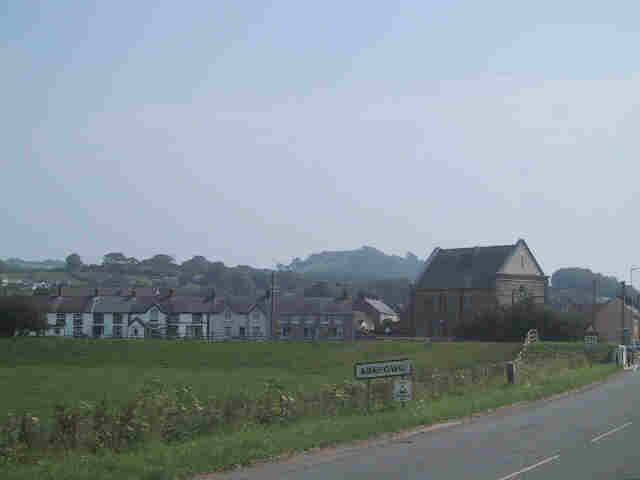
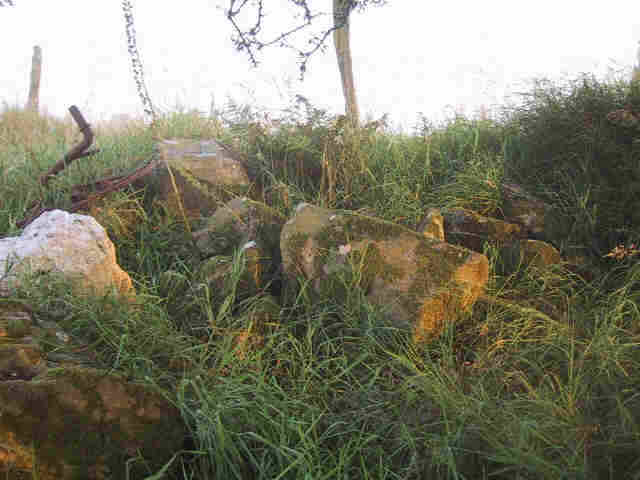
Well this little excursion requires a bit of background. It all started when I received an email from my ancient/medieval history school teacher, John Leopold, informing me that he would be visiting Britain for a number of weeks during the summer. We have both long had interests in the legends of King Arthur and even pursued these during my senior year of school in the form of an independant study where we looked at the early written tales in detail to determine just how much truth there actually was behind them. Anyhow, one thing led to another during our email correspondence and he asked me if I had ever searched the town of Carmarthen for evidence of the wizard Merlin's origins. I hadn't, so we decided to go to Carmarthen (maps, notes, and texts in hand) and look for anything that remained from the Dark Ages. This photo is a very old (neolithic) burial mound that lies seven kilometers North of the town. | ![]() |
![]() | We found an area near Carmarthen called "Brynn Myrddin" which means Merlin's hill in Welsh. The hill can be seen in the distance. |
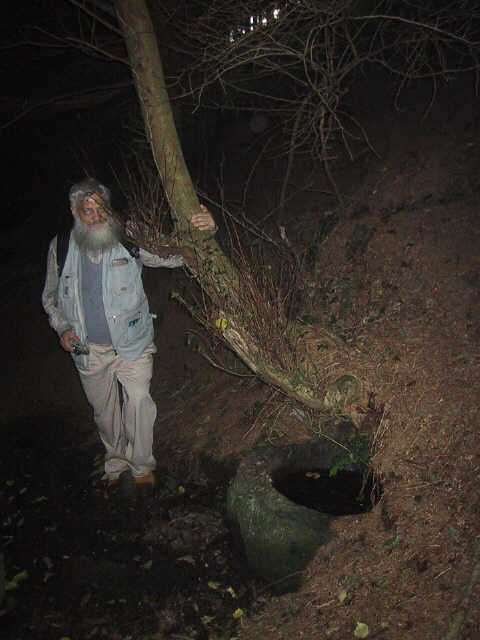
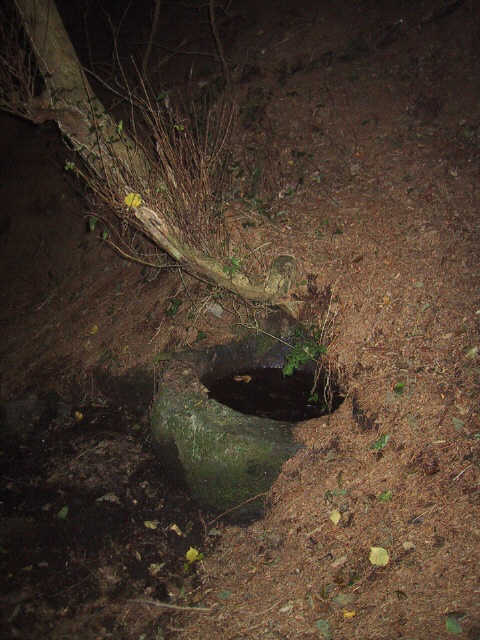
In Mary Stewart's 1970's work "The Crystal Cave" she describes a magnificent crystal cave that Merlin had visions in as a boy. Now Stewart, along with many other arthurian authors, added a lot of fantasy to the legends (which were already rather fantastic). However, with that said, Stewart based most of her material upon actual archeologic findings and embellished from that point forward. There is also the account set my Sir Thomas Mallory in "Le Mort D' Artur" (1440's) where upon Merlin's death he is trapped within a stone and buried beneath a great mound of earth. So we were left with the question as to whether or not a cave existed on Bryn Myrddin or if, perhaps, Byrn Myrddin came into existence following the death of Merlin and was in fact his grave. All we found was this reflecting pool and natural spring hidden deep within the woods covering the hill. | ![]() |
![]() | John took a close look at the crudely cut pool and estimated that it was not likely to be more than a few hundred years old due to a paucity of lichen growing on it. When I examined the surrounding rock I found it all to be sedimentary siltstone, a rock that would be unlikely to form a cave with crystals and pools of water as Stewart describes. However, it is likely that more impermeable rock than siltstone sits below the sedimentary layer where the spring emerges. What that rock might be, I can only speculate... perhaps an intrusion of igneous or metamorphic origin. Had Stewart in her research found evidence on the hill suggesting the presence of one of these crystal bearing rock types? After spending a few minutes below the canopy of vegetation covering the spring we also considered the theory that the "cave" might in fact have been a densely overgrown canopy (note that these dark pictures were taken in the middle of the day). |
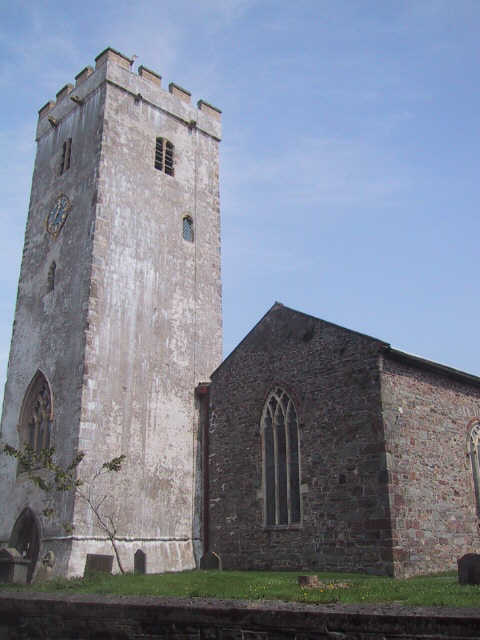
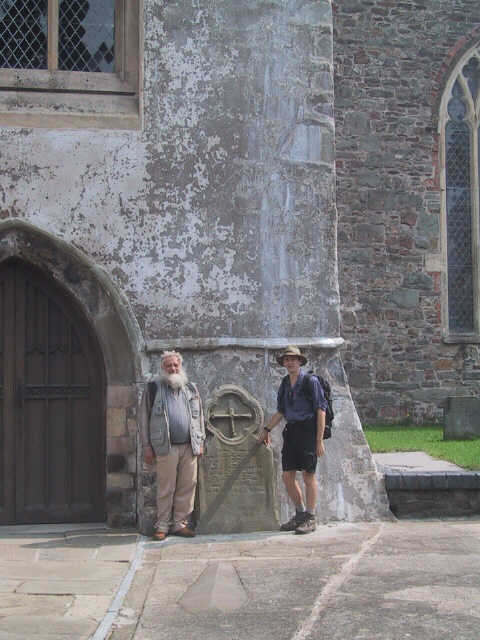
In Geoffrey of Monmouth's text "Kings of Britain" (written in 1130 AD) it says regarding Merlin "That non knew his father, but that his mother was daughter of King Demetia (a Welsh King), and that she lived along with the nuns in St. Peter's Church into the city that was afterwards called Carmarthen." Well, we found the Church. Unfortunately Henry the VIII demolished the section of the church that contained the bulk of the dark age nunnery, but much of the early stone structure still stands. | ![]() |
![]() | We searched the graveyard for some time looking for Demetia's daughter's grave. Unfortunately, we only found graves dating back five hundred years. |