Suggestions for the Conference in The European Parliament in Brussels on 17/09/2003
European drug policy: strengthening the partnership of institutions and civil society
To: Alima Boumdiene-Thiery, Member of the European Parliament, Group of the Greens/EFA
[email protected]
I write on behalf of Parents Against Lethal Addictive Drugs (PALAD), a UK voluntary organisation campaigning for effective drug policies. We believe that in a society where one in five citizens are killed by legal drugs (UK Government figures) safer alternatives like cannabis are essential. Evidence clearly shows that cannabis is a safer stress-reliever and intoxicant than alcohol in terms of addictiveness, risk of overdose, accidents and violence.
We have 2 suggestions for issues to be debated at the conference of September 17th. Both suggestions could provide much needed evidence that may help resolve the conflict over drug policy.
- A drug harm assessment protocol, to cover all legal and illicit non-medicinal drug use, should be developed by the World Health Organisation.
- The development of a non-judgemental model of the drug control system.
Harm assessment protocol:
UN drug Conventions prohibit the production, supply and use of non-medicinal drugs that cause harm. No definition is given of the terms 'drug', 'harm' or 'non-medicinal use'. Instead drugs prohibited by the conventions are simply listed with no evidence given that they are more harmful than alcohol and tobacco which remain excluded from the Conventions. Drug policy reformers claim that recent evidence strongly suggests that some prohibited drugs are safer alternatives to the legal drugs. A standard drug harm assessment is vital for the purposes of drug education but should also guide the type of intervention by authorities (together with a benefit assessment).
The World Health Organisation seems ideally placed to develop this protocol. "WHO is the only agency which is dealing with all psychoactive substances, regardless of their legal status. WHO's mandate in the area of substance abuse include:
[…] 3- Assess psychoactive substances so as to advise the United Nations with regard to their regulatory control". http://www.who.int/substance_abuse/index.html
The aim of harm assessment should be to define 4 categories of drug use that would require 4 different types of intervention from authorities: 'beneficial use' would be encouraged, 'reasonably safe use' would be tolerated, 'use harmful to the consumer' would be discouraged and 'use harmful to others' would be prevented by law. Such an assessment would consider the drug used, the method of use and the quantity and frequency of use. Measures of health consequences should include addictiveness, risk of overdose, premature death, long term illness, accident and violence.
Above all WHO should consult widely about the methodology of such an assessment before undertaking it.
We agree with WHO when they state that "People with substance dependence are among the most marginalized in societies and are in need of treatment and care. To incarcerate offenders for drug use and dependence is not an effective prevention or treatment strategy".
http://www.who.int/substance_abuse/PDFfiles/sabuse_myths_full.pdfA non-judgemental model of drug policy is vital:
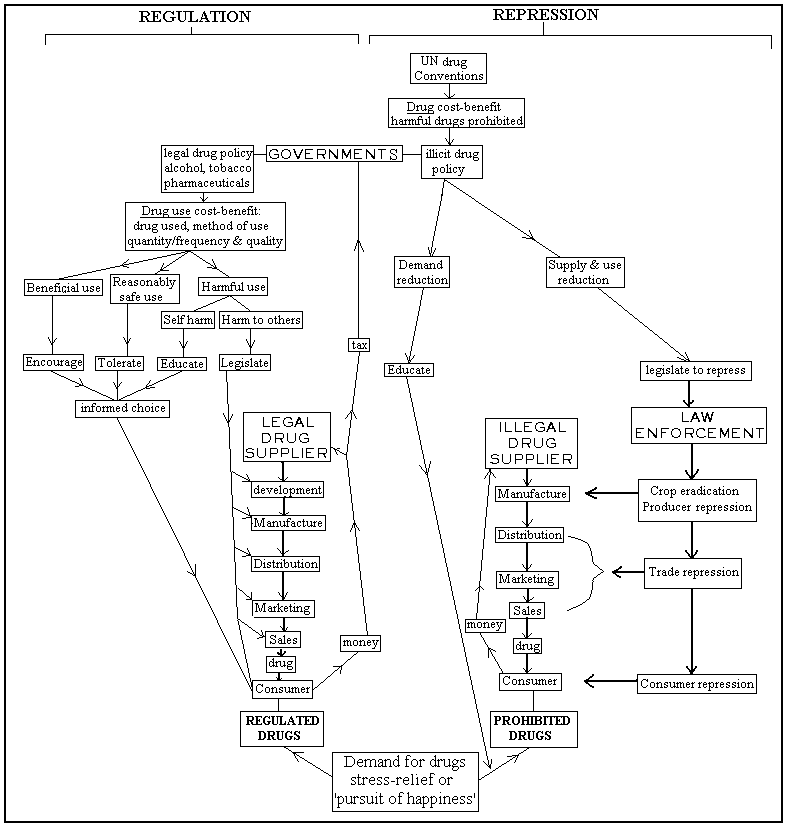
- to show the simplest overview of all essential processes within the drug control system, connecting all policy areas together into an integrated system, allowing a 'whole system' view.
- to show that UN drug Conventions divide drug control policy into 2 very different systems, one based on regulation, the other on repression.
- to compare the costs and benefits of regulation with those of repression.
- to provide prohibitionists and reformers with common ground upon which debate can be based.
- to show how organisations could cooperate by defining their roles within the system.
- to show prohibitionists that legalisation should not be feared as an unknown because it is a tried and tested system that has proven to be more effective than prohibition.
We do not know who would have the expertise to develop such a model but have attached our own attempt which, we hope, shows the potential of this approach.
From the top of the diagram:
- UN drug Conventions prohibit the production, supply and use of non-medicinal drugs that are harmful.
- The Conventions impose an illicit drug policy on national governments.
- Left side of diagram: National governments implement their own legal drug policies based on the principle of educating citizens about drug use harmful to the consumer and only legislating against drug use or supply harmful to others. Education is used to encourage 'informed choice' - outlining the benefits of healthy drug use (e.g. moderate alcohol use) and risks of excessive or inappropriate use. Legislation designed to prevent drug use harmful to others includes laws against drink-driving, passive smoking and violence. Legislation designed to prevent drug supply harmful to others can include laws requiring a cost-benefit analysis (e.g. clinical trials), quantity and quality control, safe use instructions, side-effects warnings, ingredients list, sell-by date, marketing and sales restrictions. Drug sales are taxed providing sufficient income to cover the costs of drug control, including the costs of education and treatment for harm caused by drug use and supply.
- Right side of diagram: Illicit drug policy aims to repress all production, supply and use through legislation. Education is used to discourage demand for illicit drugs. Considerable amounts of money are spent attempting to repress illicit drugs but the black market has continued to expand. Black market products can not be regulated to limit the harm they cause - there is no possibility of quantity/quality control, of marketing or sales control, or of taxing the trade to pay for social costs.
Drug reformers criticise the current situation:
- UN drug Conventions fail to provide any evidence that illicit drugs are more harmful than the legal drugs alcohol and tobacco. Recent scientific evidence suggests that safer alternatives to legal drugs have been prohibited.
- UN Conventions cannot develop as better evidence of drug harm emerges because a single nation may veto any change. As a result national governments are prevented from exploring alternative harm reduction policies.
- Legal drug policies target actual harm rather than trying to prevent beneficial use and reasonably safe use - they focus resources where they are needed and do not waste them where they are not needed. Self-harm is not criminalised, only harm to others. Production and supply regulations ensure that drugs are as safe as possible. Legal drug policy recognises the right of consumers to informed choice and the right of producers and suppliers to meet consumer demand. Regulation also allows the drug trade to be taxed to pay for the social costs, making no demands on non-drug using tax-payers.
- Illicit drug policy is prejudiced, trying to prohibit drugs not traditionally used in the West while permitting trade and use of traditional drugs equally harmful. This prejudice leads to suppliers and consumers facing discrimination, social exclusion, punishment, imprisonment, even death. There is no recognition that citizens have greater rights to risk harming themselves than to risk harming others. Citizens may risk self-harm not only from legal drugs but also from food misuse (obesity) and recreational activities (e.g. sports). There are no regulatory safeguards for production and supply making illicit drug use more harmful than if legally regulated. Crop eradication programs cause environmental damage, deny subsistence farmers their livelihood and prevent nations from exploiting their natural resources. Suppliers are denied free and fair trade; consumers are denied consumer rights. Illicit drug policy (law enforcement) is expensive but ineffective. No income is possible from taxing the trade to cover social costs so all profits go to organised crime while the additional law enforcement costs of prohibition are wasted through lack of focus on actual harm.
We hope the development of a standard harm assessment protocol and a non-judgemental model of drug control could be discussed at the conference. Please don't hesitate to get in touch for any further information.
Many thanks for this opportunity to contribute to your work toward an effective European drug policy.Parents Against Lethal Addictive Drugs (PALAD) - UK
Member of the European NGO Council on Drugs (ENCOD)
www.palad.org.uk
[email protected]