|
|
 |
Sojourn to Swat
|
|
|
| Location | Eastern District of North West Frontier Province (NWFP). |
| Elevation | 975.36 meters. |
| Weather | In Summer weather is pleasant and annual rainfall is 81cm- 88cm. In winter snow falls and weather becomes chilly. |
| Tourist Season | All the year round, Particularly from March to October. |
| Activities/Interest | Fishing, Camping, Hiking, Trekking, Mountaineering |
| Accessibility |
Saidu Sahrif is divisional headquarter of Swat and the Malakand Division, It is linked by air with all parts of Pakistan. Saidu Sharif is accessible by Road from Rawalpindi and Peshawar. Its an 257 km metalled road from Rawalpindi via Nowshehra-Mardan and Malakand pass, and it is 177 km from Peshawar and the condition of road is good. It is also connected with Gilgit via Besham on the Karakoram Highway. |
| Other Facts |
Pushto, Kohistani, Urdu & English are also spoken and under stood well. Area of Swat is 4000 sq. miles |
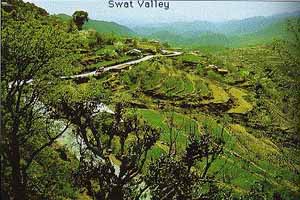
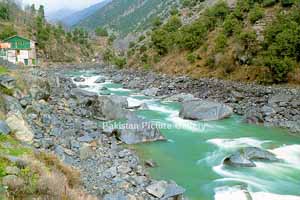
Swat is the most historically interesting valley in Pakistan. It is also one of the most beautiful - certainly much greener and more fertile than the valleys further north because it lies within the monsoon belt. In Lower Swat, the valley is wide, the fields on either side of the river are full of wheat and lucerne, and the villages are prosperous and surrounded by fruit trees. In Upper Swat, the river tumbles through pine forests hemmed in by snow-capped mountains. For the historical and amateur archaeologist, Swat offers several hundred archaeological sites spanning 5,000 years of history. For the sportsman and trekker, it offers good fishing and hiking.
History of Swat: Swat has been inhabited for over two thousand years. The first inhabitants were settled in well-planned towns. In 327 BC, Alexander the Great fought his way to Udegram and Barikot and stormed their battlemen. In Greek accounts these towns have been identified as Ora and Bazira. Around the 2nd century BC, Buddhists, who were attracted by the peace and serenity of the land, occupied the area. There are many remains that testify to their skills as sculptors and architects. In the beginning of the 11th century AD, Mahmud of Ghaznavi advanced through Dir and invaded Swat, defeating Gira, the local ruler, near Udegram. Later the land was taken over by the Dilazak, who in turn were ousted by the Yusufzais.
Places of Interest:
Mingora is the district headquarter and commercial center of Swat. The Swat Museum, located between Mingora and Saidu, Has a rich collection of Gandhara art, which is worth viewing. Swat Museum Swat Museum is on the East Side of the street, halfway between Mingora and Saidu. Japanese aid has given a facelift to its seven galleries which now contain an excellent collection of Gandhara sculptures taken from some of the Buddhist sites in Swat, rearranged and labeled to illustrate the Buddha's life story. Terracotta figurines and utensils, beads, precious stones, coins, weapons and various metal objects illustrate daily life in Gandhara. The ethnographic section displays the finest examples of local embroidery, carved wood and tribal jewelry.
Butkara (Butkada) Stupa: One of the most important Buddhist shrines in Swat is near the museum. Take the dirt track on the left (north) side of the Museum for one kilometer (about half a mile). The stupa is 400 meters (above a quarter of mile) across the fields to the left (North). The Mauryan emperor Ashoka to house some of the Ashes of the Buddha possibly built the stupa, which dates from the second century BC. In subsequent centuries, it was enlarged five times by encasing the existing structure in a new shell. Italian Excavators working in 1955 exposed the successive layers of the stupa, each layer illustrating a stage in the evolution of building Techniques.
Kabul: is a golfer's paradise an eighteen-hotel course is open all year round and anyone can play there by paying the green fees.
The Swat Valley becomes more beautiful the higher you go. In mid-winter it is sometimes blocked by snow above Bahrain, but in summer you can drive up beyond Kalam and from their trek north to either the Chitral Valley or the Gilgit Valley. From Khwazakhela, the road across the Shangla Pass to the Karakoram Highway is usually open only from April to December.
Miandam: is a small summer resort ten kilometres (six miles) up a steep side valley and 56 kilometres (35 miles) from Saidu Sharif, making it an hour's drive. The metalled road passes small villages stacked up the hillside, the roofs of one row of houses Forming the street for the row of houses above. Tiny terraced fields march up the hillside right to the top.
Miandam is a good place for walkers. Paths follow the stream, past houses with beehives set into the walls and good-luck Charms whitewashed around the doors. In the graveyards are carved wooden grave posts with floral designs, like those used By Buddhists 1,000 years ago.
Bahrain: is ten kilometres north of Madyan and only slightly higher, at about 1,400 meters (4,500 feet). It is another popular Riverside tourist resort, with bazaars worth exploring for their handicrafts. Some of the houses have carved wooden doors, Pillars and balconies. These show a remarkable variety of decorative motifs, including floral scrolls and bands of ornamental Diaper patterns almost identical to those seen on Buddhist shrines and quite different from the usual Muslim designs.
Kalam: 29 kilometres (18 miles) from Bahrain and about 2,000 meters (6,800 feet) above sea level, the valley opens out, Providing rooms for a small but fertile plateau above the river. In Kalam the Ushu and Utrot rivers join to form the Swat River. Here, the metalled road ends and shingles road leads to the Ushu and Utrot valleys. From Matiltan, one gets a breath taking View of the snow-capped Mount Falaksir 5918 meters (19,415-ft.), and another un-named peak 6096 meters (20,000 ft.) High.
Ushu, Utrot and Gabral Valleys: The valleys of Ushu, Utrot and Gabral beyond Kalam constitute some of the most beautiful parts of Swat. There is good trout Fishing around Utrot. Foreign tourists are advised to contact the local police authorities at Kalam before proceeding to the valleys Of Ushu, Utrot and Gabral. Swat is ideal for camping, trekking and mountaineering. Permits are necessary, and can be obtained from the Tourism Division, The waters of the Swat River around Kalam and in the valleys of Ushu and Gabral abound in brown trout. Fishing licenses must be obtained from the office of the Assistant Commissioner, Fisheries at Madyan and Kalam.
Marghuzar: At a height of 1,281 meters about 13 km south of Saidu Sharif in Swat, Marghuzar is a beauty spot featured prominently by the White Palace of Swat rulers. On the 2,745 meters high plateau behind lies the temple of Ram Takht believed by Hindus to be the throne of Ramachandra. According to the legend, Buddha also sat on one of the rocks in the temple and the second Buddha was born here.
Madyan: Situated at the height of 1,328 meters, 56-km northeast of Saidu Sharif on the Kalam Road on the bank of river Swat, Maydan offers a superb view of the countryside and has excellent hiking and camping sites. About 10 km north of Maydan is Bahrain, which offers a wonderful view of natural waterfalls and a lovely view of snow-clad mountains. About 60 km north of Bahrain and at an altitude of 2,074 meters is Kalam where Ushu and Utrat rivers meet to form the Swat River. Snow-covered Peaks, dense forests, wild flowers and green meadows surround Kalam, while the surroundings abound in wildlife including Mountain goats, fowls, pheasants and partridges. Not far from Kalam are the valleys of Utrot and Gabral, which offer Breath-taking natural beauty.