|
|
 |
Peshawar = The Capital of NWFP
|
|
|
Peshawar derives its name from a Sanskrit word "Pushpapura" meaning the city of flowers. Peshawar’s flowers were mentioned even in Moghal Emperor Babur’s memoirs.
Alexander’s legions and the southern wing of his army were held up here in 327 B.C. for forty days at a fort excavated recently, 27 ½ kms north-east of Peshawar at Pushkalavati (lotus city) near Charsadda.
The great Babur marched through historic Khyber Pass to conquer South Asia in 1526 and set up the Moghal Empire in the South Asia.
The pass and the valley have resounded to the tramp of marching feet as successive armies hurtled down the crossroad of history, pathway of commerce, migration and invasion by Aryans, Scythians, Persians, Greeks, Bactrians, Kushans, Huns, Turks’ Mongols and Moghals.
PESHAWAR-THE FRONTIER TOWN:
And Peshawar is now, as always, very much a frontier town. The formalities of dress and manner give way here to a free and easy style, as men encounter men with a firm hand-clasp and a straight but friendly look. Hefty handsome men in baggy trousers and long, losse shirts, wear bullet studded bandoleers across their chests or pistols at their sides as a normal part of their dress.
There is just that little touch of excitement and drama in the air that makes for a frontier land. An occasional salvo of gun fire-no, not a tribal raid or a skirmish in the streets but a lively part of wedding celebrations.
THE LAND OF PATHANS:
Remember, we are in the land of the Pathans - a completely male-dominated society. North and south of Peshawar spreads the vast tribal area where lives the biggest tribal society in the world, and the most well known, though much misrepresented.
Pathans are faithful Muslims. Their typical martial and religious character has been moulded by their heroes, like Khushal Khan Khattak, the warrior poet and Rehman Baba, a preacher and also a poet of Pushto language.
Today, they themselves guard the Pakistan-Afghanistan border along the great passes of the Khyber, the Tochi, the Gomal and others on Pakistan’s territory, but before independence they successfully defied mighty empires, like the British and the Moghal and others before them, keeping the border simmering with commotion, and the flame of freedom proudly burning.
Peshawar is the great Pathan city. And what a city ! Hoary with age and the passage of twenty-five centuries, redolent with the smell of luscious fruit and roasted meat and tobacco.
THE OLD CITY
Until the mid-fifties Peshawar was enclosed within a city wall and sixteen
gates. Of the old city gates the most famous was the Kabuli Gate but only the
name remains now. It leads out to the Khyber and on to Kabul.
THE ARCHTECTURE:
You come across two-and-three storeyed houses built mostly of unbaked bricks set in wooden frames to guard against earthquakes. Many old houses have beautifully carved heavy wooden doors and almost all have highly ornamental wooden balconies. There is a tall and broad structure whose lofty portal look down upon the street. This historic building houses the police offices and the site was occupied centuries ago by a Buddhist stupa, then by a Hindu temple and then by a Moghal serai. It was, in Sikh days, the seat of General Avitable, an Italian soldier of fortune in the service of Ranjit Singh.
QISSA KHAWANI BAZAAR
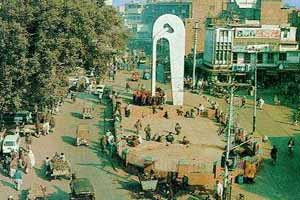
Here perhaps visiting travellers or the relaxing townsmen were regaled with stories by professional story tellers, in the evening, in the many tea-shops that still adorn the bazaar front with their large brass samovars and numerous hanging teapots and teacups.
As in most eastern bazaars, the shops of delicacies predominate, and here too you will find many colourful fruit shops displaying the glorious harvest of Peshawar’s orchards. You will be waylaid by the enticing smell of Peshawar’s unrivaled bread and justly celebrated "Kababs" and "tikkas" meat sizzling on hot coals, in the many wayside cafes.
Leather goods shops are the next most numerous selling that wonderful footwear, the Peshawari "chappals" or sandals, belts , holsters and bandoliers and a special variety of light but sturdy suitcases called " Yakhdaan".
PESHAWAR MUSEUM
Peshawar Museum is housed in an imposing
building of the British days. It was formerly the Victoria Memorial Hall built
in 1905. The large hall, side galleries and the raised platform which were used
for ball dances now display in chronological order finest specimens of Gandhara
sculptures, tribal life, the Muslim period and ethnography
NEW PESHAWAR
Across the railway line was built the new modern Peshawar, the Cantonment, like the ones which the British built near every major city for their administrative offices, military barracks, residences, parks, churches and shops.
CONTONMENT SADDAR”
The Peshawar "Saddar" (Cantonment) is a spaciously laid out neat and clean township with avenues of tall trees, wide tarred roads, large single storeyed houses with lawns and a pervading scent of rare shrubs and flowers that is Peshawar’s own.
The heart of the Saddar is the Khalid bin Walid (Company) Bagh which is an old Moghal Garden. Its huge ancient trees and gorgeous big roses are a sight to remember. Two other splendid old gardens are the Shahi Bagh in the north-east and the Wazir Bagh in the south-east, all of which give the character of a garden city to Peshawar.
In the Saddar is the splendid modern State Bank building, Governor’s House, hotels, old missionary Edwardes College, a richly stocked Museum, a fine shopping area and right in the middle is the Tourist Information Centre at Dean’s Hotel (Phone: 279781).
The Peshawar of the hoary past is the old city, the Peshawar of the British period (1849 to 1947) is the Cantonment but the Peshawar of independent Pakistan is the vast extension of the city west and east.
EDUCATIONAL INSTITUTIONS:
Westward, on the road to the Khyber, where in the days gone by, no one was safe from tribal raids, today stretches a long line of educational and research institutions, such as the Academy of Rural Development, the Teachers Training College, the North Regional Laboratories of the Council of Scientific and Industrial Research and many others.
PESHAWAR UNIVERSITY
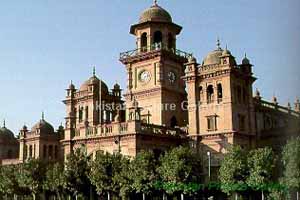
But the pride of Peshawar today is its University, a vast sprawling garden town of red brick buildings and velvet lawns, which comprises a dozen departments and Colleges of Law, Medicine, Engineering and Forestry. Special mention must be made of the Islamia College, which was the pioneer national Institution that ignited the torch of enlightenment in this region, 67 years ago.
ALONG TH G.T. ROAD:
The road stretching out east towards Rawalpindi is lined for miles upon miles with factories producing a variety of goods and also orchard producing some of the world’s finest plums, pears and peaches. Rice, sugar-cane and tobacco are rich cash-crops of the well-watered Peshawar valley through which flows the Kabul River and at the end of which the mighty Indus forms the District boundary for 48 ½ kms (30 miles). The two joining near the historic Attock Fort.