|
|
 |
Lahore = The Capital of Punjab
|
|
|
Legend has it that Lahore was founded by two sons of Lord Rama about 4,000 years ago. Historically, it has been proved that Lahore is about 2,000 years old. Hieun-tasng, the famous Chinese pilgrim has given a vivid description of Lahore city which he visited in the early parts of the seventh century A.D.
For 200 years, beginning from about 1525 A.D., Lahore was a thriving cultural centre of the great Mughal Empire. Mughal Emperors beautified Lahore, with palaces, gardens and mosques. During the British regime many monuments sprang up in Lahore which blended beautifully with the Mughal, Gothic and Victorian styles of architecture.
Lahore is the second largest city in Pakistan and the provincial capital of Punjab. Apart from being the cultural and academic centre of the country, Lahore is the Mughal "Show-Window" of Pakistan. The origins of Lahore are shrouded in the mists of antiquity. Reminiscence of its hoary past are the remains of a subterranean temple in the northern part of the Royal Fort, attributed to Rama, the legendary hero of Ramayana. Lying on the main trade and invasion routes to the South Asia, Lahore has been ruled and plundered by a number of dynasties and herdes. However, it touched the zenith of its glory during the rule of the Mughals. The Mughals, who were famous as builders, gave Lahore some of its finest architectural monuments that are extinct today.
P L A C E S O F I N T E R E S T
The most important historical monuments of the Mughals in Lahore are the Royal Fort, the Badshahi Mosque, the Tombs of Emperor Jehangir, Empress Noor Jehan, Anarkali and Asif-Jah and the famous Shalimar Gardens.
ROYAL FORT- LAHORE
Although most parts of the Royal Fort were constructed around 1566 A.D. by the Mughal Emperor, Akbar the Great, there is evidence that a mud fort was in existence here in 1021 A.D. as well, when Mahmood of Ghazna invaded this area. Akbar demolished the old mud fort and constructed most of the modern Fort, as we see it today, on the old foundations.
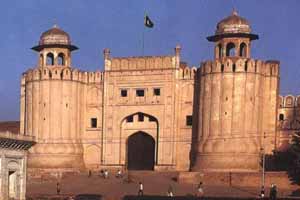
The Royal Fort is rectangular. The main gates are located alongside the centre of the western and eastern walls. Every succeeding Mughal Emperor as well as the Sikhs, and the British in their turn, added a pavilion, palace or wall to the Fort. Emperor Jehangir extended the gardens and constructed the palaces that we see today in the Jehangir’s Quadrangle, while Shah-Jehan added Diwan-e-Khas, Moti Masjid (Pearl Mosque) and his own Sleeping Chambers. Aurangzeb built the impressive main gate which faces the Hazoori Bagh lying in between the Badshahi Mosque and the Fort. The Famous Sheesh Mahal or Palace of Mirrors is in the north-east corner of the Fort. This is the most beautiful palace in the Fort and is decorated with small mirrors of different colours set.
The part of the wall of the Elephant Steps towards the Fort’s inner gate are scarred by bullet marks, bearing testimony to the Sikh Civil War of 1847 A.D.
The Sleeping Chamber of Mai Jindan houses a very interesting museum with relics from Mughal and the Sikh periods.
SHALIMAR GARDEN
Five kilometers east of Lahore are the
famous Shalimar Gardens laid out by the Mughal Emperor Shah-Jehan in 1642 A.D.
The Gardens are spread out in typical Mughal style and are surrounded by high
walls with watch-towers at the four corners. Originally, the gardens were spread
over seven ascending terraces, but only three remain now which cover an area of
about 42 acres. The brick-work of the floors of the three terraces have been
repaired according to their original designs which differ on all three terraces.
There is a marble pavilion under which water flows and cascades down over a
carved marble slab creating a water-fall effect. Across the water-fall is a
marble throne. At the end of the second terrace is a beautiful structure called
Sawan Bhadon, a sunken tank with niches on its three sides. Water cascades down
from it in sheets in front of the niches, producing the sound of falling rain.
In the olden times, small oil lamps were placed in the niches which reflected
myriad colours, through the water.
Shalimar gardens have the proud privilege of being the stage of all important state receptions. Outside its walls the annual festival of Mela Chiraghan is held every year during the year of March. Special lights on the first and second terraces of the Gardens have been installed and the area is illuminated half-an-hour after sun-set
MINAR-E-PAKISTAN-THE INDEPENDANCE
MOVEMENT:
Minar-e-Pakistan is a new landmark in
Lahore and stands in the Iqbal Park to commemorate the date (23rd March when a
resolution was passed there back in 1940 demanding the creation of a separate
homeland for the Muslims of this South Asia. The Minaret is a blend of Mughal
and modern architecture and has been very boldly designed. The Minar is about 60
metres tall.
BADSHAHI MOSQUE
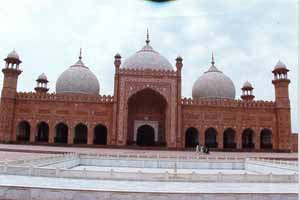
The Royal or the Badshahi Mosque is across the courtyard from Alamgiri Gate
of the Lahore Fort. The Mosque, which is made up entirely of red sand-stone was
built by Emperor Aurangzeb, the last of the great Mughals, in a record time of
two and-a-half years. Its construction was completed by 1674 A.D. It has a
beautiful gate-way which measures 21.33 metres in length and a courtyard that
measures 161.5 x 160.6 metres and is said to be the largest mosque courtyard in
the world for outdoor prayers. The marble domes cover seven prayer chambers.
Four lofty minarets stand at the four corners of the mosque, each with an outer
circumference of 20 metres, soaring up to 54 metres. In the chambers above the
Gate of the mosque, are housed relics attributed to the Holy Prophet of Islam
Peace be upon him, His Daughter and His son-in-law and are said to have been
brought to the South Asia by Amir Taimur. Within the Mosque almost all the
colours have been used for painting the floral designs but the overall effect
remains one of sobriety, piousness and simplicity
THE GOLDEN MOSQUE
Golden Mosque is situated in the Kashmiri
Bazaar inside the old city. It was built in 1753 A.D. by Nawab Syed Bhikari
Khan, who was Deputy Governor of Lahore. It is a remarkably beautiful mosque
with three golden domes
S H R I N E / M A U S O L E U M S
ALLAMA IQBAL'S TOMB
Outside the Badshahi Mosque, near its steps, lies the tomb of Allama Iqbal, the poet- philosopher of the East. The mausoleum is a mixture of Afghan and Moonsh styles of architecture and is constructed entirely of red sandstone
MAUSOLEUM OF EMPEROR JEHANGIR
The tomb of the fourth great Mughal Emperor, Jehangir, lies 5 km north-west
of Lahore across the River Ravi. It has a majestic structure made of red
sand-stone and marble. The outer entrance to the tomb opens out into a
court-yard which was used as a caravan Serai during Mughal times. An entrance to
the right leads into a Mughal garden with exact geometrical patterns balancing
each side. The marble tomb is approached from four corridors leading from the
garden. Three of these corridors are closed by intricate marble screens. The
marble grave is elaborately inlaid with floral designs and the 99 Attributes of
Allah are inscribed on its two sides. On the top is a verse from the Holy Quran.
The tomb was built by Queen Noor Jehan and the Emperor’s son Shah-Jehan,
around 1637 A.D.
NooR JEHAN'S TOMB
The Empress Noor Jehan, "Light of
the world" was the only Empress whose name appeared on the coins of the
Mughal empire. She was buried in 1645 A.D. at Shahdara (Lahore) outside
Jehangir’s mausoleum across the railway line.
Her tomb once had a marble cenotaph which she had built herself during her life time. After the decline of Mughal rule, the tomb suffered extensive damages along with her husband’s tomb at the hands of Sikh marauders when they gained power during the early part of nineteenth century. Both were stripped of most of its original beauty and splendour. All treasures and tiles, it is said, were carted off to decorate the Golden Temple at Amritsar India.
ANARKALI'S TOMB
The tomb of Nadira Begum, alias Anarkali, is situated in a corner of the
Civil Secretariat of Punjab Government at Lahore.
The tomb is circular in shape and rooted with a vast and lofty dome supported from inside by eight massive arches 12 feet 3 inches thick. It is a masterpiece of solid masonry work of early Mughal period and is neatly and beautifully fitted up
M U S E U M S I N L A H O R E
LAHORE MUSEUM
Opposite the old University Hall, a
Mughal style building on the Shahrah-e-Quaid-e-Azam, houses the Lahore Museum.
The Museum contains some fine specimens of Mughal and Sikh door-ways and
wood-work and has a big collection of paintings dating back to Indo-Pakistan,
Mughal, Sikh and British times. It has also a collection of musical instruments,
ancient jewellery, textile, pottery and armory. There are also relics from the
Graeco-Bactrian times as well as some Tibetan and Nepalese exhibits
B A Z A A R / S H O P P I N G C E N T R E S
ANARKALI BAZAAR
Anarkali bazaar is the most fascinating
of the city’s many bazaars. The alleys and lanes of this bazaar are full of
exciting wares, especially traditional crafts like leather ware, embroidered
garments glass bangles, beaten gold and silver jewellery, creations in silk
Anything that your wish for a bargain. It is named after the famous courtesan of
Amber's court called Anarkali (Pomegranate Blossom). Anarkali too has its share
of historical monuments. There is the grave of Emperor Outbidding Aibak, who
died falling of his horse playing polo. And Mahmud Ghaznavi’s General Malik
Ayyaz lies buried in the commercial area of Rang Mahal.
THE OLD CITY
In the Mughal days the Old city was surrounded by a 9 meter high brick wall
and had a rampart running around it with a moat connected with the River Ravi,
which served as a protection for the city. A circular road around the rampart
gave access to the city through thirteen gates. Some of the imposing structures
of these gates are still preserved.
In the bazaars of the Old city one still comes across tiny shops where craftsmen can be see busy turning out master-pieces in copper, brass, silver as well as textiles in the traditional fashion.