Z A N D V O O R T |
I N |
S E A |
. . . . . . . |
. . . . . . . |
U T R E C H T |
A T |
T H E |
C O A S T |
|
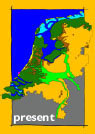
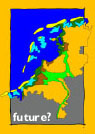
Thousands of years transgression and regression. Seven hundred years of landreclamation and making dikes. What are we actually protecting ? The Netherlands: one half under water, the other half above. A reflection on the Netherlands, a new scenario. A scenario without the need of dikes, pumping-stations and Delta-works. A scenario in which energy is divided differently over Europe. A scenario that doesn�t have to fit with the year 2030, because the process of change in the Netherlands is already going on for centuries. The result -an addition of technologic and socialcultural development- can produce with other intentions a countless amount of images. Because off an increasing sea-level, a sunken Netherlands can become reality. Not long ago a big piece of ice of the south pole broke off, an omen of more disaster. An omen that in combination with the warming-up of the sea and a decrease of groundlevel can become threatening. We can built more dikes. We can built higher dikes. It is so normal in our tradition to protect every square meter, so that we can make more suburbs, railroads and highways. In future we may give these themes other treatment and priority. In about thirty years the idea of an united Europe without borders is a generally accepted fact. As a result of further developed telematics and a logic spreading of local economic activities, the need to be a part of an own nation will make place for a universal, not local-bound feeling. Every individual is part of the electronic network and can communicate not bound to time or place. The apparent physical restrictions become possibilities for recreation as a compensation to the electronic life. Europe is big enough to support us in our necessities of life. The economy will spread over all countries. Why should we grow cucumbers in greenhouses near Amsterdam, while they will become just as green in the open air of south Tsjechi�. An united Europe and a rising sealevel: The Netherlands reprogrammed? Or will we be taken by surprise? |
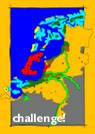
A possible program: The sea floats around islands and sunken polders. An imaginary coast will originate near the line that is now called � one meter above Normal Amsterdam Level �. Wind and water can play their game. dunes, lagoons, riverdelta�s, marshes, peat-grow, clay, streams, islands, ridges, inland seas, The Netherlands has found back her true character. The Edge-city will be a sunken metropolis-polder. A political brain, technologic inovationcenter and tradingjunction of Europe. Important cities, cultural landscapes and natural area�s are saved in sunken polders in the inland sea with their own function and quality. New ways of city planning, architecture and transport......... What will stay the same and what will become new? Where and when shall who and what have to change? Is withdrawal the best defence against the sea? What does this mean for the Dutch people? How valuable are the polders for them? What will be the meaning of the low-lands? In short; What will be the looks of The Netherlands in 2030? The reflection on the low-lands as a challenge; daydream, absurdism or future perspective? |
 |
 |
 |
 |
 |
 |
 |
 |
 |
|
