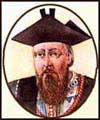
The Portuguese sailor, Vasco da Gama found the easiest way to India from Europe. Following the centuries old route taken by the Arab traders , he sailed the Sao' Gabriel to land at Kappad near the town of Calicut (Kozhikode) in 1498 AD. The entire history of the East was to change from that day. Gama, received a warm welcome from the ruler of Calicut. Trade concessions were granted to the Portuguese (They were called Parungees in Malayalam, the local language). Even though they got a warm welcome as well as favourable trade concessions, the Portuguese were extremely cruel to the local peoples. Cabral Alvarez believed in the supremacy of the Portuguese on the sea-lanes and killed anyone dared to break it. "...this deeds were blots in the annals of a Christian nation, and a disgrace to the name of humanity.." that is how the historians described the barbarity done by Gama during his second visit. Two years later, in 1500 AD, Portuguese ships under the command of Admiral Cabral visited Cochin and the Rajah of Cochin (who was in rivalry with the King of Calicut) permitted them to engage in trade. In 1503, Alphonso Alburquerque was given permission by the Rajah to build a fort at Cochin. Within the Fort they erected a church of wood . A succession of Governors, soldiers and Catholic Priests ( The Papal proclamation then had roughly divided the world into two spheres of influence between the Spanish and the Portuguese.) landed in Kerala for expanding the territories and plundering the lands they conquered. In 1502 AD Gama visited Cochin and again came back in 1524 AD ,where he died and cremated inside the St. Francis Church which they built in 1503 AD. There was some organised resistance to the Portuguese expansionism, from the ruler of Calicut, who himself once received the Portuguese with high respect, but against better weapons, technology and crookedness , it was a losing battle.
The Portuguese fought with the Dutch for the control of spice trade, who with aid of the King of Cochin evicted the Portuguese from Cochin and established Dutch East India Company in 1602 AD. Stefan Van Hegena reached Kannur ( Cannanore) in 1604. After evicting the Portuguese from Cochin, the Dutch ( Lanthakar) made successful agreement with the Zamuthiri of Calicut and defeted the Portuguese drive out the Portuguese once and for all by 1663. This gave the Dutch total control over the eastern spices trade and gaining foothold over most of the coastal areas mainly Kannur and Kochi. In 1741 at Kolachel , the king of Thiruvithanmkur , Marthanda Varma defeted the Dutch once for all. By 1795, the Dutch were so weakened, that the British did not have much trouble evicting them permanently from the Kerala. The Bolgatty palace and the palace at Mattancherry ( Dutch palace built in 1555 AD by Portuguese and renovate in 1663 AD by the Dutch) at Cochin are the reminders of the brief Dutch presence in Kerala.
Even though the Portuguese, constantly fought war and engaged in merciless killing , the people of Kerala will remember them for introducing many new agricultural crops to Kerala, like pineapple, papaya, tapioca, rubber, cashew nut and scientific farming methods for coconuts.
Mr:H.A.Van Rheede, the renowned Governor of Cochin, Kerala, during the Dutch reign of this land published a detailed study of medicinal plants of Kerala during that time in Latin from Amsterdam in 1678 AD under the title "Hortus Malabaricus" The book contains descriptions, along with illustrations and uses of over 742 plants, under their local Malayalam names. The text of this book is in Latin as well as the local names are printed in Malayalam script. "Hortus Malabaricus" is the first printed book on the medicinal plant wealth of Kerala. Information is also available in the text of "HortusMalabaricus" not only about the vegetation in 17th century Kerala but also about the general social conditions prevailing there in those days.The information on the medicinal uses of plants described in this book is of immense importance and current relevance, in the growing global needs for natural drugs.
The French also had brief moments of glory in Kerala. But a resurgent Britain put paid to their hopes of empire building and managed to confine them to a small enclave Mahe near Kannur. A small pocket barely five sq. kms. The French held Mahe from 1817 to 1954. Mahe remained a French protectorate till 1954 when the last of the Frency left. In 1962, the French gave nationalities to all those who had served French. Today, nearly a hundred families are French passport holders and members of what is called the Union des Francais de Mahe. the other symbols of the French in Mahe like the chateau of the French Administrator at the mount of the river and the statue of Marianne installed in 1889 marking the centenary celebrations of the French Revolution. But one living legacy of the French in modern day Mahe is the French legionnair’s cap that is still worn by the policemen. St. Theresa’s Church is the most famous Christian Church in Malabar. The Church was built during French Reign and it stands as a monument to the legacy of French rule.
Germans were not one of the contestants for the
rule of Kerala, but they did send their missionaries (Basal Mission in - 1829
AD) to the Malabar. German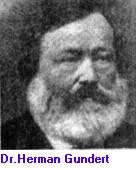 missionary Dr. Herman Gundert played an important
role in the history of Malayalam language by gifting it with the English
-Malayalam dictionery. Thallassery ( A town near Calicut) has the bungalow of
Dr.Gundert (1814-1893) . In June 1847 witnessed the birth of its first Malayalam
news paper 'Rajyasamacharam' under the stuewardship of Dr.Gundert. Gundert
published articles in German, English, Malayalam and Tamil languages in various
subjects.
missionary Dr. Herman Gundert played an important
role in the history of Malayalam language by gifting it with the English
-Malayalam dictionery. Thallassery ( A town near Calicut) has the bungalow of
Dr.Gundert (1814-1893) . In June 1847 witnessed the birth of its first Malayalam
news paper 'Rajyasamacharam' under the stuewardship of Dr.Gundert. Gundert
published articles in German, English, Malayalam and Tamil languages in various
subjects.
When the British were trying to extend their influence in South India and they came across Tipu, the King of Mysore. Travancore (The southern most Princely state of Kerala) and Cochin ( The Princely state of Central Kerala) was into a common alliance with the British against Tipu. The Mysore war was over in 1799 and the British were de facto rulers of North Kerala (Malabar), which until then were part of Tipu's kingdom. Both Travancore and Kochi were forced to accept British residents for the rest of their history. In 1947 British left India and princely states of Travancore and Cochin decided to join the Indian union and united with Malabar form the State of Kerala in 1956.