 |
| "The Sari was born on the loom of a fanciful weaver. Who dreamt of Woman. The shimmer of her tears. The drape of her tumbling hair. The colors of her many moods. The softness of her touch. All these he wove together. He couldn't stop. He wove for many yards and when he was done, he sat back and smiled at what he had created." |
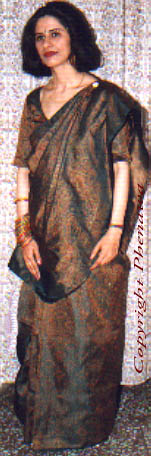
| Here you see what you need underneth the Sari: A long skirt (Petticoat) from waist to touching floor is tied tightly at the waist by a drawstring. And a fitted tanktop (blouse) that ends just below the bust. Blouse is usually the same match as sari and could be stitched to make a fashion statement. such as backless, sleeveless or with sleevs. Starting in the middle just below the navel, tuck the plain end of the sari into the petticoat for one complete turn from right to left. Make sure that the lower end of the sari just touches the floor. It is a good idia to wear your sandals before tieing the Sari. Beginning from the tucked-in end start making pleats in the sari, about 5 inches deep. Make about 5 (minimum) to 10 pleats and hold them up together so that they fall straight and even. Tuck the pleats into the waist slightly to the left of the navel, and make sure that they are turned towards the left. Drape the remaining fabric around yourself once more left to right, and bring it up under the right arm and over the left shoulder so that it falls to about the level of the knees. The end portion thus draped is the pallu, and can be prevented from slipping off by fixing it at the shoulder to the blouse with a safety pin. |
|
| How to wrap Sari |
 |
| Over the centuries, there have been changes. The diversity of the Indian people is reflected in a variety of materials used for a Sari and the way it is draped in different parts of the country. In the South of India, the nine-yard length is draped between the legs to fashion flowing pants. The Nothern, central and South Indian wear sari, which look like a full-length gown. The traditional six-yard sari, however, is a classic and allows for generous pleating and draping around the body and over the shoulder - almost Grecian in its elegance. The Sari is an Indian woman's statement to the world. It could be of shimmering silk or the fine cotton. It may even be embroidered with golden or silk thread border. It speaks of romance or riches, sobriety or sophistication and simplicity. |
Sari |
| Sari |
| Leave your comments Pahnawa |
| Legend says it that when the beauteous Draupadi - wife of the Pandavas -was lost to the enemy clan in a gambling duel, the Lord Krishna promised to protect her virtue. The lecherous victors, intent on "bagging" their prize, caught one end of the diaphanous material that draped her so demurely, yet seductively. They continued to pull and unravel, but could reach no end. Virtue triumphed yet again in this 5,000 year old Indian epic, the Mahabharat. Legend, fantasy, history or fact, it is the first recorded reference to the enduringly attractive SARI - the longest, most popular style in the history of women's fashion. |
 |
|
|
|