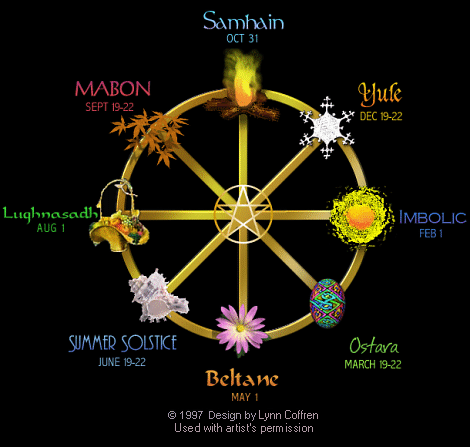
 Samhain
-- October 31. Pronounced "sow-en," not "Sam Hain." The pagan new
year, the last harvest festival of the calendar year. Traditional foods
include pumpkins, squash, and nuts. This is the time of year when pagans
celebrate their ancestors and their heritage. Traditionally, an extra
place is set and the food from that setting is put outside over night.
Anything left in the morning is buried. This is also the time of year
when the veil between the land of the living and the spirit world is
thinnest, allowing communication with ancestors, necromancy, and the
like. It is a good time for divination, notably a look at the year to
come. In Wicca, the re-emergence of the goddess from the underworld
is indicated, as in the story of Persephone, and we bid the god goodbye
as we prepare for his Yule rebirth.
Samhain
-- October 31. Pronounced "sow-en," not "Sam Hain." The pagan new
year, the last harvest festival of the calendar year. Traditional foods
include pumpkins, squash, and nuts. This is the time of year when pagans
celebrate their ancestors and their heritage. Traditionally, an extra
place is set and the food from that setting is put outside over night.
Anything left in the morning is buried. This is also the time of year
when the veil between the land of the living and the spirit world is
thinnest, allowing communication with ancestors, necromancy, and the
like. It is a good time for divination, notably a look at the year to
come. In Wicca, the re-emergence of the goddess from the underworld
is indicated, as in the story of Persephone, and we bid the god goodbye
as we prepare for his Yule rebirth.
Back to top

Yule/Winter
Solstice/Midwinter -- December 19-22, the exact time
and date occurring when the sun passes into Capricorn. The time of greatest
darkness and the longest night/shortest day of the year. The rebirth
of the Wiccan god, signifying the re-emergence of the sun, as days will
now begin to lengthen once more. There is a renewal of hope and optimism.
In modern times Pagans often celebrate this holiday as Christians do
Christmas, with feasting and gift-giving, Yule trees, decortations,
and so forth.
Back to top
Imbolc/Imbolic/Imbolg/Candlemas
-- February 1 or 2. The very earliest signs of spring and
a celebration of the growing light. The Wiccan goddess is nurturing
the young god. This is a time of new growth and regeneration. The planting
of seeds is one way of celebrating. Creative tasks in general are positive
points of focus.
Back to top
Ostara/Spring
Equinox -- March 19-22, the exact time and date occurring
when the sun passes into Aries. This is the first day of spring. The
days and nights are now of equal length. The Wiccan god continues to
mature and love is in the air... this is the time for many species of
animal to breed, and even humans seem to be focused more in a romantic
direction. New buds are appearing on the trees and flowers are blooming.
Cut flowers decorate altars and feasts of in-season foods are appropriate.
Back to top
Beltaine/Beltane/May
Day -- May 1. Spring is in full bloom. The Wiccan
goddess and god are united in love. There is a focus on physical union
in rites at this time, and there are often love-focused rituals. Often
there are bonfires, and May Poles, which are of course phallic symbols.
As usual, seasonal foods are appropriate for feasting, and so are cut
flowers.
Back to top
Midsummer/Summer
Solstice -- June 19-22, the exact time and date occurring
when the sun passes into Cancer. The longest day and shortest night
of the year. The Wiccan goddess and god are in the heat of their union.
Herbs are harvested and young animals are growing. It's the time of
year for travel, weddings and handfastings, social gatherings like barbeques,
etc. Crops grow between the times of planting and harvest.
Back to top
Lughnasadh/Lammas
-- August 1. The First Harvest, of three. Many foods are
being harvested: early grains, fruits, vegetables, There is a wide variety
of choices for the sabbat feast, and canning is begun. Young animals
are growing strong. Our creative ventures begun in spring begin to bear
fruit. Days are still long and yet they are waning; there is a lazy
feeling in the evening air.
Back to top
Mabon/Autumn
Equinox -- September 19-22, the exact time and date occurring
when the sun passes into Libra. Once again the day and night are of
the exact same length. This is the Second Harvest, the continuing harvest.
More canning and preserving are done. The nights are cool and the leaves
are turning, beginning to fall. We begin to prepare for the cold winter
months ahead.
Back to top