
Menu
The Burning Times
"You will hear this often. In reference to a historical time from around
1000CE through the 18th century when it is said that over nine million people
were tortured, hanged and burned by the church and public officers on the
assumption that they were the Christian version of witches. This turned into
a extremely profitable venture,as all the land and property was seized from
the accused individual. Historians indicate that the majority of people who
were tortured, hanged, burned and murdered were Women and Children."
Burning Times... A term used by modern witches and pagans to
refer to the period in western history of intense witch hunting and executions,
generally the mid 14th through the 18th centuries. Burning, was one of the
most extreme forms of execution,and was urged by St. Augustine (354-(430)
who said that pagans, Jews, and heretics would burn forever in eternal fire
with the devil unless saved by the Catholic Church. During the inquisitions,charges
of witchcraft were used against heretics,social outcasts and enemies of the
church. Since fire is the element of purification,nothing less than fire could
negate the evil of witchcraft. Jean Bodin a 16th century demonologist,*stated
in, De la de'monomanie "Even if the witch has never killed or done evil
to man,beast or fruits and even if he has always cured bewitched people ,or
driven away tempests,it is because he has renounced God and turned with Satan,that
they deserved to be burned alive... Even if there is no more than the obligation
to the Devil,having denied God, this deserves the most cruel death that can
be imagined."
Not all witches were burned at the stake,hangings was more
preferred means of execution in England and the American colonies. France,
Scotland and Germany,it was customary to strangle condemned witches first,as
a act of mercy by either hanging or garroting, and then burn to ashes.
Records of trails in Scotland reported that burning a witch
consumed 16 loads of peat plus wood and coal.
Further Reading:
Enemies of God: The Witch-hunt in Scotland ~ by Christine
Larner
Witchcraze: A new history of the European Witch Hunts ~ by Anne Llewellyn
Barstow
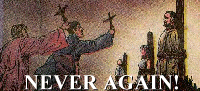
The terms burning times also refers to any threatened prejudice against or
persecution of witches and pagans by other religious groups, law enforcement
agencies, employment, politicians, and others. (see Helms Amendment )
THE
MALLEUS MALEFICARUM
of Heinrich Kramer and James Sprenger
Unabridged online republication of the 1928 edition. Introduction
to the 1948 edition is also included.
Translation, notes, and two introductions by Montague Summers. A Bull of Innocent
VIII.
The Malleus
Maleficarum (The Witch Hammer), first published in 1486, is arguably one
of the most infamous books ever written, due primarily to its position and
regard during the Middle Ages. It served as a guidebook for Inquisitors during
the Inquisition, and was designed to aid them in the identification, prosecution,
and dispatching of Witches. It set forth, as well, many of the modern misconceptions
and fears concerning witches and the influence of witchcraft. The questions,
definitions, and accusations it set forth in regard to witches, which were
reinforced by its use during the Inquisition, came to be widely regarded as
irrefutable truth. Those beliefs are held even today by a majority of Christians
in regard to practitioners of the modern "revived" religion of Witchcraft,
or Wicca. And while the Malleus itself is largely unknown in modern times,
its effects have proved long lasting.
At the time of the writing of The Malleus Maleficarum, there
were many voices within the Christian community (scholars and theologians)
who doubted the existence of witches and largely regarded such belief as mere
superstition. The authors of the Malleus addressed those voices in no uncertain
terms, stating: "Whether the Belief that there are such Beings as Witches
is so Essential a Part of the Catholic Faith that Obstinacy to maintain the
Opposite Opinion manifestly savours of Heresy." The immediate, and lasting,
popularity of the Malleus essentially silenced those voices. It made very
real the threat of one being branded a heretic, simply by virtue of one's
questioning of the existence of witches and, thus, the validity of the Inquisition.
It set into the general Christian consciousness, for all time, a belief in
the existence of witches as a real and valid threat to the Christian world.
It is a belief which is held to this day.
It must be noted that during the Inquisition, few, if any,
real, verifiable, witches were ever discovered or tried. Often the very accusation
was enough to see one branded a witch, tried by the Inquisitors' Court, and
burned alive at the stake. Estimates of the death toll during the Inquisition
worldwide range from 600,000 to as high as 9,000,000 (over its 250 year long
course); either is a chilling number when one realizes that nearly all of
the accused were women, and consisted primarily of outcasts and other suspicious
persons. Old women. Midwives. Jews. Poets. Gypsies. Anyone who did not fit
within the contemporary view of pious Christians were suspect, and easily
branded "Witch". Usually to devastating effect.
It must also be noted that the crime of Witchcraft was not
the only crime of which one could be accused during the Inquisition. By questioning
any part of Catholic belief, one could be branded a heretic. Scientists were
branded heretics by virtue of repudiating certain tenets of Christian belief
(most notably Galileo, whose theories on the nature of planets and gravitational
fields was initially branded heretical). Writers who challenged the Church
were arrested for heresy (sometimes formerly accepted writers whose works
had become unpopular). Anyone who questioned the validity of any part of Catholic
belief did so at their own risk. The Malleus Maleficarum played an important
role in bringing such Canonical law into being, as often the charge of heresy
carried along with it suspicions of witchcraft.
It must be remembered that the Malleus is a work of its time.
Science had only just begun to make any real advances. At that time nearly
any unexplainable illness or malady would often be attributed to magic, and
thus the activity of witches. It was a way for ordinary people to make sense
of the world around them. The Malleus drew upon those beliefs, and, by its
very existence, reinforced them and brought them into the codified belief
system of the Catholic Church. In many ways, it could be said that it helped
to validate the Inquisition itself.
While the Malleus itself cannot be blamed for the Inquisition
or the horrors inflicted upon mankind by the Inquisitors, it certainly played
an important role. Thus has it been said that The Malleus Maleficarum is one
of the most blood-soaked works in human history, in that its very existence
reinforced and validated Catholic beliefs which led to the prosecution, torture,
and murder, of tens of thousands of innocent people.
The lasting effect of the Malleus upon the world can only be
measured in the lives of the hundreds of thousands of men, women, and even
children, who suffered, and died, at the hands of the Inquisitors during the
Inquisition. At the height of its popularity, The Malleus Maleficarum was
surpassed in public notoriety only by The Bible. Its effects were even felt
in the New World, where the last gasp of the Inquisition was felt in the English
settlements in America (most notably in Salem, Massachusetts during the Salem
Witch Trials).
It is beyond the scope of this article to adequately examine
the role of the Malleus in world history, or its lasting effects. At the very
least, The Malleus Maleficarum (The Witch Hammer) offers to us an intriguing
glimpse into the Medieval mind, and perhaps gives us a taste of what it might
have been like to have lived in those times.
- Wicasta Lovelace