Rotcod Zzaj Interviews C III
Zzaj: I've been riding this "etherspace wave" for some many years now... how many years since YOU started surfin' that wave?
CRGIII: Your question has two answers. In the sense of a generic ethersurf of recording and performing strange and unusual "music", that probably started when I was about 4 years old in 1963 or so. My parents got a reel to reel tape recorder that totally fascinated my innocent little brain. Although I no longer possess any of these ancient documents, I still have a couple of pieces that I recorded when I was about 12: covers of Beatles songs done with jews harp and kazoo, overdubbed using this same primitive parental recorder and a portable Panasonic. I learned clarinet in third grade, giving me a bit of experience in the world of traditional instruments and western musical notation. Bored with the hokey junk I was forced to learn on the clarinet, I gave up my lessons by sixth grade and haven't had any traditional music instruction since. Composing and performing continued to be part of my life though, acquiring a guitar at age 15, followed by an ever-growing collection of recording devices and instruments as time progressed. Recordings that others might consider to be interesting started to flow around 1979. My residence in Berkeley I'm sure influenced these "ethereal" works. I got heavily into the distribution and exchange of these recordings in the early/mid 1980's, founding the Taped Rugs label during that time.
The second "answer" involves a project that I still am a part of, "The Herd Of The ETHER SPACE." This is the name given to a vast variety of sonic interactions with several different audio explorers, core members being myself, Killr Kaswan, Robert Silverman, George Gibson, Stu Sands, and Steve Schaer. I was involved in a number of projects (Temporarily K.Y., -Ing, Disism) during the time that many of the first Herd compositions were created, but the first Herd recordings were never released nor even named until about 1989. At that point in time the Herd became the project that I was most involved in until I moved to Kansas in 1996. Killr, Robert, and I just recorded together last summer, so the Herd lives on. Kansas was the birthplace of my more recent collaborative efforts: Turkey Makes Me Sleepy and Magic Potty Babies.
Zzaj: When it comes to musical adventure, you seem to have a premium on "out" composition. Where does that come from? Is it in your blood, or is it "learned"?
CRGIII: In addition to the heavy influences of those I've collaborated with, I think my work is mostly a reaction to all the various things, audio and otherwise, that my little brain gets exposed to. Often my works are a reaction to those things in my life over which I have no control, attempting to funnel my frustrations into something other than whining and self pity and my joys into celebrations that others can share. I also get bored rather easily, so I'm always striving to create something that doesn't sound like anything else. Each composition has its own life, a style that fits the purpose, and while there are certainly elements of just about every musical style in my works, I find no need nor desire to follow anyone else's particular formula unless it seems appropriate.
A lot of my techniques are bastardized versions of what I hear and see. A good example is how I learned to create reel to reel tape loops from watching a number of Frippertronics performances. With -Ing and Disism, I worked with individuals who co-wrote material that used the tape loop as a compositional tool for pieces that could be recreated for live performance. Another bastardization is my vocal style, which contains elements of vocal techniques used by Todd Rundgren, Karen Carpenter, Sammy Davis, Homer Flynn, Ray Collins, and Diamanda Galas (now isn't that a potent cocktail?)
Zzaj: Please describe your "studio" setting (no matter how humble or grandiose).
CRGIII: I've got a lot of tape recorders, phonographs, and a computer. These devices are all used as compositional tools. I have a large collection of odd records and tapes, which includes a lot of spoken word and musical nonsense to edit materials from. I snip up bits of internet samples and TV streams. I also like to make "field recordings" of just about anything, and these come in handy for composing as well.
As for "traditional" instruments: some guitars, a clarinet, an alto sax, a micro moog, a (very warped) bass, a large collection of flutes and whistles, and a whole bunch of percussion goodies fill up the tool box. I also have a great big bunch of toy instruments, of both the acoustic and electronic variety, and I often find ways of monkeying the electronic ones to do things that they weren't intended to do. One of my faves of these is a thing that creates both train and animal sounds which I augmented with a pitch bender. Of course I enjoy making my own instruments from scratch too, and I have a large collection of wind and percussive types.
Zzaj: Our readers need to know the whereabouts of your WWW lair... please point them in the write direction... & expound a bit on what your website "means" in the greater scheme.
CRGIII: Well, the site is Taped Rugs Productions at www.geocities.com/padukem. As for what's in there, there's a whole lot of sounds from various projects, some reviews and interviews, a bunch of visuals, links, and, of course, a catalog. There's about 100 recordings in the catalog. As far as the site's "meaning," hmmm...: a place for the exchange of ideas maybe, certainly not a place for making profits. As is the case for most avant home recorders, I spend a lot more money than I make on my artish endeavors, and my intent is not to capitali$e from my work, but to share it. My little brain's definition of what art is: an expression of human interaction, a close approximation of something sacred. I don't have any first hand memories of what went on in human prehistory, but I get the feeling that musical expression started long before the idea of "profit" was ever conceived of. Music for money takes away some of its power, and I want all the musical power I can get. People can buy my recordings, but I try to charge just enough to cover my expenses. Mostly I trade them with other sonic explorers for the sake of expanding mutual experiences.
Zzaj: There are many players in today's "underground" scene. The truly great ones (in my opinion) are those no one ever hears of until they happen upon a tape or CD by them. Who are some of these "unknowns" (in your opinion).
CRGIII: Well, for me, having been involved in the whole home recording underworld for so long, "unknown" is a very relative term. I'd rather refer to these individuals as heroes who haven't entered the consciousness of mainstream society, but who have made a significant mark on the world of audio exploration. It would be difficult to name them all, and I certainly don't want to offend anyone I leave out. Some of the pioneers who immediately come to mind for having stuck with their craft with persistence and ever-progressing creativeness include Hal McGee, Chris Phinney, Don Campau, Al Margolis, Bret Hart, Zan Hoffman, Brian Noring, Amy Denio, Tom Sutter, Michael J. Bowman, and indeed you yourself Rotcod. I have a collection of home recordings that is so vast, it's hard for me to find ways to store it all in my house. Among those tapes, CDs, and records, I have way too many favorites to mention here, including large collections of material that's all from one person or project. A couple of the more recent entries into the fray who I believe are producing a lot of excellent work are Tom Bollinger of Yippee Bean, Tim and Terry of Stone Premonitions, and the one-of-a-kind Buzzsaw.
Zzaj: Are you a blood (or by marriage) relative of Sun Ra?
CRGIII: No, but I did feel very much "at home" watching him perform. Nice of you to ask though.
Zzaj: You (like myself) seem to be greatly aware of the necessary junctures of words/music. Why is this so? Did you lust for your English teacher, or what?
CRGIII: I've got two writing degrees from UC Berkeley, for whatever that's worth. I started writing creatively when I was about 6. My English teachers were always very supportive of my writing skills, but seldom sexy. Language is just another art that I've practiced extensively, and, as with anything else, practice leads to developing techniques. Communication seems to come in many forms, and I enjoy dabbling in as many as I can. I'm not sure why -- probably just brain cell arrangement.
Zzaj: If you were writing the Zzaj-Rant (as guest ranter), what would you rant about first?
CRGIII: I think I've done a bit too much ranting already here, but if you want more, I'll rant about how the potential for humanity is so great, but those who hold so much of the power to fulfill that potential are so lame. More of the world's resources are used to kill, hurt, and control people than for any other purpose, and that's just plain stupid.
Zzaj: What "projects" do you have coming up in the next year (or so)?
CRGIII: Working right now on a collab with Bret Hart and Hal McGee that I think's gonna be a winner. Got a lot of solo stuff going on with computer edited compositions. Hoping to do some cover songs later this year. Just recently I started some minimalistic projects with local collabors Mike Adams and Josh Duringer. I hope to get my old Turkey buddie Eric Matchett involved in these too, and after enough stuff's collected, issuing it for public scrutiny.
Zzaj: Words of wisdom for all those aspiring "ether-junkies" out there in D.I.Y.-land?
CRGIII: Feel it, express it, share it, and always keep in mind that the sun's gonna melt the earth some day
Rotcod Zzaj, Improvijazzation Nation - Issue # 56
For the last couple decades of the twentieth century and into the 21st, Charles Rice Goff III -- or Swami Loopynanda as he would eventually come to characterize himself -- worked on the very outermost fringes of rock, pop, and experimental music. Through myriad guises and artistic collaborations, he espoused the theory and practiced the art of hometaping, eventually finding himself as part of an international network of like-minded indie musicians and composers who often traded original efforts back and forth amongst one another.
Goff started creating his own musical works from a young age. Fascinated by the reel-to-reel tape recorder his parents purchased in the early '60s, he began messing around, recording speaker-to-microphone his own crude efforts created on instruments (jews harp, toy drum, kazoo, etc.) that he taught himself. Except for his grammar school dalliance with clarinet, Goff eschewed formal training for the outright freedom of learning to play on his own, often by mimicking his records by ear on whatever instrument happened to be laying around. Besides teaching him the joys of experimentation, it also opened up a rapacious eclecticism and interest in sounds for their own sake.
By the late '70s, Goff had entered UC Berkeley, where he began taking part in free-form jams with other musicians, sometimes recording the results. Although a hometaping community did not exist at the time, he did begin to distribute tapes to a few friends and college radio stations, frequently receiving encouraging responses. By 1982, Goff and his closest collaborator, Steve Schaer, had developed a unique repertoire of pieces that were created to be played live into a tape-looping system, very similar to Robert Fripp and Brian Eno's "Frippertonics" technique from a few years before. The duo called themselves -ING and started performing around the San Francisco Bay area, usually at punk and rock venues. They earned great responses from audiences but lukewarm ones from club owners and record labels. It only strengthened Goff's resolve that the music, although perhaps not commercial in any sense, had a listening public.
In 1985, he started working with Mark Kaswan in a new act, Disism, again using a tape-loop system but with the evolution of adding specially edited tapes to the instruments that they played into the tape loops. Goff also began hearing about other non-commercial/traditional acts like his that were autonomously making tapes to distribute via the mail or through local record stores. Disism followed suit by releasing an eponymous effort via the worldwide hometaping network that they had just discovered through little independent publications and 'zines, acquiring addresses of likeminded musicians. Goff began trading tapes with his new pen pals and subsequently uncovered just how extensive the community was and how much great experimental music was being created throughout the world under the banner of hometaping. Disism began experimenting even more with different techniques and configurations of instrumentation.
Goff continued throughout the 1980s to take part in live improvisational settings with a loose affiliation of musicians that eventually called itself Herd of the Ether Space. The group's roots actually went back to the late '70s when Goff and several of the band members were trying to establish a Zappa-esque unit. (The failed experiment did surface as Temporary KY before morphing into -ING.) He taped many of their sessions, eventually editing them down into tapes for distribution. The group had no set membership or stylistic constraint, and they created an umbrella label called Taped Rugs Productions to release Herd and Disism recordings. The band also performed live on occasion. As the Taped Rugs catalog began to broaden, Goff found himself increasingly moving tapes around the world to other musicians, radio broadcasters, and reviewers, frequently earning positive feedback.
By 1989 he started creating and distributing his own solo tapes, sometimes full of songs, sometimes full of loops and sound collages. In 1996 he moved from California to Lawrence, Kansas, where he became involved in the genesis of a community radio station, broadcasting his own program, "The Deprogramming Center," to showcase the vast array of hometapers from around the world. He also devised the pseudonym Swami Loopynanda, and began playing with two local experimental musicians as Turkey Makes Me Sleepy. In addition, he became something of a spokesman for the hometaping community, writing articles and reviews for magazines about the phenomenon.
Stanton Swihart, All Music Guide
Don: This month I speak with Charles Rice Goff III. He's an interesting guy, a home taper on the scene for many years who moved from the SF Bay Area to Kansas where he resides and makes his weird sounds. His label, Taped Rugs, is truly unusual and offers many bizarre tapes. Get in touch with him.
Don: Do you see a lack of humor in most artistic expression these days?
CIII: I don't feel qualified to speak on all aspects of "artistic expression," but I do have a comment or two on audio art. Now that Zappa has left behind we of the living, and the Residents have been focusing more on dark realities rather than on dada ditties, at least two of my favorite comic reliefs have disappeared. However, there are several home recording artists like Wayne Butane, Farces Wanna Mo, and Implicit Order, who continue to funny-up the world. Home recording is clearly the best outlet for humor, because there aren't any corporate suits telling artists to tone down their craziness. Commercial acts that try to be funny, like Weird Al for instance, usually aren't, and I think that's because those who control commercial music are afraid of investing in genuinely bizzare acts that won't appeal to teenage girls and bring them lots of quick dollars.
Don: What cracks you up?
CIII: People who get all bent out of shape about stuff that doesn't matter make me laugh. People who take themselves really seriously seem pretty funny to me too. The idea of "fashion" frequently gets me chuckling. Contrived humor usually has to be pretty weird before it gets me to react much. I don't like jokes.
Don: In terms of modern culture or music is there one thing that really rings your bell in a good way? What about something that bothers you?
CIII: Originality is what I thrive on, while trends bring me down. People like to put music and most every other artform into categories. Artists that interest me most are those who plow their own turf and who are not afraid to try out new ideas. Being unimpeded by genre allows for the truest expression. Obviously every artist is influenced by other artists, but it seems that too often people are trying to fit into other people's molds, and that leads to a lot of half-baked monotony. I recently entered Turkey Makes Me Sleepy onto an internet list of local bands. I had to choose a category to list us under, and the closest match available was "techno/industrial/new wave"--clearly unsatisfactory.
Don: Are you a whiner? What do you whine about if you are?
CIII: I usually see the little positives inside the big negatives. I don't get along well with whiners. There are a lot of things in this world that could be a lot better, however. Perhaps that's why I'm an artist, because I am disturbed by a lot of things, and I feel driven to point those things out to people. While I don't whine, I do joke about disturbing realities and often shock people with graphic imagery. Among the subjects of my dissatisfaction are: how the pursuit of wealth leads to the degradation of spirit and the exploitation of everything and everybody, how people regularly are duped into doing hateful and destructive things by political and religious leaders, and how so many human beings think of themselves as experts gushing with wisdom, when even the most intelligent genius is just a pea-brained idiot when it comes to understanding the universe.
Don: Is there a spiritual path that makes you feel comfortable or strong?
CIII: As I said in my previous answer, I believe that humans are way too stupid to understand what's really going on. I figure that there are all kinds of forces and energies working on me and my fellows that no one of us will ever be able to even imagine. So I hope for the best, anticipate the worst, and try to enjoy being one of these limited little humans as much as I can. Being resolute in my uncertainty gives me comfort.
Don Campau, Go Ahead You Review It
Working either in conjunction with other musicians or by himself, CRG III's eccentric soundscapes mesh tape loops, conversation, guitar, sampled sounds and voice to create a curious amalgam that results in unique music. The closest approximation one could make would be asking the listener to set up a series of radios all at once, tuned to separate stations, and absorb the result. News broadcasts weave in and out of guitar plinkings, captivating melodies and turkey calls to create exciting soundscapes so that one is not sure whether to laugh or take the messages one is receiving with deadly seriousness. The works challenge the listener in all the right ways.
If you are interested in groundbreaking and experimental music and sounds, then C. Goff III is someone well worth contacting. Not only is he friendly and approachable, but he is also an exponent to the DIY grassroots underground ethic (My God,! You're in it for the music!) that needs all the nurturing from you the listener that it can get.
Tom Bollinger, Yippee Bean
Jerry: I'm writing an article about Bret's Duets series and would like to incorporate comments from the participants into the article. Below you will find a few questions related to the series. Tell me about your experience doing this project. Were you the "initiator" or "finisher"? If you were the finisher, were you surprised or feel challenged by what Bret sent you? If you were the initiator, were you surprised by the results after Bret finished it? If the result was something very different from what you're accustomed to could you offer some comments or thoughts?
CIII: I was both. Bret contacted me out of the blue to collaborate with him. While I'd heard a few pieces of his music here and there, and while I'd read some his reviews, he and I had never communicated directly. I understand he got my contact information from a mutual friend in Australia! Anyway, after he "initiated contact," I gathered some materials from among a few unreleased improvisation sessions to send to him as source material. Our final product "Fondling Giblets" doesn't really fit into his "duet" category, because my source material included me playing with three other groupings of musicians. I was pleased by the results that Bret produced. It's always fun to hear others mess around with sounds that I helped create, and Bret displayed some dynamite musicianship and recording skills on this effort.
Jerry: Some of you have done two or more volumes in the series, one as initiator and the other as finisher. Can you offer any comments or thoughts about the difference in the experiences and the results? Most of the Duets projects have been done by snail and email. Was this a new experience for you? Can you offer any thoughts about what it's like to collaborate on a musical project this way?
CIII: This is my only such project with Bret so far, although we plan to do more, including one that is just underway involving Bret, myself, and home recording hero Hal McGee. I have been collaborating with other artists in similar ways for the last twenty-plus years. This year I've sent my voice to A101 Usui Tadashi in Japan to include on his latest CD: Red Sky. I've been also exchanging materials with Das of Big City Orchestra this year for a similar project. Everyone works differently, but an entertaining result seems to be the rule rather than the exception. The potentials for new and interesting rhythms, noises, atmosphere, etc. seem to multiply dramatically as new and different brain paths intersect their various visions.
Jerry: Is it correct to assume that it's always preferable to be physically in the same place when collaborating,or did you find advantages or benefits to collaborating in this manner?
CIII: Both have their positives. The subconscious communication that takes place during a particularly inspiring interaction with other musicians is a life-enhancing experience and often that feeling is carried to others who listen during the session or hear a recording of it later. The methodology of "treating" someone else's sounds is also a wonderful world to explore, similar to solving a puzzle. In treating someone else's work, an artist has time to refine concepts before executing them.
Jerry: Do you have a specific thought(s) or image(s) in mind when improvising? Or are you just freely "letting 'er rip"? That is, do you typically apply any rules or guidelines to the process or does the music come straight from the soul?
CIII: Improvisation depends a lot on environment. The participants themselves,the moods that each brings with him or her to the session, the setting for the session, the instrumentation available, the acoustics, the weather outside, etc. all are parts of the experience. Each of these can have either a positive or a negative effect on the session.
Free "let 'er rip" improvisation brings all of these elements into play. While the free form allows truly new sonic territory to be discovered, the potential also exists for that territory to be somewhat unstable. Most of the completely free-form sessions that I've been involved in contain elements of genius and moronity. However, there is something positive and inspiring about risking everything on the moment--a Turkey Makes Me Sleepy show I was involved in a few years ago was completely free form and very entertaining for the musicians and audience members. I think the "risk" element helped us succeed.
Because of all the variables involved in live performances before audiences, however, it sometimes helps to have a few parameters to guide the musicians toward some familiar ground. For instance, while working with Herd of The Ether Space, we performed an entire show based on the the Persian Gulf War. We had several themes that we wished to express and some audio clips to present during each thematic "illustration." We rehearsed a few times and eventually became comfortable with one particular collection of instrumentation and an overall musical atmosphere and/or progression for each "piece." Within those vague parameters is where the improvised "music" was created.
The one thing usually missing when improvising within parameters is the potential for a completely new idea to come into existence. Most of the live shows I've done have been a mix of both free and parameter-driven improvisation. While working with Turkey Makes Me Sleepy, we combined these two approaches by asking the audience to yell out themes for us to sonically illustrate. In this case, the musicians worked with an entirely unfamiliar set of parameters and paved some new sonic turf in the process, a refreshing bit of dada logic and noise about alien abductions and mad cow disease.
Jerry Kranitz, Aural Innovations
Taped Rugs Productions is a label operated by Charles Rice Goff III to showcase recordings by his groups Herd Of The Ether Space and Disism as well as solo recordings. I now have several cassettes by Herd Of The Ether Space (Goff and Killr Mark Kaswan, George Gibson, Robert Silverman), including Other Than Random Modulation, Beyond The Confessions Of Hiss, Tut's Slaves, and Dada's Little Psycho. You never know what to expect when you listen to a Herd cassette -- it definitely makes for some strange and often downright bizarre listening. Much of the material is improvisationally-based sonic sculptures employing a vast array of acoustic instruments, strings, guitars, keyboards, percussion, tapes, electronics and voice. From silly and absurdist to dark reflections of man's inner and worldwide struggles to excursions into the outer limits of consciousness and the ether space! One of their most recent cassettes, Noises Of War, is an ambitious live work concerned with the horror of and the world's dismay at the Persian Gulf War.
Hal McGee, Electronic Cottage
OAKLAND outside San Francisco is no. 6 on the list of american cities with the most murders. It's also the home of the baseball team "Athletics." I had the dubious pleasure of watching a game between the A's and the Toronto Blue jays. The A's won. The person with 2 free tickets was the hometaper Charles Rice Goff III, also known as part of the experi-mental bands Disism and Herd of the Ether Space.
On July 24th, we also went together to see a brilliant concert by the Yugoslavian band Laibach at the I-beam in Haight Street. While staying with Charlie and his guinea pig -Pig- I also attended a rehearsal where he and his buddy Killer played piles of strange instruments. I also took part in recording some far-out vocals. Charlie introduced me to a few classic TV shows like "The Prisoner", "Secret Agent Man" & "Outer Limits". Charlie has later relocated to Lawrence, Kansas.
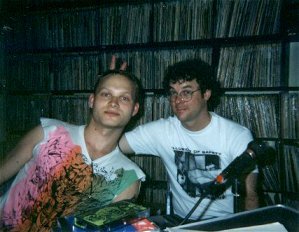
Chuck and I managed to squeeze ourselves into John Gullak's radioshow "No Other Radio" at KPFA, Berkeley on Aug. 12th. Great fun! Charlie also came down to San Jose to be a guest on Don's radioshow on KKUP on Aug. 2nd. Don's friends Greg Gray & Joe Menichetti also came around to the studio. The three of them had a jam session in Joe's house in Felton ouside of Santa Cruz the day before.
From Jan Bruun's USA Travel Diary, Summer 1992.