The
Olympic flame
and the ancient Olympic games
 In ancient times the
Olympic games took on a religious significance. The grounds on which the games
took place were sacred. In Elis, temples were dedicated to the gods. Such as,
the
In ancient times the
Olympic games took on a religious significance. The grounds on which the games
took place were sacred. In Elis, temples were dedicated to the gods. Such as,
the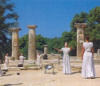 temple of Zeus, which was one of the largest in mainland Greece. It housed one
of the SEVEN WONDERS OF THE WORLD, the gold and ivory statue of Zeus by
Phidias.
Another, was the temple dedicated to Hera. A
statue of Hermes and the young
Dionysus of Praxiteles. In Elis, people gathered to worship their gods and every
four years the Olympic games were held in honour of the gods.
temple of Zeus, which was one of the largest in mainland Greece. It housed one
of the SEVEN WONDERS OF THE WORLD, the gold and ivory statue of Zeus by
Phidias.
Another, was the temple dedicated to Hera. A
statue of Hermes and the young
Dionysus of Praxiteles. In Elis, people gathered to worship their gods and every
four years the Olympic games were held in honour of the gods.
 As
well as a religious importance, the games were held in memory and honour of a
Greek hero. One story in Greek Mythology tells us of how Pelops, one of the
founders of the Olympic games, held the chariot race every four years
as an Olympic event in honour and in memory of Oenimaus. His was a tradition
that was preserved throughout ancient Greek times. The same was done by
Alexander the Great. After every victory, Alexander the Great organized athletic
events in order to acknowledge the gods and to honour the heroes that died
during a combat.
As
well as a religious importance, the games were held in memory and honour of a
Greek hero. One story in Greek Mythology tells us of how Pelops, one of the
founders of the Olympic games, held the chariot race every four years
as an Olympic event in honour and in memory of Oenimaus. His was a tradition
that was preserved throughout ancient Greek times. The same was done by
Alexander the Great. After every victory, Alexander the Great organized athletic
events in order to acknowledge the gods and to honour the heroes that died
during a combat.
The connection that existed between
religion and burial traditions is due to the belief of the ancient Greeks that, the relationship between life and death is dialectic. From
the lifeless ground, birth is given to a bud. The symbol that represents the
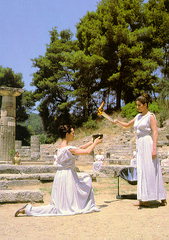
idea that life and death are connected is the sacred Olympic Flame. Every four
years when the ancient Olympic games were held, the Olympic Flame was lit
symbolizing the re-birth of the spirit of the dead heroes and burned endlessly
during the events held.
ancient Greeks that, the relationship between life and death is dialectic. From
the lifeless ground, birth is given to a bud. The symbol that represents the
idea that life and death are connected is the sacred Olympic Flame. Every four
years when the ancient Olympic games were held, the Olympic Flame was lit
symbolizing the re-birth of the spirit of the dead heroes and burned endlessly
during the events held.