DISCUS
The discus event was held in honor of Patroclus and did not have any relation to military exercises or farm work.
The discus event could cause death by accident There were numerous accidental killings according to Greek mythology. For example, Apollo accidentally killed his friend Hyakinthos with the discus, when the Zephyr blew it off its course.
ORIGIN
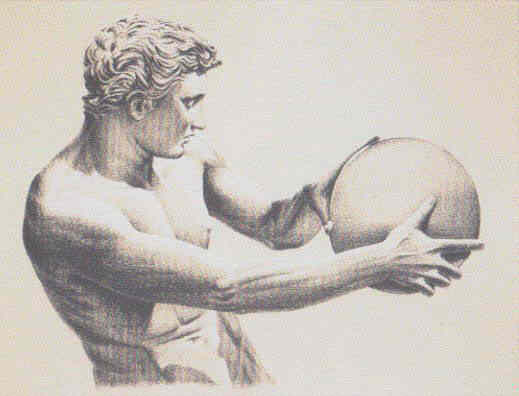 The discus was originally made of stone, and then later made of iron, lead, or
bronze according to archaeological finds and vase paintings
The discus was originally made of stone, and then later made of iron, lead, or
bronze according to archaeological finds and vase paintings
The discus, like it is today, consisted of two convex curves that had a large circumference.
Small wooden pegs marked a thrower's performance, and it was measured with rods.
RULES OF GAMES

In discus the contestants were each given five throws, and his best throws were counted. To throw the discus well, an athlete would hold the discus high with one hand and support it with the other. He would then swing it forcefully down and forward or from the side and forward. This motion utilizes the shoulder muscles, chest and ribs.
Here is a description for throwing the discus: A right handed discus thrower stood with his left leg forward and the weight of his body on his right foot. Using his right hand, he swung the discus up and down a few times. When the discus was above his hand, more support came from his left hand. Each time the discus swung down and behind, he slightly turned his body to the right. He then transferred his weight from his right foot to his left foot and threw the discus forward with a vigorous accelerating swing.
characteristics of a Good Discus Thrower
Throwing of the discus required
rhythm
precision
and power