CLASSICAL
(5th - 4th CENTURY BC)
 F
F
What is certain is that Olympia developed gradually to a major festival site that came to be respected and continued to attract visitors from all places of Greece throughout antiquity.
Olympia reached its highest acme of glory following the Persian wars. Athletes from Sparta and Kroton in Italy dominated the Olympic festivals of this century. Olympia soon became the symbol of the Greek's national awareness unity after their victory against Persian wars.
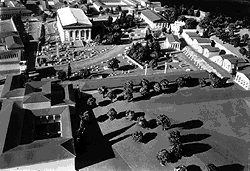
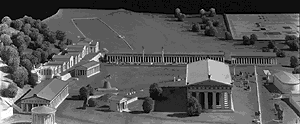
Olympia was the most important construction for all the centuries and it was a symbol of the common religion and communal strength of the Greeks. The famous temple of Zeus and the elaborated statues placed in Altis added more glory to the site. It was built in the middle of the 5th century BC.

New athletic facilities such as the Stadium III and the Hippodrome were constructed. In its third phase of construction, the stadium took its final shape. In order to preserve the area east of the altar of Zeus for cult purposes, the track was shifted 75 m east.
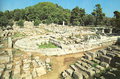
An embankment on its west side closed off the track. This track was 212 m wide. It was made of packed earth, whereas the starting and finishing-lines were marked by stone kerbs 192.28 m apart. No special seats were made, apart from the seats made for the umpires, the guests of honor, and the priestess of Demeter Chamyne, the only woman that was allowed to attend the games.
The Hippodrome was the area of the chariot races. From Pausanias' descriptions the hippodrome was in the south of the Stadium. It was a broad area, 600 m long and 200 m wide. Two posts, placed at its two ends, marked the starting/finishing line and the turning point respectively. The main track was divided in two by a stone or wooded wall (390 m long), the "embolon". The chariots had to go up one side, make a turn and return down the other. This made a total circuit of 1,200 m.
Pausanias has left us with a full description of the complex starting system, the "hippaphesis". It is set on the west short side of the Hippodrome. These were starting positions that formed a triangle; at the apex of the triangle was a bronze dolphin on a raised pole; a brick altar was built along the axis of the triangle's apex. This altar contained the starting mechanism. On top of the altar a bronze eagle lied. Just before the race, the chariots entered the special compartments. Upon the signal of the trumpet, the eagle was raised high on the altar so it would be visible to the spectators, while the dolphin fell to the ground.
The Prytaneion was built at the NE side of the site in
In the late 5th century, important changes in the life and the values of the Eleans took place: Elis ceased to live in prosperity and the Eleans became temporary allies of different city-states.
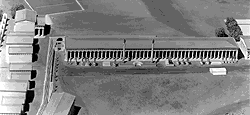
The Peloponnesian War brought the decline of many of the moral values expressed by the games. These changes in the spirit of the political life are particularly evident in the spatial organization of the site: from now on the main sanctuary is separated from the area of the games and the stadium. The erection of the Echo colonnade, the largest in the sanctuary, on the eastern boundary of the Altis, marked off the separation of the religious center from the stadium, which was moved further to the east. It was named "Echo" after its acoustics, and "poikile" (painted) after the paintings which decorated its interior.
T
hose athletes who were caught cheating paid fines, that were used for the erection of the Zanes: these were the statues of Zeus which were put up to remind them of the penalties issued for those who did not obey the rules of the games.In the late Classical times, a few more religious buildings were erected at
Olympia: the Metroon, and a number of Stoas. Built in