Removable Prosthodontics Fall
Final Exam Review
This review is brought to you by Wildlife®
The final exam will consist of 70 multiple choice questions over the following topics:
House Personality Traits
|
Philosophical |
Thoughtful Understands nature of problem |
BEST Prognosis |
|
Exacting |
Methodical, precise, hyperaccurate Needs all details (explain everything) Much care, effort & patience from DDS |
Prognosis depends on expertise of DDS Any flaws, even minor, will annoy patient |
|
Indifferent |
Patient doesn’t care Not interested or motivated Apathetic Not cooperative Blames others for problems (i.e., previous dentist) |
Prognosis is generally unfavorable |
|
Hysterical |
Emotionally unstable Apprehensive, excitable Usually needs psychiatric intervention |
Poor prognosis |
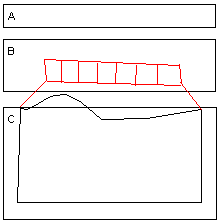 Denture Processing
A) Lid
B) Intermediary
(intermediate
ring)
C) Base
All three components comprise the flask
Filling the flask (Investing):
1)
embed the
master cast in the base with plaster or stone just to the edge of the base
purpose is to hold the cast in
place and avoid undercuts when opening the flask
will just cover the base of the
master cast
2) invest teeth/wax-up
with next layer of plaster or stone (just to incisal edges)
records contours of wax-up and
position of teeth
a separator (Vaseline or Cosep) is used between stone layers à NOT applied to teeth
or wax
à if the separator is
applied to teeth, it could alter the shape/contour of the denture
(some professional labs will add
a 2nd mix at incisal margins before the 3rd mix)
3) 3rd mix, or CAP
is placed as the next layer
engages only the incisal edges
and occlusal surfaces
purpose is to record and
preserve the occlusal position
easy to remove this layer à
makes denture visible
What forms the
internal surface of the final denture? à the Master Cast
Note: the wax pattern is boiled away, and the record base is removed and discarded
This is different from investing an inlay pattern (wax pattern is invested and reproduced)
For dentures, internal surface is formed by pressure with acrylic forced against master cast
Thus, it is very important not to damage the master cast!
After Investing
4) Wax Elimination
Flask is placed in boiling water, which softens the wax
The softened wax is flushed out with boiling water, detergent, or steam
Creates a “clean space” for placement of acrylic
5) Open Flask
Master cast is still in the base
Teeth are in the intermediate ring, and the underside of them is visible
a DIATORIC
(retention hole) is placed in each tooth
allows better bonding of acrylic
to teeth
6) Place Separator
This separator is placed acrylic-to-gypsum,
NOT on teeth (want acrylic to bind to teeth!)
Tin Foil Substitute à water-based agar substance (Vaseline not used b/c
not water-soluble)
7) Add Acrylic
Mix Powder and Liquid (the ratio is 3:1 à necessary to avoid
shrinkage of acrylic)
Liquid à
MMA (methylmethacrylate), this is the monomer
Powder à
PMMA (polymethylmethacrylate), this is already
processed monomer
“pre-shrunk”, allows resin
acrylic to be a “workable dough”
Dough is placed into clean space (also called mold space)
8) Close Flask
Once the acrylic is placed, the flask is reassembled
Assure complete closure by metal-to-metal
contact
9) Curing
This acrylic is known as a Heat Cured Denture Base
Resin
An accelerator is in the resin, and is
activated by heat
Conventional Cure à
160°F for 9 hours
Fast Cure à 160°F for 1½ hours,
followed by boiling (212°F) for 30 min.
Which cure has the lowest amount of
residual monomer? The fast cure has the lowest.
à important
for patients with monomer allergy
with these patients, the boiling
time can be increased to hours
Why not just boil completely? In thicker areas of acrylic, boiling creates
porosities
because the rxn
is exothermic.
When completely cured, the denture is 90% PMMA
10) Finishing
The completed denture is polished, with rough edges removed
Must be careful to avoid warping of denture
Warping can be caused by…
heat of polishing (friction)
thermal shock from rapid cooling
drying out of denture over time
(denture should always be stored in water)
Some excess monomer can be polymerized by the frictional heat of polishing
11) Remount
Lab Remount à immediately after
processing
corrects errors of processing (usually
w/ incisal table off, occlusion will expand)
re-align denture with
articulator
Clinical Remount à
done at delivery with remount cast
allows for denture to fit
patient
pumice is used to block
undercuts of ridge
recheck centric record with
patient
remount denture with new record
on articulator
Central Bearing Device
used at centric record
appointment
creates a centered force on
denture
occlusal load is centered when
patient bites
allows for optimizing occlusion
Plaster Index
upper and lower casts are
typically destroyed during processing
a plaster index is taken BEFORE
processing
preserves the face-bow mounting
of upper cast
allows repositioning of upper
cast during remount
Summary
Upper cast à
positioned via Plaster Index
Lower cast à
positioned via Centric Record
Occlusal Adjustment is done (once
mounted) for delivery to patient
12) Repairs
A Cold Cure resin is used for repairs (as opposed to heat cure for
processing)
Doesn’t need long water bath protocol
Includes a chemical accelerator
Density improved with pressure and warm/hot water
13) Delivery of Denture
Important to monitor pressure of denture on tissues
Paint PIP (Pressure Indicating
Paste) on denture then seat
PIP is pushed away at high pressure spots
PIP will also disclose undercuts
How much undercut do we remove? The
patient is the guideline à relieve until no pain
Disclosing Wax is used at the
periphery of the denture (build up wax over flange)
Indicates an overextension of denture border (PIP won’t work b/c too thin)
14) Occlusal Adjustment
Excursive movements are guided by multiple posterior stops
For Working Side Lateral Excursive Interferences (aka laterotrusive) à
use BULL rule
For Non-Working
Side Lateral Excursive Interferences (aka mediotrusive) à use LUBL rule
Final Protrusive movement should end in edge-to-edge contact of incisors
Necessary because humans use
incisors to grasp things
For Protrusive
Interferences à
use DUML rule
Immediate Dentures
à delivered at time of extraction (“pre-made”)
|
Advantages |
· Wound protection device (controls bleeding, protects sockets) · Preserves tooth form/shape · Preserves vertical dimension · Gives instant restoration of function and appearance ·
Patient can adapt to changes right away (this
can encourage pts to complete the extractions) |
|
Disadvantages |
· No anterior try-in appointment (pt doesn’t know what he/she will look like with the new denture) · No preservation of bone · Increased patient adaptation (more office visits for re-lines) ·
Increased expense |
What happens to bone upon extraction of teeth?
The bone resorbs
Will the bone resorb with a different pattern with the use of a denture?
No, the denture does not preserve bone
Will people with dentures have less bone loss than those without dentures?
No, the denture does not preserve bone
Bone Resorption
Immediate denture does not preserve the ridge that was present before extractions
Bone loss is variable to the individual and to site of extraction
It makes no difference, with regard to bone loss, if the patient wears a denture or not
à EXCEPT for heavy bruxers, who have increased bone loss with dentures
Bone loss can also be increased in patients with active periodontal disease
Bone loss can also be increased in diabetic patients, or those who are severely immunocompromised
HIV+ patients, or those with arthritis or hypertension will have NO difference in bone loss
Increased bone loss can cause
problems for immediate dentures (proper fit, etc.)
Strategies for the
Edentulous Patient
Ideal à Maxillary complete denture opposing mandibular partial
Worst à Maxillary partial and mandibular complete
If a patient
needs a mandibular complete denture, discuss implants instead
Immediate Denture Adjustments
As bone loss occurs in the first couple of months à reline as needed
From
- Permanent Reline à re-coat inside with acrylic
- Rebase
the Denture à
completely remove old base and redo
provides a new, uniform base
Within 1 to 2 years à plan on making the patient a new definitive denture
The old one can then become an emergency use denture
Why is it important to retain some mobile teeth while preparing an immediate denture?
Retaining vertical dimension
Retaining esthetic reference
Border Molding for Final Impression
Mold to optimal extension, with a thin labial flange (1-2 mm max., don’t make a hockey puck)
à thin flange won’t over bulk the lips
If a mistake is going to be made, it is better to under-extend the mold
Can be corrected with a re-line
An over-extended mold is a huge problem
Causes pain,
and must be adjusted à will never be optimal
Centric Record
Patient bites into wax
Determine VDO w/ natural teeth (before extractions)
Under what condition is a patient allowed to bite until the teeth touch?
If the
patient has their natural anterior teeth WITHOUT a Centric Slide
Teeth should not be mobile
Desirable Traits:
- firm, low mobility teeth
- no centric (CR/CO) deflection or slide
- patient close on wax until teeth touch IF AND ONLY IF vertical dimension on natural teeth is physiologically appropriate for the patient
**If these three traits are met, then the centric record can be taken with the natural teeth
Immediate denture should match VDO of centric record (there is no compensation made during processing, nor are there any changes made to VDO)
Maxillofacial Prosthodontics
- Area of prosthodontics related to restoring and replacing stomatognathic and craniofacial structures
- Most closely related to removable prosthodontics
- Treatment for squamous cell carcinoma in 85% of head and neck cases; remainder is other types of tumor damage
- Maxillectomy – removal
of part of the maxilla
Caused by sinus tumors
Creates a hole in the hard or soft palate
Requires an obturator (a prosthesis that fills the empty space; not used on mandible) - Velopharyngeal Insufficiency
Caused by tumor, cleft palate, stroke
Identified by speech patterns (hyper- or hyponasal), and by swallowing
No change in breathing of mastication - Mid-Facial Prosthesis
Useful with mid-facial resection
Involves à Nose, Upper Lip, Hard Palate (which may involve the use of an obturator)
PMMA à useful for prosthetic nose, obturator, and cranial implants
used for biocompatibility (it is a clear acrylic, like plexi-glass)
Silicone Materials à useful for facial prostheses (need for flexibility)
smaller prostheses can be held in place with spray-on skin adhesive
larger prostheses can be held in place with implants - Multi-discipline Approach
Medical, social rehabilitation, internal medicine, surgeons
Communication is very important!
à Written, Verbal, Study Casts, Surgical Stent
Everything should be well communicated prior to any surgical procedures
“If you know all of this stuff, you are going to do great on
this test.” - Dr. LaBarre