November 13, 2006
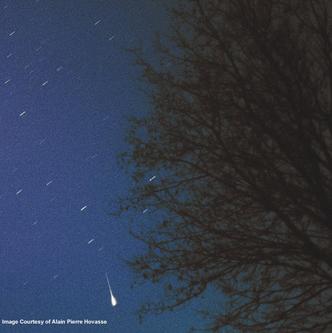
The nights and early morning hours of November 17-19 mark the return of the Leonid meteor shower to the skies of Earth. Will it be worth your while to get outside and take a look? Well, that depends on which expert you listen to and where you live.
For the most part, this year's Leonid's display should be a pretty typical meteor shower. Just days away from New Moon, the sky will be free of moonlight so viewers should be able to see as many as 20 faint, fast-moving meteors per hour during its peak (the evening of November 17, early morning of November 18).
However, unlike a typical meteor shower, astronomers are predicting an unusual "outburst" of meteor activity late November 18 - early November 19 (the date it occurs depends on where you live).
Viewers along the northeastern coast of the United States and Canada, as well as people in Europe and western Africa might get to see a possible "outburst" of as many as 100-600 meteors per hour. This spike in activity is predicted for 11:45 p.m. - 1:33 a.m. EST on November 18-19 (4:45 - 6:33 UT on November 19).
This outburst is tied to Earth's passage through a particularly dense debris trail left by the comet 55P Tempel-Tuttle during its 1932 pass around the Sun. In 1969, Earth passed through this same region with rather spectacular -- though brief -- results (with viewers seeing 2-4 meteors per minute over a 30-minute period). This year's passage probably won't produce quite the same intensity as it did in 1969. Even still, astronomers are predicting anywhere from 100 to 600 meteors per hour. (The predictions vary depending on when Earth actually passes through the trail: earlier, fewer meteors -- later, more meteors.)
Even at 100 meteors per hour, the Leonids won't be as spectacular as other showers. Traditionally, the meteors that make up this shower are much smaller and therefore fainter when they hit Earth's atmosphere and burn up. In addition, these are usually fast-moving meteors, so you have to look quick for those faint streaks.
As a result, it is especially important to observe the Leonid shower from dark skies. For a change, you don't have to worry about the Moon during this shower. Its thin, waning crescent shape doesn't rise until just before sunrise on the 18th and 19th, so it won't interfere and drowned out any meteors. However, those pesky city lights will. So, if you are going to observe the shower, make an effort to drive to a location that has few if any lights nearby. (That may require quite a bit of driving these days, but it should be worth it.) Be sure and pack a lawn chair, a blanket, and a thermos filled with a hot beverage.
For more meteor shower observing tips, visit Meteor Showers: Where, When, and How to Look for Them.
Meteor showers offer a great excuse to sit outside and enjoy nature -- just be sure to pack warm clothes, these November nights get chilly.
November is famous for the Leonid Meteors. Every 33 years or so, this shower can be a real downpour! That happened several years ago, so this year it may not be much more than a trickle, but well worth the effort of looking.
Tomorrow morning, go out a couple of hours before sunrise and face east-southeast. Well up in the heavens you should be able to locate the “Sickle” of Leo, with Saturn just to the right. The Leonids appear to radiate from the semi-circle of the Sickle, which is Leo’s head and mane. There is no actual relation between the meteors and the constellation. It’s just that the earth’s orbit crosses the path of the meteors in that region of the sky.
Lower down you can find a very thin crescent moon, with Spica in Virgo just above it. About an hour before sunrise, Mercury rises above the horizon to join this grouping. But you will need a low and unobstructed horizon, and clear skies, as Mercury is only about 10 degrees high by the beginning of twilight.
Meteor showers can be disappointing if your skies are cloudy or if you live in the wrong location. This weekend's Leonid meteor shower, for example, will be best viewed from parts of Europe and eastern North America.
Skywatchers elsewhere, including western North America, should see a typical rendition of the annual show—a few meteors per hour—but will miss the peak flurry, expected to start around 11:45 p.m. ET and last a couple hours.
The less fortunate can listen in, however.
Some meteor enthusiasts are already capturing snippets of faraway radio broadcasts that bounce off the electrified trails of Leonid meteors. A variation on the technique can be used to record pings of varying intensity and length amid background static. You can try to capture the sounds yourself, or you can hear a live broadcast of them on the Internet.
"Meteors burn up in the atmosphere and leave an ionized trail which acts like a mirror to reflect transmitted signals from stations hundreds of miles away," explained Michael Boschat, a member of the Royal Astronomical Society of Canada. "Any meteor will be heard this way, but more are usually heard during meteor showers."
When and how
Many more meteors can be heard than seen, including faint meteors that would not shine bright enough to be noticed visually. So while a typical hour of pre-dawn skywatching this weekend might reveal just a handful of Leonids, Boschat is already hearing several dozen each hour.
Residents in western North America will miss this year's Leonid peak because the constellation Leo, from which Leonids appear to emanate, won't have risen yet. But listeners are not inhibited by the horizon.
"They can be heard before Leo rises and one will note an increase in the number per hour as the night goes on," Boschat said in an email interview. "At maximum they can continuously overlap each other, as happened to me in the 1998 and 2002 peaks."
Audibly, the Leonids continue for a while past dawn, too.
"Watching is better," Boschat admitted. "But if overcast ... this is the best way not to miss the shower. One can always visualize them zipping by in their mind."
You can listen to the Leonids at the Roswell Astronomy Club website or hear past events of varying types archived by the American Meteor Society.
Do it yourself
Boschat explained two ways you can create your own listening setup.
The least expensive way is to use a digital FM radio set to a distant known station frequency that you cannot hear. A meteor will reflect that signal so you will hear a brief bit of music or speech. For this to work, you can't have too many FM stations in your area because overlap from them will mute the meteor signal.
The second way is using an amateur radio set at a TV station known frequency. "For me I have to use Ch. 6 at 83.25 MHz. The other stations would be Ch. 2 at 55.25 MHz and Ch. 4 at 67.25 Mhz."
The latter method requires an amateur radio with a dipole antenna, however, a setup "that could be a bit beyond the scope of some observers," Boschat said.
Put a big circle on your calendar around Saturday, November 18. If that night is clear, bundle up warmly and head outside in the early morning hours because you may be able to catch a really impressive display of meteors in your night sky.
The Leonids, as they are called, are considered the most spectacular of modern showers. They are composed of the dusty debris from comet Temple-Tuttle which orbits the Sun at 33 year intervals. In recent years the comet has had a propensity for producing spectacular meteor displays; meteors falling by the hundreds, if not thousands per hour.
During the 1966 shower it was estimated that there were around 500,000 meteors per hour seen by observers all over the planet! That’s 140 per second, the fastest piece traveling at 70 kilometres a second. These "shooting stars" all apparently emanate from the constellation of Leo, the Lion. Hence the name "Leonids."
The comet last passed the Sun and Earth in 1998, and from that year through 2002, the Leonids produced showers in which meteors fell at rates of more than a thousand per hour − displays that astronomers call meteor storms.
This weekend, we'll find out whether the predictions of several reputable meteor scientists come true. They say we’re in for quite a show. On November 19, as the Earth passes through the trail of debris left by the Leonids' parent comet on one of its previous returns, expectations are that as many as 100 to 150 Leonids per hour may streak across our nigh skies as we interact with that decades-old ribbon of debris again.
Meteor showers are notoriously difficult to predict at the best of times, there may be far more or far less than this number visible, we simply can’t tell.
Most of the meteors seen during this outburst are expected to be faint, so dark skies will be very helpful. Even if you miss the November 18 outburst, the shower is reasonably active for about a week from November 14-21. After this year no further outbursts are expected until the end of the 21st century so this really is the last chance to see the Leonids at their best.
Meteor watching is easy. Simply find the darkest location you can with a clear view of the north-eastern horizon then go out and look up. You don’t need binoculars or a telescope. The best time to view the shower is between 2-5am.
Meteor Watching Tips
> The part of Earth where dawn is breaking is always at the leading edge of our planet's plunge along its orbital path around the Sun. This part of the planet tends to "catch" oncoming meteors left by a comet, whereas the other side of Earth, where it is dusk or late evening, outruns the debris. For that reason, the hours between midnight and dawn are typically the best time to watch a meteor shower.
> Allow time for your eyes to adjust to darkness. A good hour is smart, so that you can also practice some prior to prime observing time.
> Dress warmer than you think you need to, especially in winter.
> Bring a lounge chair or blanket, so you can relax and look up with ease.
> During meteor showers, shooting stars appear to emanate from a point in the sky called the radiant. There are different ideas about how to use this fact to aid in spotting meteors. Robert Lunsford has these thoughts:
One idea is that it is preferable to look away from the radiant so that the shower meteors you see will be longer and therefore easy to detect motion. As Mark Davis stated one should look 20-40 degrees distant. At this distance the radiant is still in your field of view so that shower association is still fairly easy.
Those who look directly at the radiant can see shower activity travel in any direction. Shower association will be fairly obvious. Meteors that appear near the radiant will be foreshortened and therefore the motion will be more difficult to detect.
I would suggest that new observers face slightly away from the radiant. Those who enjoy good perception over a large field of view may be able to directly face the radiant with no problems. Those who prefer to face the radiant must not do so unless the radiant is at least 50 degrees high in the sky. If you don't then you are wasting the bottom portion of your field of view on the ground!