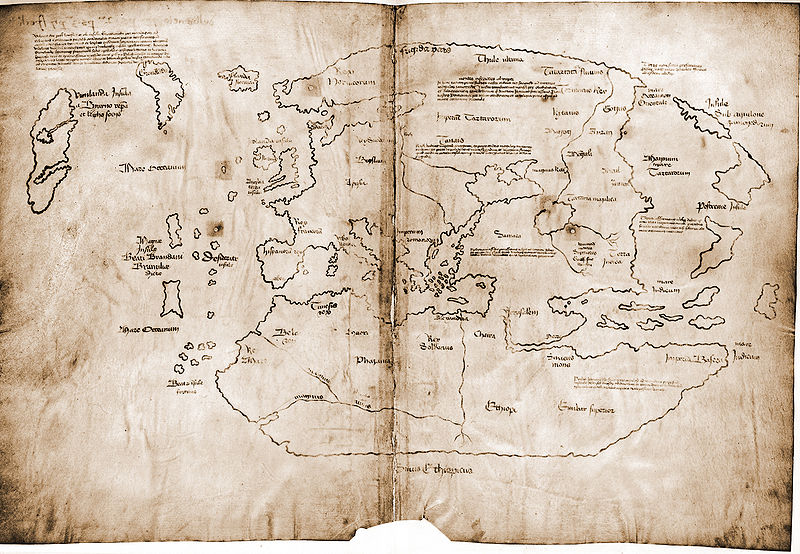
The map,or chart, depicts the entire Eastern seaboard from Labrador to North Carolina and inland details including Lake Ontario. The map, according to this publication, was purchased in 1957 from a private Spanish collector, and donated to Yale University later. The map was ink drawn on parchment in 1440 from data received from Norse seafarers centuries before. A later description reads thus: "The Vinland map is purportedly a 15th century map redrawn from a 13th century original...showing Africa, Asia, and Europe. The map depicts a large island west of Greenland in the Atlantic labelled Vinland. If authentic, it documents pre-Columbian Norse travels to the Americas, but the map has been controversial since it was first reveaed in 1965.
More recently, the authenticity of the map has again been questioned, and one of the main points being "the absence of a clear provenance for the map". That is, a question remains about the source.
The greatest threat to the authenticity of the Vinland Map is the question of the ink . "The ink supposedly contained a type of titanium that was not used in pigment until the 1920's" But the amount of titanium in the ink, as tested by a team at Crocker Nuclear Laboratory, "was only 2% and could occur in nature". Further, the same "team " went on testing other parchments and ink from the 13th to 15th centuries, and found no difference in the comparison.
Regardless of whether or not the map is genuine, it has been independently proven to general satisfaction that Greenland was settled by Vikings around 970 and lasted until the 15th century. The finds in L'anse aux Meadows in Newfoundland, Canada show that there was a Viking settlement which predates by five centuries John Cabot's landing in North America in 1497 and Christopher Columbus's voyage to South America in 1498. AL-
More info.: http://en.wikipedia.org/wiki/Vinland_Map