 |
|
|
|
|
|
|
|
|
|
|
|
|
|
|
|
|
|
|
|
|
|
|
|
|
|
|
|
|
|
|
|
|
|
|
|
|
|
|
|
|
|
|
|
|
|
|
|
|
|
|
|
|
|
|
|
|
|
|
|
|
|
|
|
 |
|
|
|
 |
|
 |
|
|
|
|
|
|
|
|
|
|
|
|
 |
|
|
|
 |
|
 |
|
|
|
|
|
|
|
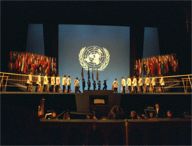
United Nations General Assembly |
|
The Division of Terrafirma |
|
UN InterFaith Consortium |
|
|
|
Globalization |
|
|
|
Uno Currency |
|
|
|
 |
|
|
Global-Centered Governance |
|
Fiat Military Powers |
|
One World Religious System |
|
|
|
|
|
 |
|
|
|
|
|
|
|
|
|
|
|
|
|
|
|
|
|
|
|
|
|
|
|
|
|
|
|
|
|
|
|
|
|
|
|
|
|
|
|
Globalization on U.N. agenda |
|
|
|
By Barbara Crossette |
|
 |
|
|
|
|
 |
|
|
|
|
|
The New York Times |
|
|
|
|
|
|
|
|
|
|
|
|
|
|
The stormy battle over globalization that brought protests to the streets of Seattle and Washington moves this week to the heart of the world's only truly global organization, the United Nations. |
|
|
|
An extraordinary, three-day Millennium Summit of more than 150 world leaders called to thrash out problems of poverty and peace is turning into a debate about the future of the organization, as well as the world, at a time when national borders have become nearly as irrelevant to economic and political tides as they are to infectious diseases or popular music. |
|
|
|
The summit will begin Wednesday and end Friday. A dozen or more other events are planned for the fringes this week, including a "dialogue of civilizations" featuring Iranian President Mohammad Khatami, a "state of the world forum" of government and private sector leaders, numerous street protests and a 10-hour teach-in against a greater role for global business in world affairs. |
|
|
|
The United Nations is a more diverse organization than the groups that have been the focus of recent protests -- the World Bank, the International Monetary Fund and the World Trade Organization. So it is still seen as a hope for solving problems of globalization, rather than as a source of them, and it isn't expected to face the same heated protests that caused so much havoc in Washington and Seattle. Still, the debate over globalization will be intense. |
|
|
|
For some countries, most of them in the industrial world, globalization is an opportunity to expand international standards in law, social development and human rights. For others, many of them developing countries, it holds out the worrying prospect of a United Nations aligning itself ever more closely with new power centers: the big corporations, high technology gurus and cultural icons of the industrialized world. |
|
|
|
At the U.N. summit, the fears and frustrations of the world's weakest nations will be given equal time with the powerful. |
|
|
|
President Clinton, who will give the opening address, will be followed to the podium by the president of Equatorial Guinea. Russia's president will be followed by the leader of the Maldives, who likes to remind others that the big worry for his tiny nation of atolls is that globalization could mean disappearing completely -- if global warming, and an accompanying rise in sea levels, isn't halted. |
|
|
|
"Globalization is seen by some as a force for social change, that it will help to close the gap between the rich and the poor, the industrialized north and the developing south," said Theo-Ben Gurirab, foreign minister of Namibia and the U.N. General Assembly president. "But it also is being seen as a destructive force because it is being driven by the very people, the colonial powers, who launched a global campaign of imperial control of peoples and resources in what we call now the Third World. Can we trust them?" |
|
|
|
U.N. Secretary-General Kofi Annan, a Ghanaian with a U.S. education, straddles two worlds. |
|
|
|
"Globalization is really defining our era," he said, explaining why he forged alliances with multinational corporations to improve labor and environmental standards as well as to bridge cyberspace gaps between the industrial and developing worlds. |
|
|
|
He also warns political leaders that they have to govern well and learn to take advantage of international opportunities or their fragile economies are doomed. He argues that when citizens of any country are abused, the rulers can no longer tell others to stay out of their affairs. |
|
|
|
"The world around us is changing, and we change with it or we will be left behind," Annan said. "We have to adapt to the realities outside." |
|
|
|
"It has been said that arguing against globalization is like arguing against the laws of gravity," Annan said last week. "But that does not mean we should accept a law that allows only heavyweights to survive. On the contrary: We must make globalization an engine that lifts people out of hardship and misery, not a force that holds them down." |
|
|
|
|
|
|
|
Post Script:(NYT Addition)
Clinton's U.N. speech Wednesday will endorse a report, issued by a special advisory group to Secretary-General Kofl Annan, sugg-
esting a permanent peacekeeping operation. That would sidestep the awkard process of re-creating a peacekeeping structure each
time U.N. forces are needed. "In principle, we are supportive of what is in the report for a peacekeeping operation," Berger
(Clinton's national security adviser) said. "It parallels what we have been recommending for several years." [NYT - D. Sanger] |
|
|
|
|
|
|
|
Globalization |
|
|
|
Uno Currency |
|
|
|
|
|
|
Global-Centered Governance |
|
Fiat Military Powers |
|
One World Religious System |
|
|
|
|
|
|
|
|
|
|
|
|
|
|
|
|
|
|
|
|
|
|
|
|
|
|
|
|
|
|
|
|
|
|
|
|
|
|
|
|
|
www.aamen.org www.oxbows.com
Amen Ministries of Austin��///� Oxbows Ministries International�
P.O. Box 27683 - Austin, Texas� 78755 |
|
|
 |
|
|
|
New addendum -- world/gobal statistics on downsized world population and characteristics !! |
|
|
 |
|
|
|
|