



[USA/FDA FORFEITS Moral High-ground]

Abortion Pill Gets Approval From FDA
By Marc Kaufman
Washington Post Staff Writer
Friday, September 29, 2000
The controversial abortion drug RU-486 won long-sought approval from the federal government yesterday for sale in the United States, launching what opponents and advocates agree will be a new era in the nation's rancorous abortion debate.
The Food and Drug Administration's decision for the first time gives American women an alternative to surgical abortion: a pill that will be widely available and will allow them to abort a pregnancy in the privacy of their homes.
The drug is expected to be available within a month and to cost about the same as a standard abortion. It will be administered first at clinics that have received special training but eventually by any doctor who can ensure that a standard abortion will be available in the rare instances that the pill fails.
As a result, the pill is expected to fundamentally transform the abortion experience for millions of American women. Instead of facing the prospect of a potentially hostile environment outside a clinic, they will be able to abort their pregnancies much more discreetly, much earlier and with what many women describe as a greater sense of control.
The announcement was hailed by abortion rights supporters as a breakthrough for American women and condemned by abortion opponents as a travesty for endangering human life.
Gloria Feldt, president of Planned Parenthood of America, called the approval "an historic moment, comparable to the arrival of the birth control bill 40 years ago."� Kate Michelman of the National Abortion and Reproductive Rights Action League called it a "milestone on the long road to women's reproductive freedom and equality in this country."
But Laura Echevarria, spokeswoman for the National Right to Life Committee, said approval marks an unfortunate turning point for the country. "In the past, the FDA has approved drugs to save lives and prolong lives," she said. "Now they are approving a drug designed to take human life."
The decision quickly became part of the presidential campaign. Vice President Gore said the decision "is not about politics, but the health and safety of American women and a woman's fundamental right to choose."� Texas Gov. George W. Bush called it "wrong" and said he fears it will make abortions "more and more common rather than more and more rare."
Republican leaders have made clear they want to overturn the decision, and House Republican Conference Chairman J.C. Watts (Okla.) said that� "a new administration, I am certain, with moral leadership and a commitment to the family will reverse this Clinton-Gore decision."
President Clinton criticized as political the Republican attack on yesterday's decision. "This administration treated that issue as purely one of science and medicine," he said. "And the decision to be made under our law is whether the drug should be approved by the FDA on grounds of safety.
The intense feelings about the pill ? and the fear of potential violence by opponents� were manifested in two aspects of yesterday's decision. FDA Commissioner Jane E. Henney said the agency for the first time did not publish the names of the experts who reviewed RU-486 for the agency. In addition, it broke precedent by not publishing the name or location of the company that will manufacture the drug.
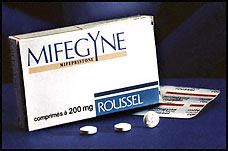
RU-486, which will be sold as Mifeprex, will allow American women to use an abortion technique first approved in France in 1988 and available now across Europe and in countries from Israel to China. The FDA said that 620,000 European women have used it.
Based on the drug's impact in other countries, the pill is not expected to increase the number of abortions in the United States, which has been dropping significantly for the past decade, to about 1.3 million annually. Surgical abortions are expected to remain more common because RU-486 can be used only during the first 49 days after a woman's most recent menstrual period.
Advocates predict, however, that the drug will increase the number of women who undergo early abortions, because it can be used earlier than surgical abortions generally are performed.
The FDA dropped restrictions on how RU-486 might be used that it proposed last summer. There will be, for instance, no registry of doctors prescribing the drug or women who use it, and prescribing doctors will not be required to be licensed to perform surgical abortions. Advocates of the drug had feared such restrictions would severely limit the drug's availability.
The drug will not be available through pharmacies, however, and will be distributed to patients with a detailed pamphlet outlining all possible complications. In addition, the sponsor of the drug, the Population Council, will be required to conduct post-marketing studies of the drug's effects and of whether doctors are using it properly. If problems are found, Henney said, individual doctors could lose their right to prescribe the drug and its overall approval could be reassessed. That unusual requirement could make the drug more easily withdrawn under a new administration, observers said.
Dropping the proposed restrictions sparked an outcry from Rep. Tom Coburn (R-Okla.), who has twice led successful efforts in the House to deny FDA funds for the testing of RU-486. (The efforts died in the Senate.) Coburn said he would offer a bill limiting distribution of the drug to include most of those proposed restrictions.
Under the FDA protocol, women will visit their doctors three times for an RU-486-induced abortion and will take two sets of drugs. The first drug is RU-486, which softens the uterus and loosens its connection with the embryo. The second is misoprostol, which triggers the contractions that expel the embryo.
Researchers have been experimenting with different dosages and reduced doctor visits since the initial application was made to the FDA in 1996. But Henney said that the agency would not allow divergences from the approved protocol and that doctors who use different protocols could lose their ability to order the drug.
Officials said there has been no final decision on how much the medical abortion will cost. But abortion rights advocates have said the cost is expected to be similar to that of a surgical abortion� about $300.
The French pharmaceutical company that first developed the drug decided against seeking FDA approval because of antiabortion opposition, and rights to the drug were transferred to the Population Council, a New York-based reproductive rights group.
The Population Council ultimately gave the rights to manufacture and distribute the drug to a start-up company named Danco Laboratories LLC, which has been financed directly or indirectly by foundations set up by, among others, George Soros, Warren Buffett and David Packard.
The FDA first ruled that the drug was safe, effective and "approvable" in 1996. But in addition to abortion politics, including boycott threats against potential drugmakers, the drug's approval was slowed by business blunders by the American sponsor.
One issue that delayed the drug's approval was the sponsor's difficulty finding a company that would manufacture it and assuring the FDA that the product would be pure. Danco finally found a manufacturer but has been unwilling to publicly disclose any information about it because of concerns it will be targeted by antiabortion activists. The manufacturer is believed to be overseas, and speculation has focused on China or India.
Staff writers Ellen Nakashima, Ben White and Juliet Eilperin and special correspondent Christine Haughney contributed to this report.
[Old Serpent loose again in the garden of man]
Decision Forces Foes To Revamp Strategy

By Hanna Rosin
Washington Post Staff Writer
Friday, September 29, 2000
Yesterday, the federal government handed American women a new option for obtaining an abortion, and in so doing transformed the political fight that has raged since the procedure was legalized in 1973.
Ever since Roe v. Wade, antiabortion activists have been able to target many of their protests at a finite number of abortion providers, concentrating on the clinics where about 1.3 million American women go each year to have their abortions.
But by dispersing abortion into homes and ordinary doctors' offices, the RU-486 pill changes the physical landscape, making those locations elusive, the targets anonymous.
Activists on both sides agreed yesterday that the pill will radically alter the tactics and counter-tactics that have become mainstays of abortion politics. But the greatest burden, they said, may be on antiabortion activists trying to keep the stigma alive.
Within hours of the FDA's decision yesterday, the antiabortion movement began searching for new, more sophisticated ways to convince American women that taking the pill is not a routine procedure but an option as morally and politically loaded as having a surgical abortion.
"Right now the average ob/gyn will say 'That's not my specialty' and refer you to the abortion clinic,"� said Troy Newman of Operation Rescue West, a spinoff of the radical antiabortion group known for organizing some of the most aggressive clinic protests. "But now any ob/gyn has to face the question, and that makes things more difficult for us."
Newman and other antiabortion protesters spent the day devising possible new databases, new pamphlets, new arguments. For Newman, it was just a question of redoubling their efforts. "We can just call every hospital, every ob/gyn and ask them: 'If I am your patient will you give me RU-486?' " said Newman. "Then we will treat them the exact same way we treat an abortion provider."
Others spoke of expanding their list of targets in new and creative ways, investigating to identify the unnamed pharmaceutical company that manufactures the pill, the investors who funded it, and perhaps even the FDA that approved it.
Some antiabortion groups were thinking up ways to equivocate abortion and RU-486, to counter the argument that the new option is morally neutral.
At the American Life League, which considers itself an education provider, the Rev. Joseph Howard said they were thinking of starting something called "Initiative 21" to remind women that a heart starts beating at 21 days after conception, well within the time most women would take RU-486.
"You try to emphasize a different set of biological facts," said Howard. "Because what's the difference? RU-486 is a chemical procedure, abortion is a surgical procedure. That's the only distinction. You're still destroying an unborn life."
Many antiabortion groups said they realize their hardest struggle will be to keep that scarlet letter affixed to a procedure many doctors and women are apt to find more palatable.
In surveys, women who have taken the pill in both the United States and Europe report feeling more comfortable with the procedure and less traumatized, exactly the feelings the antiabortion groups want to prevent.
"t's very private, so it removes some of the visibility, the harassment,"� said Susan Tew of the Allan Guttmacher Institute, which studies family planning. "And because it happens so early it might make the procedure more socially acceptable for many people, more mainstream."
Doctors are also more comfortable with the procedure. In a 1998 study by the Kaiser Family Foundation, 45 percent of doctors said they were "very" or "somewhat" likely to prescribe mifepristone, as RU-486 is also known, once it was available. Only 3 percent of them had performed surgical abortions.
RU-486 also has the potential to build a broader consensus for abortion. In general, Americans are more likely to accept abortion if it's performed early; 61 percent said they support abortions in the first trimester, well within the seven week window RU-486 is prescribed. Support drops dramatically in later weeks.
To restore the shame, antiabortion groups plan to seize on some of these perceived advantages of RU-486 and turn them into personal crosses to bear. Because the average doctor can do the procedure himself and not just shift it to a colleague, the average doctor now is faced with a stark moral choice, said the Rev. Pat Mahoney of the antiabortion group Christian Defense Coalition.
And because a woman has to take the pill herself and not let the doctor do the procedure for her she too has to search her conscience.
"There are no more gray areas. This will separate the chaff from the wheat, the sheep from the goats," said Mahoney. "It will force every ob/gyn to ask himself: am I here to support life or kill it, instead of referring that moral dilemma to someone else."
"And now women are personally culpable," he added. "The baby doesn't get sucked out into a tube where they can't see it. They have to do it themselves. It personalizes the murder."
Some also considered another option: replacing an emphasis on stigma with one on women's health, expressed in more soothing therapeutic tones. In its press releases, the National Right to Life yesterday underscored the "intense trauma" to women, the uterine bleeding and the contractions, the emotional stress and loneliness, and offered "healing help."
[Eve has bitten the apple again]
Abortion Activists Face New Era
By Susan Levine and Leef Smith
Washington Post Staff Writers
Friday, September 29, 2000
Maxine Klane started her morning yesterday with a meeting at the Planned Parenthood clinic in Falls Church, and so was there when the fax machine started humming shortly before noon and the announcement long awaited, deeply contested� arrived at last.
"FDA Approves Mifepristone" declared the single page from headquarters in New York, using the generic name for the abortion pill RU-486.
"The staff was waving it in the air and saying, 'They approved it! They approved it!'" said Klane, who oversees patient services at Planned Parenthood's six Washington area clinics. "There was a great deal of elation."
With the Food and Drug Administration's move yesterday to allow the abortion pill on the market, many abortion-rights advocates exulted, but other reactions were more nuanced, even uncertain. Numerous area doctors refused to comment, reflecting the emotion and violence that have surrounded abortion in the United States.
"This is an issue of personal safety and preference,"� said Lisa Saisselin, a spokeswoman for George Washington University Hospital, conveying the decision of its OB-GYN staff to remain mum. "They choose not to comment."
Elisabeth Van Der Woude, owner of the Prince William Women's Clinic in Manassas, who has been targeted by protesters, said her office will offer mifepristone. But she cautioned that it likely will be more expensive than a surgical abortion and, according to the clinical trials she's read, more painful. For those reasons and the fact that women must make two trips to a doctor's office before the abortion is complete, she will hesitate to recommend the pill.
It� "will be more traumatic than [the usual surgical abortion] done in the office," Van Der Woude said.
Still, she described the drug as a "milestone" in the history of abortion in this country, offering women greater access to the procedure through their gynecologists and general practitioners. "Some women may like the privacy of [having an abortion] in their home, with their husband or significant other or parents there," she said.
That is one of the drug's major selling points. Rather than possibly having to cross a protest line outside a clinic, a woman who has decided to end a pregnancy can swallow mifepristone in her doctor's office or at home. Two days later, she must return to the office for a second medication that causes her body to expel the aborted embryo.
"Now people won't have to fear right-wing extremists. They won't have to deal with harassment," said Nell Till, 55, who works at the Anne Arundel Circuit Court as an administrative assistant. "It will stop a lot of demonstrations. I think it will take away the need for the clinics and therefore the venue for the protesters."
The protesters agreed. "There's no doubt that one advantage in the abortion debate was the abortion clinic,"� said the Rev. Patrick Mahoney, of the Washington-based Christian Defense Coalition. "It was an address, a rallying point. It was the focal point for demonstrators and dissent."
And if opponents no longer have that, "it totally changes our approach and tactics,"� he said. "The pro-life movement has not moved quickly enough to deal with the new abortion. . .� The pro-life movement can't be an anachronistic movement stuck back in the '70s."
Although the FDA says that complications have proved rare, some people worried yesterday about the what-ifs. Fairfax legal assistant Terry Guy, 23, questioned the health risks when a woman takes the abortion process home.
Recalling the near-fatal hemorrhage of a girlfriend who had an abortion two years ago at a clinic, she asked: "Who's going to be responsible if someone bleeds to death at home? It's really scary."
Colleague Kathi Mulholland criticized mifepristone as an advancement that may make abortion too easy. "When a woman has a surgical abortion, she's going to remember it,"� Mulholland said. "This is like getting a gum ball out of a gum ball machine. It's too easy. It's a quick fix."
The pill will not make its way immediately into the marketplace. Officials at Planned Parenthood of Metropolitan Washington, whose clinics perform 6,000 surgical abortions annually, said they must complete guidelines on how to inform patients about the drug and how it will be distributed.
"We get calls all the time asking for it,"� Klane said. "I think now we're going to have to really go into high gear."
Although this kind of abortion can take place within weeks of conception� and several weeks earlier than a surgical procedure is usually done its timing likely will not change minds on either side of the debate.
"I don't think abortion should be used as a family planning tool,"� said Phil Dunn, 55, an Annapolis developer, "but a drug like [the] birth control [pill] that performs anti-conception is no different than an abortion pill for the early stages."
Just as opposed was housekeeper Ida Jones, 56, who works at Anne Arundel Medical Center: "I don't believe in abortion. It's for weak-minded people. I think it's bad because it kills."
[Quick Fix leads to quick expulsion]
���������� www.aamen.org��������������������������������� www.oxbows.com
Amen Ministries of Austin��///� Oxbows Ministries International�
��������������������� P.O. Box 27683 - Austin, Texas� 78755
