 |
| The Hindu "faithful" come to Allahabad for a six week festival to 'dip' in the holy river waters. |
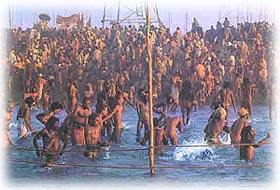
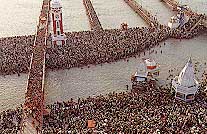
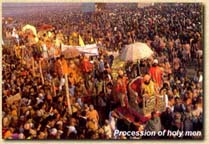
| Ganges Festival Draws Millions http://www.nytimes.com/2001/01/25/world/25INDI.html By BARRY BEARAK ALLAHABAD, India, First into the sacred waters were the naga sadhus ... the naked mystics ... a powder of ceremonial ashes anointing their bodies and swords and tridents brandished in their hands. The more modest among them wore loincloths, though none any wider than the tail of a kite. Following them toward the ritual bathing platforms were the bearded gurus, seated on great ornamental thrones that were pulled by tractors. Favored disciples hovered near, protecting the revered sages with gilded parasols. And finally the procession was given over to the pilgrims. Then more and more of them. And more yet. And still more. They numbered in the millions, all on a personal search for the divine, there for a miraculous dip into the bracing chill of the merging rivers. Officials variously put the number at 20 million to 30 million, [70+ million for the six week festival] enough to temporarily make historic Allahabad into one of the biggest cities in the world. But people were spread widely across a vast riverside flood plain. Any count was seat-of-the- pants guesswork. The faithful had come for the gargantuan Hindu festival known as the Purna Kumbh Mela. It is a six-week fling, and it began on Jan. 9. According to the astrological positions of the sun, the moon and Jupiter, this morning's predawn offered the most auspicious moments of the most auspicious day in this most auspicious of events. And Allahabad is considered among India's most auspicious cities, home to the "sangam," the confluence of three holy rivers, two of them real, the Ganges and the Yamuna, and one that exists only in myth, the Saraswati. The pilgrims, themselves an assortment of ages and occupations, arrived with an assortment of beliefs and expectations. Some said the immersion vouchsafed them eternal salvation, freeing them from the cycle of birth, death and reincarnation; some said it cleansed them of all sin; some said it simply refreshed the spirit. The notion of pilgrimage is a powerful lodestar in predominantly Hindu India, a country of more than a billion people. The religion's mythology comes alive within the nation's borders. Gods reside in the Himalayas, and the life-giving Ganges and Yamuna, which start in these heavenly mountains, ripple across India's vast northern plain. The origins of the Kumbh Mela reside in the ancient memory of this mythology. By legend, gods and demons churned the primeval ocean, summoning treasures from the depths. The gods made off with most of the riches, but there was a fight for the final bounty, the coveted kumbh, or pitcher, which contained the nectar of immortality. In a chase toward heaven, some of the elixir was spilled onto what are present-day Allahabad, Hardwar, Ujjian and Nashik ... marking them as special places. Each of these cities has a Purna Kumbh Mela at 12-year intervals. The kumbh is part religious observance and part fair, and the property itself takes on many aspects of a fairground. Vendors sell peanuts in bags made from scraps of newspaper. A hurdy-gurdy man shows off a pet monkey that does headstands. Overhead flies a huge blue balloon, beseeching the faithful to drink Nescaf . Just inside the Juna Akhara's gate sits the naga Amar Bharti Baba. A hushed crowd is usually watching him. As an act of renunciation, he keeps his right arm steadfastly lifted in the air like a schoolboy certain he knows the answer. He gave his age as 60 and said he had kept his arm hoisted for half his life or so. The renounced arm has petrified. His fingers are gnarled, the growth of the nails distorted into long curlicues, like wood shavings. Disciples knelt at his side as pilgrims laid money at his feet. His left arm, as spry as the right one is lame, protectively tucked the larger bills beneath a carpet. "These are not gifts for me; these are the fruits of my labors," he said of the donated cash. He is well used to being asked the purpose of his arduous penitence. "Only if you do this can you learn why it makes sense to do this," he said with a trace of humor. "You learn the taste of bread only when you eat it." Around the corner were several younger sadhus in the walking sleep of a meditative trance. Most had matted hair, including one who could toss out a thick braid like the tie line of a boat. Radhey Puri Naga Baba, 33, was leaning on a swing covered with a folded towel and a garland of marigolds. He said he had vowed to remain standing for 12 years and was now about two-thirds done with the ordeal. His feet are swollen. This renunciation, he explained, was a learning exercise, teaching him to will away the distractions of pain and pleasure and other attachments to the world. For many pilgrims, the goal of their visit was not just to bathe, but to do it at the prime spot, the sangam. An armada of decrepit but functional boats ferried pilgrims there at 40 cents apiece. Men stripped down to undershorts and lowered themselves into the water. Women waded in in their saris. The Ganges, these days infused with raw sewage as well as religious sanctity, is relatively clean at this hallowed location. |
|
 |
 |
 |
| The Ganges -vs- Jesus "for the removal of sins" |
 |
 |
 |
| www.aamen.org www.oxbows.com Amen ministries of Austin��///� Oxbows Ministries International� P.O. Box 27683 - Austin, Texas� 78755 |
 |
 |
Oxbows.com Comment Ceremonial 'washing' to bring about 'spiritual cleansing' is an age-old practice in most all established religious orders prior to the Cross. There is ceremonial 'washing' in Exodus and Leviticus of Aaron and his sons, as well as ritual preparatory to entering the Tabernacle etc. The blood of Jesus Christ 'takes away the sin of the world' and is His finished work and not of our own doing. Any religious sects where the 'faithful' can cleanse themselves through 'works', incantations, and/or ritual practices are based in the pagan-primitative. When and were was the last time we witnessed 70+ million people gathering to celebrate Christ ... it will come! |
|
|