 |
| By Robert Roy Britt Senior Science Writer Space.com |
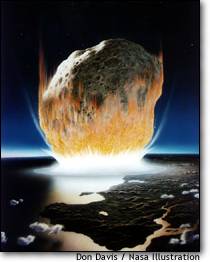
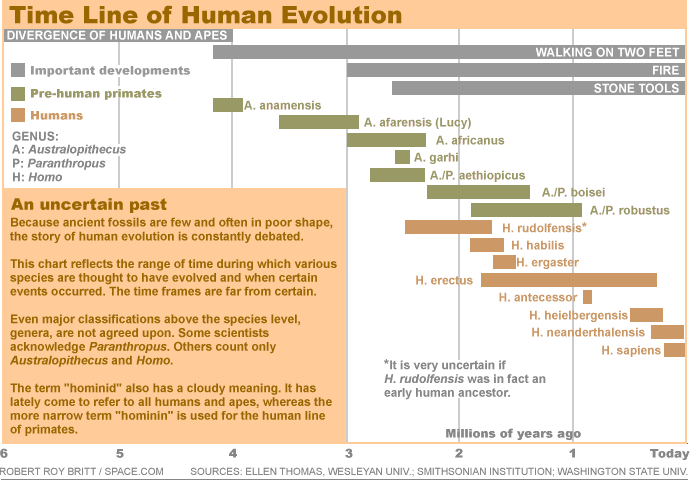
| In the five million years or so it took for apes to become human, many humanlike branches of the evolutionary tree were lopped off. Scientists have long wondered why these other hominid species, estimated to number a dozen or more, didn't malke it. Were those who came to travel to the moon and ponder their very origin the logical and inevitable victors in the most important of all Darwinian struggles? Or did they just get lucky? A NEWLY PRESENTED mathematical argument suggests that the birth of Homo sapiens was guided by catastrophic asteroid or comet impacts, which created climate conditions that competing species, frankly, couldn't handle. It also holds that our human ancestors avoided early elimination by the statistical skin of their rotting teeth. "The reason that Homo sapiens have survived in spite of these global disasters has little to do with the traditional explanations given by neo-Darwinists," said Benny Peiser, a social anthropologist at Liverpool John Moores University. "It is sobering to realize that we are alive due to cosmic luck rather than our genetic makeup." Peiser bases his argument on the fact that populations of hominids and early modern humans were extremely small. "Had any of these impacts occurred in the proximity of these population groups, we might also have gone the way of the dodo," the said. The study's assumptions and calculations have met with strong caution and even sharp criticism among scientists who specialize in evolution, as well as asteroid experts. |
| ADAPTIVE ADVANTAGE |
| David Balding, a professor of applied statistics at University of Reading in Britain, said the idea that human survival is due to "cosmic luck" does not compute: "Perhaps we were lucky in avoiding a massive impact, but perhaps it was our adaptive advantage that helped us survive modest regional impacts whereas our hominid cousins did not,?"said Balding, whose own research focuses on human evolution. But some called the new scenario plausible. It has not been published in a peer-reviewed journal, but it is based on impact estimates that are generally accepted by the asteroid research community, though there are disagreements over the precise number of times a large asteroid or comet has struck our planet. Peiser laid the idea out earlier this month at a conference, "Celebrating Britain's Achievements in Space." He worked with Michael Paine, a volunteer for the Planetary Society in Australia who ran impact scenarios through a computer program. (Paine has written freelance stories for Space.com in the past.) The researchers concluded that there would have been 20 "globally devastating" impacts during the past 5 million years, with effects strong enough to have had "a catastrophic and detrimental effect" on human evolution. Five million years ago is roughly the time when hominids diverged from other apes, though some recent controversial evidence puts the split as far back as 6 million years ago. Did space rocks set the human stage? No one argues that asteroids can be devastating when they tangle with Earth. An impact 65 million years ago is widely believed to have spurred the demise of the dinosaurs and many other animals and plants. |
| But efforts to tie other, more ancient mass extinctions to impacts remain inconclusive. while extinctions are clearly identifiable in fossil records, impact evidence seems not to survive the millennia as well. So impact estimates are based largely on the moon - a nearby archive of countless craters that have not eroded much over time. Still, because scientists have not witnessed a severe impact, the presumed effects are speculative. If an asteroid larger than a kilometer (0.6 miles) hit the planet, it would cause instant death across a wide area near the site of impact, and researchers generally agree that drastic climate changes could last a year or more. Even our protective ozone layer could be damaged, studies have shown. But the precise consequences of these effects are not known. It is thought that long-term climate change could make life impossible for many species, which in turn would cause mass death that might move up entire food chains. Peiser suggests another possible effect: "The abrupt loss of the ozone layer and the sudden release of toxins may even affect the DNA in some unknown manner, thus triggering macro-mutations, including the sudden reorganization of entire genomes." Ellen Thomas, a Wesleyan University research professor who examines how climate change affects evolution, said few evolutionists would buy this argument of quick, significant changes in the genetic blueprints. Instead, macro-mutations are seen by many as a genetic dead end. "Macro-mutations can hardly ever lead to evolution," Thomas said. "They lead to non-viable organisms." BASIC NUMBERS QUESTIONED Of course to affect human evolution in any fashion, a space rock first has to hit Earth. But "no one knows how many impacts took place, or when, or with what severity, over the past 5 million years," said David Morrison, an asteroid expert at NASA's Ames Research Center in California. Morrison told Space.com that instead of the 20 potentially devastating impacts assumed by the study, he expects there were probably only five or 10 with enough energy to create global environmental effects. "But we know very little about specific impacts in this time frame, and virtually nothing at all about their actual environmental effects," Morrison said, adding that there is "no evidence of an impact associated with a hominid extinction." |
| Morrison did not discount the whole idea, however. "I would be surprised if impacts had not had some influence on early hominid populations and perhaps evolution," he said. "On the other hand, I am not convinced that impacts led to numerous extinctions in the past 5 million years. This is all interesting speculation, but specific data are lacking on either impacts or extinction events and there is no known correlation between the two." Peiser counters that the estimates used in the study are "very conservative." He acknowledges that shortcomings in the human fossil record (fossils on land erode more easily than those in the oceans) "are far too big to allow any direct correlation between impact catastrophes and hominid extinction." But he said that the study shows that "impact catastrophes that occurred during the crucial period of human evolution should no longer be ignored." Still, it is clear that more research will be needed before any consensus emerges. "What (Peiser and Paine) may have added,"said Balding, the statistics professor, "is some quantitative simulations to make more precise some well-established speculations." Speculation about evolution is nothing new. And the more one delves into the nitty-gritty of our own past, the stronger the criticism gets over Peiser's attempt to reinvent Darwin. |
| REINVENTING DARWIN AGAIN? |
| If asteroid experts are sometimes a mile apart on their view of history "and they are" then evolutionary theorists live on different continents. Followers of Charles Darwin have long believed that failed branches of our ancestry reflect a common mode of evolution, whereby species are gradually replaced by more advanced species that adapted because of their superior genetic fitness. But in recent decades, a different view called punctuated equilibria has taken hold. This theory, first put forth in the 1970's by Stephen Jay Gould and Niles Eldredge, expects sharp changes in evolution. In either scenario, luck plays a role. And both fit within the most famous of Darwinian themes, survival of the fittest. But the rapid shifts assumed in punctuated equilibria, be they caused by sudden disasters or other means, are thought to be the mechanism by which one species replaces another. "There has been debate for over 100 years on wheter evolution is gradual or punctuated," said Balding. Recent fossil findings have some researchers leaning back toward the gradual approach to human evolution. Peiser said his study supports punctuated equilibria, and helps explain why "almost all hominids. i.e., the 14 known species of human ancestors, have become extinct during the last 5 million years." But Wesleyan's Ellen Thomas said it is not even known that there were 14 species. "The human fossil record is incomplete, it is not easy to agree on which fossils belong to different species," Thomas said in an email interview. "The experts disagree wildly." Thomas echoed other scientists in pointing out that there is no fossil evidence -- neither human remains in Africa nor marine organisms, which leave a much more complete record -- that reveal any mass die-offs during the 5 million-year period covered in Peiser's study. "And if the extinctions affected humans, they should show up in the extinction record of other organisms as well," Thomas said. "The paper just shows that many impacts, many of which could have been damaging, possibly occurred." But Peiser says n o expert on near-Earth asteroids, the space rocks known to exist inour region of the solar system, questions that "many such global disasters must have occurred." Yet he said "all textbookds on human evolution completely ignore occurrence of catastrophic impacts." |
| IRONY IN OUR EXISTENCE |
| In an ironic preface to the whole argument, it's possible that asteroids and comets were responsible for life in the first place. A growing movement among astrobiologists suggests that rocks from space brought critical building blocks that stimulated the initial biological activity in the earliest primordial soup billions of years ago. Regardless of whether cosmic messengers helped make us who we are, there is one thing researchers seem to agree on: Given the evidence that our ancient ancestors were clustered in a relatively small area (in Africa) you are some what lucky to be reading about all this. |
| "Asteroids certainly had the opportunity to wipe out man at his roots," said Jack G. Hills, an asteroid specialist at Los Alamos National Laboratory. "Only good luck prevented it." |
| OTHER FORCES OF EVOLUTION While Peiser and Paine suggest that comets or asteroids are a driving force behind evolutionary change, it is the climatic consequences of impacts that are the would-be crushing mechanisms for fledgling species. Other researchers have long debated possible links between climate change and human evolution. For example, cold periods are suspected of forcing migrations that created small, isolated groups that could have evolved significantly but then died out. One such period may have occurred as recently as 71,000 years ago. But firm links between climate and serious evolutionary changes elude researchers. |
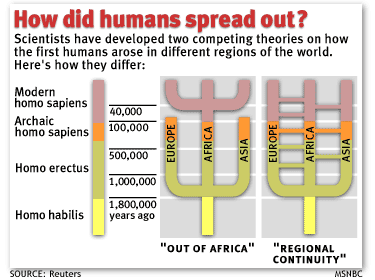
| The prevailing view, known as the "Out of Africa" theory, holds that modern humans evolved from a common Homo erectus ancestor in Africa. Homo sapiens then left Africa and spread across the world, displacing other hominid species such as Neanderthals. The competing theory, called "regional continuity," contends that modern humans evolved from Homo erectus in several different places - what are now Africa, Europe and Asia - with interbreeding between the regions. |
| One recent international study, released earlier this year and led by Jeremy Marlow of Newcastle University, showed evidence of a significant cooling of the climate 2 million years ago that the authors said "adds weight to the theory that climate change played a significant part in the evolution of early humans." Further clouding the possibilities, recent findings have hinted at the possibility that the worst extinctions might require multiple killing mechanisms, such as when an impact, or perhaps several, happens to occur during a time of heavy volcanic activity. In an ironic preface to the whole argument, it's possible that asteroids and comets were responsible for life in the first place. A growing movement among astrobiologists suggests that rocks from space brought critical building blocks that stimulated the initial biological activity in the earliest primordial soup billions of years ago. |
|
| Theory Blends 'DEEP IMPACT' with Darwin |
| Featured on MSNBC.com Technology |
 |
 |
 |
| ���������� www.aamen.org �������������������������������� www.oxbows.com Amen Ministries of Austin��///� Oxbows Ministries International� ��������������������� P.O. Box 27683 - Austin, Texas� 78755 |
 |
|
|
 |
 |
 |
| The Space.com article presented below is an obvious flag of the end-time and the desperate attempt on behalf of the anti-creationists to once and for all present the Darwin Theorem in a newly twisted and convoluted scenario. The 'outer-space' invasion of earth by 'asteroid impaction', 'alien creature visitation' or cosmic evolutionary implantation are rapidly becoming grist and fodder for Hollywood cinema spectaculars. The increase in these type fantasy wanderings is a clear example of the degree of threat the 'principalities and powers' are experiencing ... in the knowledge of Christ's emanate return and judgment of all unrighteousness The opening question posed in the first paragraph below clearly positions the text as anti-creationistic / anti-Christian. It is presented on this web site ONLY as a means to draw comparison to the blatant and abominable counterfeit belief embodied in the Darwinian Origin of the Species ... when read againt the Genesis account set out in scripture. You need to know what will be in next year's public school text books and at local and national science fairs. Praise God for HIs Son and His Blood |
| Again, this article is presented only as current evidence that the Darwinian factor is still attempting to pronounce the gospel of Jesus Christ as 'nonsense' and promote the evolutionary, secularized and scientifically based explanation for the Origin of Life and the Power of Creation to the DNA/atomic/molecular level of emergence. This type blatant attack on the Genesis account of creation will receive more air-time, classroom explanation and copy space that any Christian advancement of Christ's saving grace, redeeming blood and gift of eternal life in the secular media venues. From ozone layer collapase, to invasion by toxic agents from outer space, to corrupted DNA, to alien abductions -- the Darwinian fraudulent hypothesis will continue to attempt to supplant the Christian Doctrine and all of its magnif- icent saving grace and love --- and it will fail as it always has since 1859. 2 Tim.1:12 - "for I know whom I have believed and am persuaded that He is able to keep that which I have committed to Him until that Day" |
 |