Hurricane Fault/Colorado
Plateau Model
(Layman's briefing)
The Colorado Plateau is
a 1000 kilometer diameter uplift, similar to a layer cake, when viewed
from the side. It is a flat-and-level cake which has a larger than normal
thickness of crust underneath it, although when viewed in cross-section it is
much eroded at the surface. It is very colorful, since when driving along its
road cuts and river channels, it displays the erosion of many ages and colors of
sedimentary formations, or beds.
This is not to say that there are no
distortions in the layer cake; infrequently there are intrusions of igneous
rocks, various crumpling of the beds by compression (sideways), and large
slices or faults noticed- which cause various colors and type of rocks to be
found facing each other laterally. Its' elevation is at least 6000 (~2 km) feet,
on average, and it displays sedimentary beds mostly in the Mesozoic (65- 225
million years age), although significant Paleozoic (previous) as well as
Cenozoic (subsequent) rocks are found.
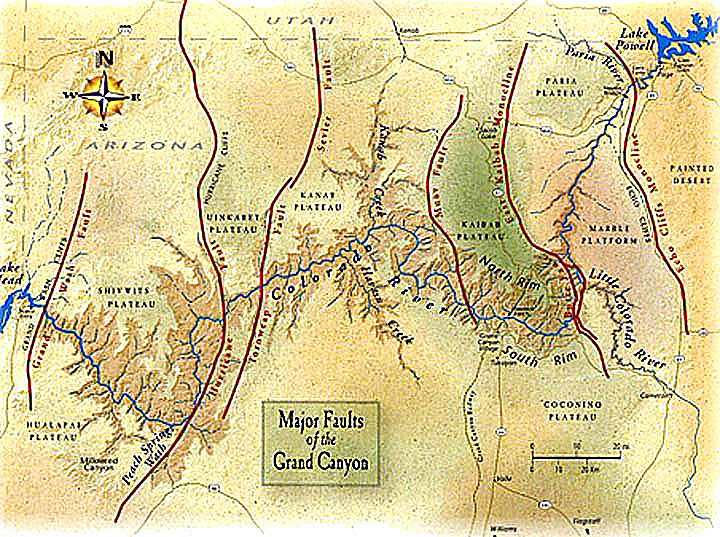
The CP is very noticeable, since it is
generally higher than its neighboring rocks, by several thousand feet, except
for its NE portion. There is a transition on the west and SW sides, where the
surface tapers off to the west gradually- called the
Transition Zone- and it is in this zone
where its edge can be investigated without concern that one is in the further
west zone called the Basin and Range (B&R). It is bounded on the SW and
south by the Mogollon Rim (through most of AZ), on the west by the B&R
(Utah), on the east by the Rio Grande rift, and on the north by the Uinta Mountains. The NE side is indeterminate, since this is the
termination of the underlying plate subduction, which created
it.
The CP was initially created after the
Mesozoic, by the thrusting of the Pacific Ocean floor and its underlying rocks under the Plateau during
the Nevadan, Sevier, and finally Laramide orogenies, via a plastic layer- called
the asthenosphere- which allows sliding of brittle rocks over the upper part of
the mantle. These, although named separately, were gradual movements eastwardly
(NE-wardly mostly) which shoved up old mountain roots in its path- creating the
named Nevadan and Sevier orogenies. The dominant movement, which shoved up the
CP a km or so, was the last of the thrustings (subductions), terminating against
the Rocky
Mountains. This subduction is
now dead, since the Pacific movement has now turned to a northward direction,
but the results of the previous action are apparent in the CP in many places. We
will study some of them, where N-S orientation of linear features, called
hogbacks, anticlines, swells, and great faults remain in the exposed ancient
beds (these are generally oriented perpendicularly to the direction of
thrust).
The movement of the CP which is seen best
is the later stretching and fracturing of the whole West USA (particularly west
of the Hurricane fault), where compression of the rocks was replaced by an
extension, when the Pacific movement turned northward (about 41 mybp- million
years before present), and this turn can be readily seen in the linear
presentation of the Hawaiian Islands- Emperor seamount chain, as a 60 degree
turn to the SE (present islands), from the previous N-S orientation (undersea
mountains). Since that time, there has been no significant compression of the CP
rocks, except for local volcanoes or other igneous uplifts- rather there has
been a NW-SE oriented fracturing and stretching of the formations seen at the
surface. This fracturing of the rocks on a macro (small) or kilo (large) scale
can be seen as one walks over the exposed surface. It can be measured readily
with a compass, and tells whether there is the normal regional SE-NW fracturing
or whether there is a local anomaly yielding a departure from the normal (such
as would occur with a volcano, slump, geothermal event, or other
distortion).
Besides fracturing and faulting (shearing
of the rocks), there are other events occurring in the CP and its transition
zone. There is a general uplift by thermal expansion (such as would happen by
heating an iron bar), there is rotation of the Plateau by shearing forces, there
is differential uplift causing local anomalies such as the Hurricane fault,
tilting caused by differential stresses across a given large section of rock,
and uplift caused by unloading (large-scale erosion). Unloading, or rebound, is
similar to that occurring in Scandinavia, where glacial ice of many thousands of feet thickness
added weight to the ground surface (thereby depressing it), and then when the
ice melted the surface rebounded upward.
The transition zone, where
LaVerkin and
Hurricane are located, is a zone where there are many expressions of faulting,
geothermal release, and uplift, so that the mechanism of the uplift may be
studied- all of these are clues to the action generated deep in the crust of the
earth and the underlying mantle. There are speculations that the uplift is
simply one due to radioactive decay of elements thrust under the CP during the
Laramide, and that now the decay is sufficient to cause a heat buildup. This
would express itself as vulcanism, if the shearing created faults and fractures
along which the heat could readily escape. If the CP proper contained this heat
with its insulating blanket of thick shaly rocks, the Plateau would simply
expand upwardly.
The first guess in the days before
understanding earth subductive tectonics was that the mantle contained
circulating thermal currents (rotation of fluid or plastic mass, as in a
teakettle), causing the CP to be moved as a unit by advection- separating it
from the extending part of the B&R by this same laterally-moving
advection.
Another speculation for the heating of
the CP is that the subduction during the Laramide left low-density rocks
under-compacted according to their depth. Gradually the rocks would compact with
the overlying weight of the depth at which they finally found themselves, and in
the case of Basalt being compacted to a new crystalline form with higher
density, called Eclogite, heat of crystallization would be
released.
A combination of the above factors
probably occurred, but whatever mechanism is found to be dominant, it elevated
the CP uniformly internally, but suddenly quite unevenly at the beginning of the
transition zone- the Hurricane cliffs. This is a sharp transition- called a
scarp- and occurs for over a hundred miles with about the same elevation
difference looking E-W along the N-S expression (the Hurricane
fault).
We can easily measure or observe the
shear, fracture and uplift with an altimeter, tape, clinometer, and compass. The
interpretation of these data is not so simple, but we can model the results and
note how other geological circumstances agree (or disagree) with the physical
model.
Several features are apparent along the
Hurricane fault:
- The latest cliffs are
fairly uniform in elevation change along the
scarp;
- Volcanoes stretch along
the N-S path, being most noticeable in the Hurricane-LaVerkin
area;
- Many distortions occur on
the west of the fault, most noticeably in the Virgin River crossing (but the beds are mostly flat and regular to
the east);
- The sedimentary beds tilt
upwardly to the west east of the fault, and continue this up-to-the-west
feature in some younger beds on the west side;
- Fractures and river
orientations change when crossing the fault;
- Laramide compressions
are numerous on the west side, but rare on the east side of the
fault;
- Basalt flows occur on both
sides of the fault, and sometimes cover earlier gravel flows in stream
channels (conglomerates)- these may be used for dating, by radioactive
decay of K40 and other elements; and
- There is a progression of vulcanism toward the west with time.
My intention is to hike along many of
these features, and make measurements of fractures orientations, faulting strike
(orientation on the surface) and dip, vulcanism ages and location relative to
other features, springs and seeps location and temperatures, orientation of
fissures and surface anomalies, and distortions noticed. From all of these
observations, one can integrate them in a model of the dynamics of the uplift
(at least on this side). The Hurricane fault is a linear feature, which should
give clues as to the underlying mechanism, when looked at near the scarp.