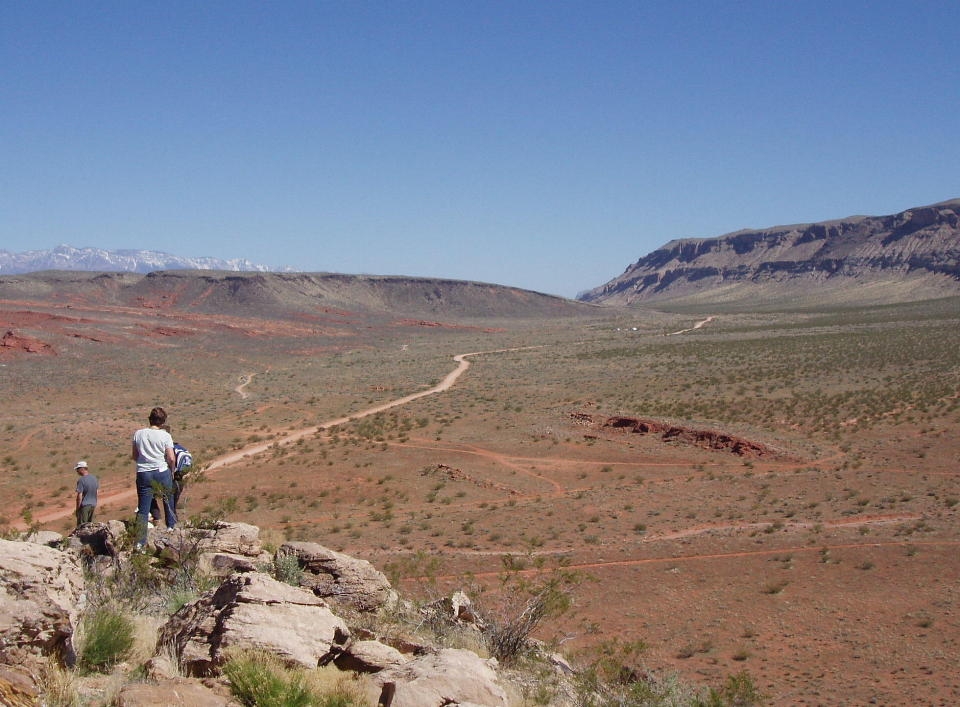
2006 Hurricane Fault Report
Abstract
The second year of hiking about the H-f yielded significant
findings about the incipience of this Pleistocene entity:
-
This youngest cycle of uplift is younger than near-million year basalts above North Creek, Virgin town, since Pine Valley Mountain intrusive cobbles at the base of the basalt were found, indicating that there was no scarp to impede their SE path in this Pleistocene time;
-
A model was formed to investigate the Physical movement of the fault, based on
shrinkage of the ellipsoidal earth (due to slowing), as the equatorial to mid-latitude bulge contracts from the equator to local latitudes. In an extensional environment, this allows N-S fractures to develop, through which magma rises to produce an upward bulge which is retained in the upthrown block (west-facing scarp). Upon cooling, the magma shrinks the most along the fault, causing sinking of the downthrown block above it- yielding a monocline and resulting Hogback. The orientation is N-S also, and might be mistaken for a Laramide feature, but N-S open shrinkage cracks and fissures are found west of the town of Laverkin, indicating its youth; the feature is duplicated north of the AZ border south of Grass Flats. The monocline tilts uniformly down into the fault zone and can be seen at the southern hogback, where the basalts which flowed prior tilt down into the fault also.
-
Although there are minor splays of the fault, mostly there is a single distinct entity along the area investigated from Toquerville to the AZ border. The splays tend to form canyons, as at the Virgin, Gould’s wash, Frog Hollow (airport), and at the Honeymoon Canyons. This simplicity allows elimination of the various other entities influencing the scarp in other areas, such as the anomaly at the Pine Valley to Laverkin quarry, bifurcation at the AZ border, and weaknesses formed during Laramide times.
-
For every volcano investigated near the scarp, there is a concomitant CW rotating of a sedimentary block to the west of the scarp. This rotation is likely
restricted to that zone above the elevation of the shallowest magma chamber formed during extrusion, similar to that occurring at the bulge of salt domes at the 1 km depth (which are somewhat similar, but not as hot or with as much shrinkage).
The Virgin
(To the melody of Spanish Folk Song- from my guitar debut days)
High in the Strawberry Drainage, it flows,
Telling us of all those December snows-
How it caresses the dunes, as they yield to its tunes,
Translating Man’s story of Life, as it goes.
South goes the East Fork, as it wends on its way,
Gushing and Flushing debris of the day-
Bits of life, songs of strife, how it cuts like a knife
Through the fossilized beds- which once showed winds’ bouquet.
Sheer are the cliffs of that part of the rhyme,
Which display ancient hills from a desert-like clime;
How they came from the north, o’er a sinking air hearth*,
To be saved through an Era of geologic time.
Into Man’s realm it emerges- that Lion-
Fresh from its arduous travels through Zion;
Artificiality, Domesticity, not a shred
of consistency,
It exposes them now as it yields man a try-on.
Its Spirit untamed, it nears the Great Scarp,
Toting the baggage of flood, mud, and warp-
Tackling the cracks, of limestone it soon hacks,
To
finds the Earth’s strains, which it plucks like a harp.
Jeering, yes sneering, it ignores the small towns
It encounters enroute, as it makes its new rounds;
It can easily engage them, multi-year can enrage them,
When El Nino rampages, its force knows no bounds.
Then through the gorge it makes its swift way,
Carrying the scarps and plateaus in its sway;
Bit by bit, it erodes them, not a whit it abodes them,
Down to the Great River, that has ultimate say.
The debris of the whole West, it soon adds to its bag,
Debasing the continent from basin to crag;
In a single-year quirk, it offsets million-year work
Of the Earth which has, with Life, had a billion-year lag.
Will Man, at the Peak, subvert Universal Will?
Or can he subside before witnessing the Nill
Of the symbolic Wisdom, the harmonious Rhythm
Of the concord of Earth-Life that humans can still.
Harold L. Overton
*At 20-30 degrees N/S Latitude, air sinks, heating & drying the Landscape (hearth)
2006 Report: HURRICANE FAULT
We have it! Combined with the disclosure that the Earth
is indeed shrinking, as it slows down, we have now tested the Model of the N-S oriented H fault with its three components:
I. The earth shrinks along N-S linears or lineaments (with E-W orthogonals), that I puzzled over so long in the depths of the Verde Valley- in the Verde limestone of Pliocene
age. Centrifugal force created by spin of the Earth has caused an elliptical bulge at the equator, and as the spin slows allows shrinkage from the equator on to middle latitudes (a general test for this entity would be to find whether the scarps are higher at the equator, in Africa and South America). This creates great fractures and faults, where there is a significant crustal thickness difference, looking east to west. This causes the west side of the plateau to form linear faulting at the region where the crustal thickness has thinned radically (E-W) Alternatively, for the SW corner of the Colorado plateau, CP, the shear or wrenching created after the Pacific plate moved north towards Alaska (after the 41 mybp shift in the Hawaiian- Emperor seamount chain) caused a scarp to form in the NW-SE direction- the Mogollon Rim;
II. The fracture weaknesses allow magma to rise in or near the lineation, creating a band of volcanoes to emerge within a few miles of the faulting on either side of the fault;
III. Whenever the crust is being extended, independently, this creates a zone where three separate
phenomena can be expressed;
A. The crust on either side will be compressed upwardly, allowing the upthrown side to remain dipped up to the west (in an extensional regime) after the downthrown block has fallen.
B. Although both stratigraphic sections will be raised as magma rises, the cooling of the magma after fruition will shrink and draw the downthrown block into the weak zone created by the extending crust. This creates a CW-rotating stratigraphic block (looking north) filling in the sinking space, simultaneously making a monocline- with its’ accompanying Hogback. The upthrown block is retained in its almost original lipped-up configuration, since it is unaffected very little by the extension. This is shown for a
photo taken for the Grass Valley extrusion and its later-formed monocline to the south near the AZ border. The monocline rotates into the fault, forming a Hogback at its western boundary, and is limited in its downdrop by the
top of the cooling magma chamber in its shrinking descent into the crust. The limit to this process is observed by looking at the large mesa to the southeast of the hogback, where the northern part of the mesa is rotated down into the H-f with little influence on the southern part- a mile to the south; C. Fissures will occur in an N-S orientation, as the rotating block continues to fall into the weak zone, especially east of the hogback. The weak zone is not an evacuated chamber, but is a zone in the crust (evidently all the way to the heat source) which shrinks with cooling of the previously rising
magma;
The three phenomena are noticed whenever there is a canyon formed by the intersection of the weak zone and rising volcanoes, as in the Virgin, Honeymoon, and Gould’s creeks. It seems that the emission of lava helps create the weak zone, whenever the transfer of mass and subsequent cooling of the weak zone causes shrinkage of the 1-2 km wide block.
The phenomena above do not continue forever, since there are borders created by much older weaknesses. The
Pine Valley Mountains is a chain creating a termination to the simple explanation of N-S lineation of faulting. Although the PV intrusion is not part of this model, it was studied to determine the boundaries of the physical paradigm. The PV chain has followed an ancient NE-SW weakness, created during the Precambrian. The mere presence of a rare NE-SW orientation is anomalous from a West US standpoint- most chains run N-S or NW-SE, following the fracture pattern of the western US, created by compression, shear, or wrenching of the Basin and Range, B&R, away from the Colorado Plateau, CP, by change of direction of the Pacific Plate. The
eastern Pacific plate moved towards Alaska, after the bend in the Hawaiian-Emperor Seamount chain at about the 41 mybp time. I believe that there was a major change in plate movement direction at that time, created by crossing of a major transform fault. Due to the rotation of the earth with unevenly divided mass, segments of the Pacific plates move faster than neighbors, and this causes apparent shifts in the direction of plate movement (one problem with this analysis is that of a sawtooth, which should occur with time, in the line of islands and seamounts, as one side of the transform moves faster than the other; this occurs in the trenches, but not in the chains- as seen on a Pacific Basin floor map). Two major transforms occur in an E-W orientation, striking the West US coast at about the Inverness and Las Angeles locations, and this creates a null in the mainland subductive extrusions between these two locations as the resultant plate movement changes direction (creating extensional rather than compressional tectonics- which terminated in Eocene time).
The other arbitrary boundary to our investigation is that at the AZ border, mainly because of logistics. At the Honeymoon Canyon, just north of the border, the sequence of N-S faulting, vulcanism, opening of the scarp to river drainage (across a barrier of up dip and topographic high elevation), and rotation of a block of
earth CW into the magma-shrinking zone of about 2 km width recurs. This is a repetition of that seen at the Virgin River opening across the H scarp.
The natural boundary of the PV Mountains is seen to create a major disruption in the trend of the H fault; not only does the fault bifurcate to the north of Laverkin, but the intrusions create a weaker zone as igneous dikes protrude toward the SE. This zone continues at least to the scarp and causes major spalling of the cliffs between Toquerville and Laverkin- as many as six parallel fault slivers occur. The movement must be continual, since the soil created remains un-cemented and erodes rapidly. I believe that the fissures along the
Virgin River have been initiated by this NW-SE strain (although gravity spalling into the Virgin canyon is the dominant action now). Even the river course itself can be seen to have NW courses and the resultant orthogonal orientations to the NE, near the great scarp.
Due to the interference of the PV weakness, we will not attempt to resolve the changes which occur to the H fault, as it re-orients toward the NNE (at the Pk peak, NE of Toquerville). The location of a major spring, the NW-SE trending Wet Sandy Creek, and the turn of the H fault toward the NNE tell me that this is the boundary of the simple system, due to another major tectonic influence. The bifurcation strains the limits of two-dimensional analysis. Geophysics or some way of analyzing three dimensional crustal views must be used.
We have studied this edge of the Colorado Plateau, CP, by making more than 30 hikes and evaluations in the periphery of the Virgin River and Hurricane cliffs. After all this, it appears that we fortuitously chose the simpler segment of the Hurricane fault. There is
generally only one main fault (versus at least two near Toquerville, and more south of the AZ border), which has to be evaluated in relation to the other major factors: volcanic emission, change of crustal thickness from east to west, extension of the B&R to the west- creating a wrenching and shearing of the transition zone, and NW-SE fractures which were pre-existent.
The obvious phenomena, which were observed in the first year by the hiking group, included:
a. The upthrown Paleozoic rocks are lipped up to the west, creating a barrier to westwardly flowing streams, so that only a few canyons allow water to cross the Hurricane cliffs;
b. The streams draining the CP do not flow along the N-S scarp, except for the parallel Ash and Laverkin creeks, as would be expected for a graben running along the cliffs, rather they run westerly toward the Muddy and Colorado Rivers;
c. At the northern edge of the region of investigation, the PV Mountains cause drainage to flow south (Ash and Laverkin Creeks), and this forms a boundary to the simple one fault system;
d. South of the AZ border, multi-faulting occurs, and this forms another boundary to the region investigated;
e. The creeks which cross the H fault occur whenever there are volcanic extrusions nearby (Gould’s, Honeymoon, and Virgin canyons);
f. Major creeks created zones where extra erosion occurs, and this causes undulation of the cliffs (on a map view);
g. Spalling of cliffs (“walking” by shear of cliffs) is minor, except where there is a significant stream;
h. Some landscape was almost level before vulcanism occurred, as shown by flat and level tabular sandstone below the oldest basalts at the Sky Mountain Golf cliffs at the Virgin River. This indicates that there was no Virgin River in its present course prior to the less than million year age basalts;
i. Large thickness of river conglomerates, Pc, below early basalts along the present Laverkin course indicate that this was the major drainage before the last scarp formation. These streams flowed to the southwest, as indicated by Pc immediately below basalts west of Sullivan’s Knoll;
j. Pc above Mesozoic also occurs at a fairly constant elevation (3823 feet, below earliest basalts) near the town of Virgin, and at Coal Pits wash, indicating that the large valley was fairly flat, with a SW stream flow, at this <1 mybp age. Compare this with the 3100 elevation tabular sandstone at Sky Mountain Golf, which indicates a drop of about 700 feet (200+ meters) since vulcanism commenced;
k. Drop of the present Hurricane Valley occurred in at least 3 stages, as indicated by three benches or terraces above the town. The latest scarp is formed by basalt, which ponded against the Paleozoic to the east, and is not as easily eroded as is the softer Pk limestone;
l. The Virgin
River lies near the town of Virgin in elevation (no significant cliffs down to the river), as it does near the Hiway 9 crossing, indicating that the river found a way of cutting through the lipped up rock on its way across the scarp. This path is shown by right-angle turns of the river-indicating that there were easy paths through the fractured limestone fissures and solution channels;
m. Pah Tempe hot spring augments the conclusion that the river used subsurface channels or surface fractures to exit the
landscape above the limestone hills as it flowed west. The conglomerates near Virgin show that the path of the river was not the same as now- flowing more to the SW rather than west as it now does;
n. Right-angle turns of the river indicate that there is a major change of fracture orientation as the scarp is crossed. These are not meanders, but sharp turns; however there is one documented meander below the Sky Mountain Golf, which was formed by damming of the Virgin by Pleistocene basalt flows. This sluggish river flow was offset, whenever the dam was breached, and quickly eroded through the Pc
conglomerates;
o. Youngest Pc (not overlain by basalts) in the meander cited, are unusually strong in shear strength, and this must be because of the unusual cementation created by saturated CaCO3 water emerging from Pah Tempe hot springs;
p.
High-strength basalts have been eroded easily, even though the river could have made new paths north of them, and this shows that the basalts were weakened by major fracturing and faulting during this late Pleistocene time;
q. As for Gould’s wash (which is very young, probably formed after the 10k year Sullivan’s Knoll), this channel has been influenced by agriculture over the last century, and masks the natural geology portrayed. But the drainage forms a half moon shape, NE starting at the south of Sullivan’s Knoll and proceeding toward the scarp, then
diverting toward the NW to confluence with the Virgin over a sheer basalt cliff. These factors testify to its youth, and to the presence of a low elevation zone just to the west of the scarp, such as would develop into a monocline and hogback further to the west in the future. The calculated rate, using 2 mm/year downdrop, would yield an elevation difference of about 66 feet for the 10k year time since cooling of the magma chamber. This is about the amount of elevation difference along the Hiway 9 going E-W in Hurricane, from the cliff rubble edge to the crossing of Gould’s wash, but the whole entity is disrupted by man’s activities in the last century and by the foothills of the volcano.
Here are the conclusions formed, using the above observations and information gleaned from the outcrops during the second year of hiking:
1. There are two separate types of movement or downdrop at the Hurricane fault:
a. Downdrop caused by shrinkage of the
thinner crust west of the fault, as instigated by decrease of the centrifugal force as the spin of the earth decreases, and
b. Rotation of blocks of crust CW into the fault- looking north- created by evacuation of lava from local volcanoes, and subsequent cooling and shrinking of the magma chamber- which draws the overlying block downward. The movement is greatest at the H fault, because of the greatest concentration of heat. As the magma cools, this has the greatest effect at the fault and becomes less, further from the fault- with the result that a monocline is created.
The edge of the monocline is a hogback, and its angle of rotation may be measured. The sine of the angle will determine the extra drop of the local block on its east side (which will be nearly that of the width of the monocline, for a 45 degree rotation. This may be near 1 cm/year, as compared to less than 1 mm/yr for the primary stratigraphic throw.
2. The sinking mentioned above is most pronounced for the older volcanoes, as at Laverkin monocline, estimated as greater than 100,000 year age, and at the AZ border, estimated as 800,000 years for the older movement. This is compared to that near Sullivan’s Knoll,
which is estimated to be near 10,000 years age, and where the Gould’s Wash is young, only forming a canyon at the intersection of the Virgin. Consequently, the farmlands near old town Hurricane have only begun to sink. Cracks in the soil are slight, as compared to great fissures in the soil west of Laverkin (and older canyons).
3. There are two monoclines at the AZ border, and this signals the start of bifurcation of the Hurricane fault. These are oldest of the three rotations investigated, and a rough
calculation may be made of the sinking rate due to the cooling of the magma chambers. For Laverkin, estimating the drop to be essentially half that of the width of the monocline (2 km, with a 30 degree dip), and estimating the age of the nearest crater to be 100,000 years, this yields 1 cm/year sinking rate (not counting the .2-.3 mm/yr drop of the Hurricane fault.
At the AZ border, the fartherest monocline is about 2-3 km from the present H scarp, and the closest volcano is very eroded, indicating an age of about half million years. This yields 2 mm/yr drop by rotation (sin of 30 degree monocline dip = .5), in addition to that caused by the main fault. Using the lesser of the rotation rates, 2 mm/yr, for the latest volcano in Hurricane (Sullivan’s Knoll at 10,000 years) would put the sinking of Hurricane Valley near 20 meters total since eruption of the young volcano. This seems excessive, and it is not known how long it takes the magma to cool and initiate sinking of the ground surface. Gould’s Wash has no canyon, except for that at the Virgin confluence, and it is a ditch greatly affected by local agriculture and artificial influence. However, the canyon mouth at the H scarp is significant, and shows influence of rapid erosion. At the airport 3 km further to the south, there are cracks in the soil which will result in breaks in the new slabs emplaced there in the next few years. This will yield
additional knowledge about the sinking of the local surface as a new monocline forms.
GEO-verse
The Earth calls me to the Field again,
Down in the Canyons wild,
Where GAIA sings and the sweet water springs
Revive my days as a child,
Where the rocks breathe and the folds heave, and the great layers show their sliding,
And the grainy space shows the very place, just where my Psyche’s hiding.
I must re-probe the Crust again
(To whisper in my ear,
How she embraced all Life- the sweetest wife-
Throughout a billion-day year)
Where Time hardly passes, as the Earth de-gasses, recycling all her fringes;
Outer electrons’ actions, and hot granite fractions, reveal the Universal tinges.
I must re-enter the deep Salt shaft
Searching for my Soul,
Where the sulfate streams show a land of dreams,
As deep as a magnet’s pole.
And all I ask, for my Life-long task, is empathy (from all earth’s creatures),
Where Orb’s great Song ensures that I belong, in the heart of Her Worldly Features.
Harold L. Overton